Currently Empty: ₨ 0
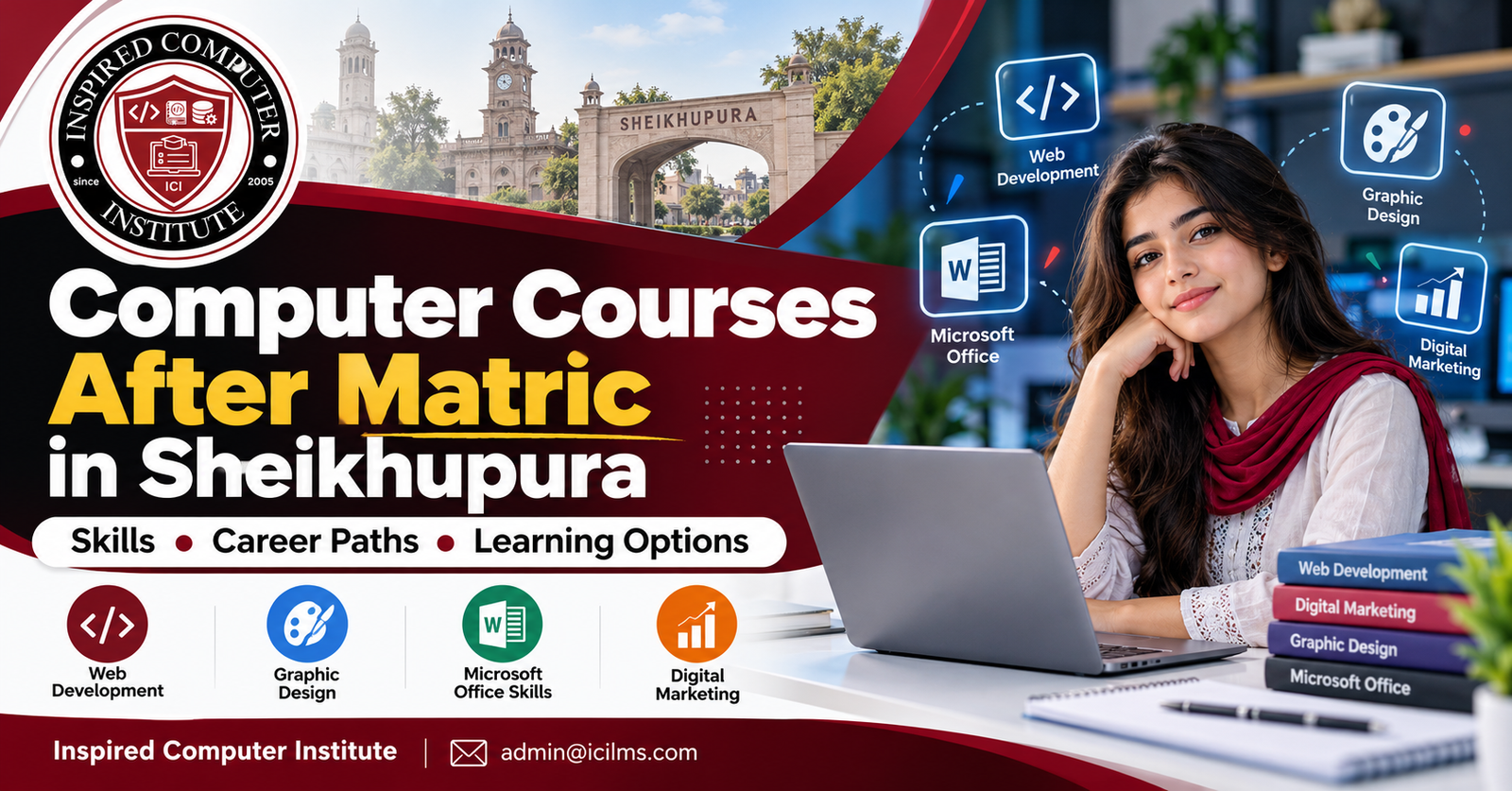
Computer Courses After Matric in Sheikhupura: Skills, Career Paths and Learning Options
Komal Shahzadi
- October 13, 2026
- Comment 0
Computer Courses After Matric in Sheikhupura: Skills, Career Paths and Learning Options
Introduction to Computer Courses After Matric in Sheikhupura
Completing Matric is an important milestone for students in Sheikhupura, but it also brings a big question: what should you do next? Some students plan to continue their education in FSc, ICS, FA, or ICom, while others want to learn a practical skill that can help them prepare for employment, support their families, or explore online earning opportunities. If you are interested in technology, computer courses after matric in Sheikhupura can provide a useful starting point. The right course can help you become comfortable with computers, learn a creative skill, understand website development, or explore the growing world of digital business. You do not necessarily need advanced mathematics, previous programming experience, or an expensive computer to begin learning the basics.
Sheikhupura offers students access to different types of learning opportunities, including private computer academies, vocational training providers, and online courses that can be studied from home. However, the availability of particular courses, admission requirements, fees, and certificates can vary from one institution to another. That is why students should compare their options carefully instead of choosing an academy simply because it advertises a popular course. A short course in office automation may suit someone interested in administrative work, whereas a student who enjoys drawing and visual communication might prefer graphic design. Someone curious about technology could explore programming or web development.
The most important thing is to select training that matches your interests, educational plans, budget, and long-term goals. A certificate can demonstrate that you completed a course, but practical ability is what helps you solve real problems and show employers what you can do. When you approach computer education with realistic expectations and a willingness to practise, the period after Matric can become an excellent opportunity to develop useful skills without abandoning further academic studies.
Why Learn Computer Skills After Matric?
The world of work is changing, and computer literacy has become useful in far more fields than software development alone. Businesses use computers to maintain records, prepare invoices, communicate with customers, manage stock, create advertisements, and organise everyday operations. Schools, hospitals, factories, retail shops, offices, and online businesses all depend on digital tools in different ways. For students in Sheikhupura, learning these skills after Matric can provide a practical advantage while they continue their education. Instead of waiting until graduation to discover how workplace technology operates, students can begin developing useful abilities at an earlier stage. Even a basic understanding of spreadsheets, document formatting, email, and file management can make academic assignments and everyday tasks easier.
Another reason to consider computer education is flexibility. A student who enrols in ICS or FSc may be able to attend evening classes at a local academy, while someone who cannot travel regularly might explore online training. Students can start with beginner-friendly courses and progress towards more specialised fields as their interests become clearer. For example, learning office applications first can build confidence before moving on to spreadsheets, accounting software, or administrative support. Similarly, someone who enjoys visual creativity can start with graphic design and later explore branding, social media content, or user interface design.
However, computer training should be approached as a learning investment rather than a promise of immediate employment. Completing a course does not automatically guarantee a job, a steady freelance income, or a successful online business. Results depend on the quality of instruction, regular practice, communication skills, access to suitable equipment, and the ability to demonstrate useful work. The strongest approach is to choose one realistic goal, learn the relevant tools, practise consistently, and gradually build experience. For many young people, this combination of education and practical training is more valuable than collecting certificates without developing the skills those certificates are supposed to represent.
Benefits for Students and Parents
For students, a computer course can offer a structured way to explore interests before making a long-term career decision. Matric students do not always know whether they will enjoy coding, designing, marketing, or office work, and a beginner course can help them test an interest without committing to a lengthy qualification. Parents can also benefit from understanding the differences between short courses, technical diplomas, and longer academic programmes. Rather than selecting a course based only on its advertised salary, families can compare the training requirements, likely expenses, duration, and opportunities for further study.
There is also a practical benefit to learning alongside formal education. A student studying commerce may find spreadsheet and accounting skills useful, while an aspiring engineer may benefit from developing programming and problem-solving abilities. Students interested in media or business can learn visual design, content creation, and digital marketing. These skills can complement academic studies, although they should not replace a recognised qualification when a particular career requires one.
Parents should discuss the student’s preferences instead of making the decision entirely on the basis of market trends. A young person who enjoys solving logical problems may thrive in programming, whereas someone with a strong interest in colours, layouts, and visual storytelling may find graphic design more engaging. Some students prefer structured office tasks and organised records, making office automation a reasonable starting point. When students have a genuine interest in their chosen subject, they are generally better positioned to stay motivated through difficult lessons and repeated practice. The goal is not simply to enrol in a course; it is to help the student build a useful skill while maintaining a sensible plan for future education.
Best Computer Courses After Matric in Sheikhupura
The best course depends on what you want to achieve, how much time you can devote to training, and whether you prefer creative, technical, or administrative work. Students searching for computer courses after matric in Sheikhupura will commonly encounter options such as basic computer applications, office automation, graphic design, web development, programming, digital marketing, and freelancing. Technical institutes may also advertise computer diplomas or vocational programmes, although course names and recognition can differ. Before paying an admission fee, ask the provider for the exact syllabus, practical training hours, examination method, certificate details, and total cost.
A useful way to compare courses is to consider what you will actually be able to do when the training ends. A basic computer course should leave you comfortable creating documents, working with spreadsheets, managing files, and using email. Graphic design training should help you create original visual materials rather than simply reproduce classroom examples. Web development should introduce you to building and testing functional websites, while digital marketing should teach you how to plan campaigns, understand audiences, and measure results. Freelancing training is most useful when it explains client communication, proposals, pricing, deadlines, and professional conduct alongside a marketable skill.
Students should also consider their available equipment. Some courses require a reasonably capable computer and regular access to the internet, especially those involving video editing, development environments, or advanced design software. Other introductory courses can be completed using modest equipment, although a keyboard and a larger screen usually make practical learning easier than relying entirely on a mobile phone. If your family budget is limited, compare the cost of local classes with free learning resources and supervised practice opportunities. A sensible first course should be affordable, relevant, and sufficiently practical to help you decide what to learn next.
Basic Computer and Office Automation
A basic computer course is often a suitable starting point for students who have little experience using a desktop or laptop. It introduces the everyday skills that support education, office work, and more advanced technical training. Depending on the provider, lessons may cover computer hardware, operating systems, typing, file management, internet browsing, email, word processing, spreadsheets, and presentation software. Some courses also introduce printing, scanning, basic troubleshooting, and safe online practices. Students should check the syllabus because the term “basic computer course” does not guarantee that every provider teaches the same material.
Office automation takes these foundations further by focusing on the tasks people perform in workplaces. For example, students may learn to prepare professional letters in Microsoft Word or a compatible application, organise information in Excel, create presentations, and manage digital records. Spreadsheet practice is particularly useful because it can include formulas, tables, sorting, filtering, charts, and simple calculations. A student who learns these skills properly may be better prepared for junior administrative duties, data-entry work, reception tasks, or assisting with business records, provided the employer’s other requirements are also met.
For students in Sheikhupura, office automation can be a practical choice because the skills apply across different types of organisations, from small shops and service businesses to educational institutions and industrial offices. It can also support students who later pursue commerce, accounting, business administration, or information technology. However, students should understand the limits of this option. Basic office skills are widely taught, so a certificate alone may not make someone stand out in a competitive job market. Accuracy, typing speed, attention to detail, professional communication, and the ability to work independently can make a meaningful difference.
Before enrolling, ask whether the academy provides individual computer practice or mainly delivers lectures. Every student should have enough time to complete documents, build spreadsheets, prepare presentations, and correct mistakes. By the end of the course, aim to produce a small collection of sample work that demonstrates what you can do. A well-organised spreadsheet, a professional letter, and a clear presentation provide more convincing evidence of practical ability than simply saying you attended classes.
Graphic Designing
Graphic design may be a strong option for students who enjoy drawing, photography, colours, typography, layouts, and visual communication. Rather than focusing mainly on calculations or written documents, this field teaches you how to communicate a message through images and carefully arranged text. A designer might create a business logo, a social media post, a product advertisement, a brochure, a poster, or a promotional banner. In Sheikhupura, potential clients may include shops, restaurants, educational academies, clothing businesses, event organisers, and small companies that need promotional material. The availability of paid work depends on local demand, competition, and the quality of the designer’s portfolio.
Beginner courses may introduce tools such as Adobe Photoshop, Adobe Illustrator, or Canva, depending on the level and approach of the instructor. Learning software is only one part of the process, though. Good designers also need to understand visual hierarchy, colour combinations, typography, spacing, image quality, and the intended audience. A design can look attractive but still fail if its message is difficult to read or its layout does not suit the business using it. That is why practical assignments and feedback are essential parts of effective training.
Students should look for a course that encourages them to create original projects instead of merely following step-by-step demonstrations. For example, you might design a promotional poster for a fictional clothing shop, create a set of consistent social media graphics, and develop a basic brand identity for a small business. These projects help you practise different design decisions and provide examples for a portfolio. They can also reveal which areas interest you most, such as advertising, brand identity, publication design, or digital content.
Graphic design can eventually lead to employment, internships, contract projects, or freelance opportunities, but beginners should not expect guaranteed earnings immediately after completing a course. Clients generally want work that solves a real communication problem, arrives on time, and can be revised professionally. Students should also learn about image licensing, font usage, and intellectual property so they do not unknowingly misuse other people’s work. If you enjoy creativity and are willing to revise your designs repeatedly, graphic design can be a rewarding skill to develop alongside your studies.
Web Development and Programming
Web development is a suitable option for students who are curious about how websites and online applications work. When you open a shopping website, use an online booking system, or visit a business page, you are interacting with software built using different technologies. Web developers help create these digital experiences, from the visible layout of a page to the systems that process information behind the scenes. Students do not need to be experts in mathematics before starting beginner web development, although logical thinking, patience, and a willingness to solve problems are important. A computer course after Matric can introduce these concepts gradually and help students decide whether a technical career interests them.
A beginner web development course usually starts with HTML, which organises website content, and CSS, which controls presentation and layout. Students may then learn JavaScript to add interactive features, such as menus, form validation, and dynamic page elements. More advanced training can introduce front-end frameworks, databases, server-side programming, and application programming interfaces. However, a student should not feel pressured to learn every technology at once. Building a small, working website and understanding how its parts fit together is a more useful first achievement than memorising the names of numerous programming tools.
For example, a student could build a simple portfolio website that includes an introduction, a list of skills, sample projects, and contact information. A second project might be a website for a fictional local business, with service descriptions, opening information, and a contact form. These exercises provide practical experience with layouts, links, responsive design, and debugging. They also create evidence of progress that can be shared when applying for internships or beginner projects.
Programming can lead to several career directions, including website development, software development, quality assurance, and eventually mobile or application development. The time needed to become employable varies considerably with the chosen field, the depth of training, and the amount of independent practice. Students should also consider continuing their education through ICS, a relevant diploma, or a degree when appropriate. For those exploring computer courses after matric in Sheikhupura, web development can be a valuable long-term path, especially when formal education is combined with practical projects and a strong understanding of programming fundamentals.
Digital Marketing and SEO
Digital marketing focuses on helping businesses reach the right audience through online channels. Instead of designing a website’s technical structure, a digital marketer may work on search visibility, social media campaigns, advertising, content planning, email communication, and performance measurement. This can appeal to students who enjoy communication, research, business, and understanding why people choose particular products or services. Local businesses increasingly have reasons to establish an online presence, although the level of demand for paid marketing services varies by business, industry, and budget. Students should therefore learn the fundamentals before assuming that every business will need or pay for their services.
Search engine optimisation, commonly known as SEO, is one part of digital marketing. It involves helping useful, relevant website content become easier for search engines to discover and understand. Beginners may study keyword research, page titles, headings, internal links, content organisation, website usability, and basic performance analysis. Good SEO is not simply about repeating a keyword as many times as possible. It requires understanding what people are searching for and creating content that genuinely addresses their questions. For instance, a local training institute might publish a detailed guide explaining course options, admission requirements, and the documents students should bring when applying.
A digital marketing course may also cover social media content calendars, advertising concepts, audience targeting, and analytics. Students can practise by creating a sample campaign for a fictional business and explaining its intended audience, message, budget assumptions, and success measures. They might compare different headlines, track engagement, or prepare a simple report showing how a campaign performed. These activities help learners understand that marketing involves both creativity and measurement rather than posting attractive pictures without a clear objective.
Students in Sheikhupura can explore digital marketing through private academies, vocational programmes where available, or reputable online courses. When evaluating an institute, ask whether it teaches current practices, includes hands-on exercises, and explains ethical advertising and data privacy. Avoid programmes that promise guaranteed rankings, instant clients, or effortless income. Search algorithms and advertising platforms change, so successful marketers must continue learning after completing their initial training. For a student who enjoys writing, communication, research, and business strategy, digital marketing can be a flexible skill that complements further education and other technical abilities.
Freelancing and E-Commerce
Freelancing and e-commerce are often advertised as easy ways to earn money online, but students should understand what these fields actually involve. Freelancing means providing a service independently to clients, while e-commerce involves selling products or services through online channels. Neither is a complete substitute for learning a marketable skill. A beginner who understands graphic design, web development, video editing, writing, or digital marketing has something more concrete to offer than someone who has completed only a general introduction to freelancing.
A freelancing course can be useful when it teaches students how to identify a suitable service, prepare a portfolio, write clear proposals, communicate with clients, estimate project costs, manage deadlines, and handle revisions. Students may also learn how freelance marketplaces operate and why a professional profile needs evidence of ability. However, registering on a platform does not guarantee work. Beginners often face competition, and obtaining the first client can take time. It is sensible to practise through sample projects before committing money to paid subscriptions, promotional schemes, or expensive mentorship programmes.
E-commerce training may introduce product research, online store setup, product descriptions, inventory management, customer support, order processing, digital payments, and marketing. The exact skills depend on whether the learner plans to sell physical products, digital downloads, or services. Someone considering an online shop should first understand costs such as product sourcing, delivery, packaging, returns, payment processing, and advertising. A business can generate sales while still losing money if expenses are not calculated properly. Students should also learn to protect customer information and follow the applicable rules for online selling.
For Matric students, the safest starting point is usually a low-cost learning project rather than an expensive business launch. A learner could create sample designs, develop a demonstration website, or help a family business organise product information and social media content with permission. These activities build experience without requiring a large initial investment. Students under 18 should review platform age requirements and involve a parent or guardian where necessary, particularly when handling payments, entering contracts, or sharing personal information. With patience and realistic expectations, freelancing and e-commerce can become useful extensions of a practical computer skill rather than risky shortcuts to quick earnings.
Technical Diplomas and Government-Supported Training
Short computer courses are not the only options available after Matric. Students who want a more structured technical education can investigate diploma programmes, vocational qualifications, and government-supported skills training. These options may offer a more detailed syllabus, a defined assessment process, and a clearer progression into further technical study. Depending on the programme, students might study computer applications, information technology, programming, networking, hardware maintenance, or related subjects. The appropriate choice depends on eligibility requirements, the student’s academic background, and the kind of work or further education they eventually want to pursue.
In Punjab, students can investigate vocational training through the Punjab government’s technical education and vocational training system, including the Technical Education and Vocational Training Authority (TEVTA), as well as programmes offered by other authorised training providers. The availability of a particular course in Sheikhupura should be confirmed directly with the relevant institution. Government-supported initiatives may also announce subsidised or free training opportunities from time to time, but eligibility, admission dates, funding, and available seats can change. Students should check official announcements rather than relying on social media advertisements or claims made by an intermediary.
A diploma can be a useful option when it offers substantial practical training and a recognised qualification relevant to the student’s goals. Nevertheless, the word “diploma” alone does not prove that a programme is accredited, accepted by employers, or equivalent to a formal academic qualification. Before admission, ask who issues the certificate, whether the awarding body recognises the course, how students are assessed, and whether the qualification supports the next stage of education. Families should also confirm whether the programme’s admission criteria accept the student’s Matric subjects and marks.
The main advantage of a structured programme is that it may provide a more systematic learning path than a collection of unrelated short courses. Students can build foundations, practise technical tasks, and demonstrate their understanding through assignments or examinations. The trade-off is that a longer qualification may require more time, travel, and money. Compare the complete programme with your alternatives, including academic study and shorter practical courses, before making a decision.
DIT, CIT and Other Computer Diplomas
Students searching for computer education after Matric may encounter names such as DIT, CIT, and other computer-related diplomas or certificates. These abbreviations are not always used consistently across institutions, so the title alone should never be treated as a reliable description of the syllabus or qualification level. One provider may emphasise office applications and computer fundamentals, while another may offer more technical subjects. The course outline, duration, entry requirements, awarding body, and assessment method matter far more than the name printed on a promotional banner.
A diploma in information technology may include a broader mix of subjects than a short introductory course. Depending on the specific programme, students might study computer fundamentals, office applications, databases, networking, programming, web technologies, or computer maintenance. Some programmes focus on practical vocational skills, while others follow a more formal academic structure. Students interested in software development should check how much programming and project work is included. Those aiming for office administration should look for substantial practice with documents, spreadsheets, data handling, and workplace communication.
Before enrolling in a DIT, CIT, or similar programme in Sheikhupura, ask the institute to provide its current prospectus and a written fee breakdown. Verify whether the course is approved or recognised by the relevant authority and whether that recognition applies to the specific campus and qualification. If you plan to continue to a degree or another diploma later, contact the intended receiving institution to confirm whether the qualification will meet its entry requirements. Never assume that every certificate automatically qualifies a student for university admission or a government job.
A longer diploma is most valuable when it provides skills that you can demonstrate and a qualification that serves a clear purpose. If your goal is to obtain a particular job, check recent vacancies to see what employers request. If your goal is to become a developer, inspect the programme’s programming content and student projects. If you are uncertain about your direction, a beginner course followed by further research may be a more economical first step. Making an informed choice now can help you avoid spending time and money on a qualification that does not fit your plans.
How to Choose the Right Course After Matric
Choosing a computer course is easier when you start with your own interests instead of advertisements about high salaries or popular careers. Ask yourself three questions: What kind of work do I enjoy? What can I realistically afford? And what do I want this course to help me achieve over the next one or two years? A student who enjoys creating posters may prefer graphic design, while someone who likes logical challenges may find programming more interesting. A student who wants to prepare for office work could begin with office automation. These are starting points, not permanent career decisions; you can change direction as you gain experience.
Your educational plans should also influence your choice. If you intend to continue with ICS, FSc, ICom, or another intermediate programme, consider a course that fits your timetable and supports your future studies. A short course with evening or weekend classes may be more practical than a full-time programme that interferes with school. If you want to pursue a technical diploma, first investigate its admission criteria, duration, recognition, and progression options. Students should not abandon formal education simply because an advertisement suggests that a short computer course can replace every other qualification. For many careers, further academic study remains important.
It is helpful to test your interest before paying for expensive training. Explore introductory lessons, try a few simple projects, and speak with people who work in the field if you can. You might design a poster, create a basic spreadsheet, or build a simple web page. Notice whether you enjoy the actual work, including the frustrating parts. Every field involves revision, troubleshooting, and practice, so an honest trial is more informative than choosing based on the most attractive job title.
Finally, evaluate the institute rather than focusing only on the course name. Ask to see sample student projects, the syllabus, the instructor’s relevant experience, and the number of practical hours. Find out whether students receive individual feedback and whether the course includes a final project or assessment. Compare total costs, including registration, examinations, software, transport, and any certificate charges. The right course is one that fits your circumstances and gives you a realistic opportunity to develop demonstrable skills.
Course Duration, Fees and Learning Formats
The duration and cost of computer training in Sheikhupura depend on the subject, institution, level of instruction, and amount of practical work involved. An introductory computer course may be relatively short, while a specialised programme or formal diploma may take considerably longer. It would be misleading to quote one fee or duration as if it applied to every academy. Fees and admission schedules can change, and some government-supported programmes may subsidise training for eligible students. The most reliable approach is to request current details directly from the institute before deciding.
The following table provides a general planning guide. These are indicative learning estimates, not verified offers from any particular Sheikhupura institution. Actual course structures vary.
| Course type | Illustrative duration | Main learning goal |
|---|---|---|
| Basic computer skills | 1–3 months | Computer use, files, internet and email |
| Office automation | 2–4 months | Documents, spreadsheets and presentations |
| Graphic design | 3–6 months | Visual design and portfolio projects |
| Digital marketing and SEO | 2–6 months | Content, online promotion and analytics |
| Web development | 4–12 months | Building and testing websites |
| Freelancing fundamentals | 1–3 months | Portfolios, proposals and client communication |
| Formal technical diploma | Varies by programme | Structured technical or vocational education |
Course duration should be considered alongside the quality of practice. A programme that runs for several months but offers very little time on a computer may be less useful than a well-structured course with meaningful assignments and feedback. Ask how many hours are devoted to practical work each week and whether students can access the lab outside scheduled classes. For programming and design, regular practice between lessons is particularly important because students need time to experiment, make mistakes, and learn how to correct them.
Fees are only one part of the overall budget. You may need to account for admission charges, examination fees, certification costs, transport, internet access, printing, and computer equipment. Before paying, ask whether the quoted price covers the entire course and whether any software must be purchased separately. Be cautious about expensive programmes that promise guaranteed jobs or immediate online earnings. A sensible investment is one that provides clear instruction, relevant practice, and transparent costs without placing unnecessary financial pressure on the family.
Comparing In-Person and Online Learning
In-person classes can be useful for students who need direct guidance, a computer lab, and immediate help when something goes wrong. A good teacher can observe how a student works, explain errors, and provide feedback on assignments. For families who prefer a structured timetable, attending a local academy may also make it easier to establish a regular study routine. However, travelling to classes takes time and money, and not every institute offers the same quality of instruction.
Online learning provides more flexibility. Students can study from home, revisit recorded lessons, and choose courses suited to their interests. Free tutorials and structured online programmes can help learners explore a subject before committing to a paid course. The challenge is that online learners need discipline and a practical way to complete assignments. Watching someone build a website is not the same as building one yourself, and following a design tutorial does not automatically teach you to make independent design decisions.
A blended approach may work well for many students. You could attend a local course for guidance while using online resources to practise additional skills and review difficult topics. If you study from home, establish a consistent timetable and set a measurable weekly target, such as completing a spreadsheet, designing two graphics, or finishing a small website feature. Parents can support younger learners by helping them maintain a routine without turning every study session into a source of pressure.
Before choosing either format, consider your access to equipment and the internet. Some technical subjects are difficult to study using only a mobile phone because students need to type code, manage files, or work with professional applications. If you do not have a suitable computer at home, a training centre with reliable lab access may be a better choice. The ideal format is the one that enables you to practise consistently and receive enough feedback to improve.
Career Opportunities After Computer Training
Computer training can open several possible career directions, but the opportunities available to a student depend on the depth of training, practical ability, qualifications, and local employer requirements. Basic computer skills may support applications for entry-level office or administrative work, while specialised training can provide a foundation for creative, technical, or marketing roles. Some students use computer skills to improve their academic performance and continue towards a degree, while others gradually build a portfolio for internships or freelance projects. There is no single path that suits every Matric student, and the first course does not have to determine the rest of your working life.
A student who learns office automation may prepare for tasks involving documents, spreadsheets, record keeping, and administrative support. Someone trained in graphic design could develop promotional materials for businesses or pursue junior design opportunities. A web development learner might work towards internships, website projects, or further programming education. Digital marketing students can explore content creation, search optimisation, campaign assistance, and analytics. These are possible directions rather than guaranteed job outcomes, and employers may require additional experience, communication skills, or qualifications.
The distinction between learning a skill and becoming professionally competent is important. A short course can introduce a subject, but workplace responsibilities often involve unfamiliar problems, deadlines, collaboration, and quality standards. Employers and clients want people who can apply what they know rather than simply repeat classroom exercises. Students should therefore use training as the beginning of a development process. Complete projects, ask for feedback, correct mistakes, and gradually take on more demanding tasks as your confidence grows.
Students should also keep long-term education in view. Computer skills can complement studies in commerce, science, engineering, business, media, and information technology. If you eventually want a specialised professional role, research its qualification requirements early so you can choose an appropriate academic route. A practical course after Matric can help you explore the field, but a diploma or degree may still be necessary for particular jobs. Combining formal education with practical experience can give you a stronger foundation than relying on either one alone.
Building a Portfolio and Getting Your First Experience
A portfolio is a collection of examples that demonstrates what you can do. It is particularly valuable in fields such as graphic design, web development, and digital marketing, where practical work can help others understand your abilities. Instead of relying exclusively on a certificate, prepare several original projects that reflect the skills you have learned. A graphic design student might create a small set of social media posts, a promotional poster, and a sample brand identity. A web development student could build a responsive personal website and a demonstration site for a fictional business.
The purpose of a portfolio is not to pretend that practice projects are paid client work. Label sample projects honestly, explain the problem each project addresses, and describe the tools and techniques you used. If you work with a real local business, obtain permission before displaying its materials or sharing information about the project. Protect private customer data and avoid publishing confidential business details. These habits help you demonstrate professionalism while building experience.
Students interested in office automation can create a portfolio too, even if it looks different from a designer’s portfolio. It might contain a sample business letter, a spreadsheet with formulas and charts, a formatted report, and a presentation. Use fictional information rather than exposing anyone’s personal records. These examples demonstrate accuracy, organisation, formatting, and the ability to present information clearly. For digital marketing, you could prepare a sample content calendar, a keyword research exercise, and a report explaining how you would measure a campaign’s performance.
Once you have several strong examples, use them to support applications for internships, entry-level jobs, or small projects. Ask teachers, mentors, or experienced professionals to review your work and identify areas for improvement. You may need to revise your projects several times before they are ready to share, and that is normal. Your first objective should be to demonstrate reliability and steady progress rather than to earn a large amount of money immediately. Every well-completed project can teach you something about the technical work itself, professional communication, and the expectations of future employers.
How to Find a Suitable Computer Institute in Sheikhupura
Finding the right computer institute is an important part of choosing computer courses after matric in Sheikhupura. A course may sound impressive in an advertisement, but its actual value depends on the teaching quality, practical facilities, syllabus, and opportunities for students to apply what they learn. Start by identifying institutes in Sheikhupura that offer your preferred subject, then compare their course outlines and admission conditions. Ask whether the programme is suitable for students who have recently completed Matric and whether beginners can enrol without previous computer experience. If possible, visit the campus before paying any fees so you can inspect the computer lab, speak with staff, and understand how classes are conducted.
Students should investigate several types of training providers. Private computer academies may offer short courses in office applications, design, web development, and digital marketing. Technical and vocational institutions may provide structured skills programmes or longer qualifications. Online learning platforms can offer another option for students who need flexible schedules or cannot travel regularly. The availability of a particular programme, however, should always be confirmed directly because institutions can change their courses, admission dates, and fee structures.
For students interested in government-supported training, investigate official information from Punjab’s technical and vocational education system, including TEVTA. You can begin by visiting the official website at TEVTA Punjab and checking for relevant programmes and institute information. Confirm whether a specific course is currently available in Sheikhupura, whether Matric students meet its entry requirements, and whether any financial assistance applies. Do not assume that a course is free, recognised, or available locally simply because a general advertisement mentions government training.
Questions to Ask Before Admission
Before selecting an institute, ask for the current syllabus and confirm that it covers the skills you actually want to learn. If you are considering graphic design, for example, find out whether the course includes original design projects and feedback rather than only demonstrations of software tools. If you are interested in web development, ask whether you will write code and build complete websites. For office automation, check that students practise documents, spreadsheets, presentations, and file management on individual computers.
It is also sensible to ask about the instructor’s experience, the number of students in each class, the availability of computers, and the method used to assess progress. Request a clear breakdown of tuition, registration, examination, and certificate fees. If the provider claims that its certificate is recognised by a particular authority, ask for evidence and verify the claim with that authority. A professional institute should be willing to explain these details without pressuring you to pay immediately.
Be careful with advertisements promising guaranteed jobs, exceptionally high monthly earnings, or immediate success on freelance platforms. No training provider can honestly guarantee that every student will secure a job or attract clients simply by completing a course. Look instead for transparent teaching practices, practical assignments, realistic career guidance, and examples of student work. Talking to former students can also help you understand the strengths and weaknesses of a programme.
Finally, consider the practical details that affect your ability to attend regularly. Check the distance from home, transport costs, class timings, safety, and the availability of support when you miss a lesson. Parents should discuss these factors with their children so that the chosen course remains manageable alongside school and family responsibilities. The best institute is not necessarily the most expensive or the one with the biggest advertisement. It is the one that provides appropriate training, treats students professionally, and helps them build skills they can demonstrate.
Conclusion
Choosing the right computer course after Matric can be a valuable step towards developing practical skills, exploring career interests, and preparing for future opportunities. For students in Sheikhupura, the options may include basic computer skills, office automation, graphic design, web development, programming, digital marketing, freelancing, and technical diploma programmes. Each option serves a different purpose, so the best choice depends on your interests, educational plans, budget, and the time you can dedicate to learning. A student interested in office work may benefit from spreadsheets and document preparation, while someone who enjoys creative problem-solving may prefer design or website development.
Before enrolling, compare the syllabus, practical training hours, instructor experience, certificate recognition, total fees, and admission requirements. Investigate relevant vocational programmes through official sources, and confirm current availability rather than relying on outdated advertisements. If you plan to continue studying after Matric, choose a course that fits your timetable and complements your longer-term education. Remember that a short course can introduce a useful skill, but professional competence develops through repeated practice, feedback, and real projects.
The most effective approach is to begin with a realistic goal and build gradually. Learn the fundamentals, complete several projects, seek constructive feedback, and expand your knowledge as your interests develop. Avoid choosing a programme solely because someone promises quick earnings or a guaranteed job. Instead, focus on what you will be able to do after the course and how those abilities fit your future plans. With careful research and consistent effort, computer courses after matric in Sheikhupura can provide a practical starting point for further education, technical training, and a wide range of possible career paths.
Frequently Asked Questions (FAQs)
1. Which computer course is best after Matric in Sheikhupura?
The best course depends on your interests and goals. Basic computer skills and office automation are useful starting points for beginners and students interested in administrative work. Graphic design may suit creative students, while web development and programming can be appropriate for those interested in technical careers. Digital marketing is another option for students who enjoy communication, research, and business. Compare the syllabus and practical work before deciding which course suits you.
2. Can I learn computer courses after Matric without prior experience?
Yes. Many introductory computer courses are designed for beginners and do not require advanced computer knowledge. Basic training can introduce you to operating a computer, managing files, using office applications, browsing the internet, and sending emails. Once you become comfortable with these fundamentals, you can progress to specialised subjects such as graphic design, web development, or digital marketing. Check the entry requirements of the institute before enrolling.
3. How long do computer courses take after Matric?
The duration varies according to the subject and training provider. Some introductory courses may take a few weeks to several months, while specialised programmes can require six months or longer. Formal technical diplomas may have different durations and admission conditions. Ask the institute for its current course schedule, practical training hours, examination arrangements, and completion requirements before paying the admission fee.
4. Are there free computer courses available in Sheikhupura?
Free or subsidised training may be available through government-supported skills programmes or specific initiatives, depending on current funding, eligibility requirements, and available seats. Students can investigate relevant information through official vocational training sources, including TEVTA Punjab. Confirm that the programme is currently offered in Sheikhupura and that Matric students are eligible. Do not assume that all government-associated courses are free or that every advertised programme is currently accepting applications.
5. Can I earn money after completing a computer course?
It is possible to earn money using computer skills, but completing a course does not guarantee employment or freelance income. Opportunities depend on your practical ability, portfolio, communication skills, experience, and the needs of employers or clients. You may begin by applying for suitable entry-level positions, seeking internships, or completing small projects related to your training. Focus on building demonstrable skills and realistic experience rather than expecting immediate earnings.
6. Which computer course is best for beginners after Matric?
Basic computer skills and office automation are good starting points for students with little or no previous experience. These courses introduce essential tasks such as typing, creating documents, using spreadsheets, managing files, and browsing the internet. After learning the fundamentals, students can explore specialised fields such as graphic design, web development, or digital marketing. Choose a course that matches your interests and provides enough practical exercises to build confidence.
7. Can I learn graphic designing after Matric in Sheikhupura?
Yes, students can start learning graphic design after Matric without an advanced technical background. Beginner courses may cover design principles, typography, colour selection, image editing, and tools such as Adobe Photoshop, Adobe Illustrator, or Canva. Look for training that includes practical projects, such as posters, logos, advertisements, and social media graphics. Building a portfolio of original designs can help you demonstrate your abilities when applying for internships or seeking clients.
8. Is web development a good career option after Matric?
Web development can be a promising option for students who enjoy technology, logical thinking, and solving problems. Beginners can start with HTML and CSS before progressing to JavaScript and other development technologies. It is important to practise by building websites rather than relying entirely on video lessons or classroom demonstrations. Students may also continue their education through ICS, a relevant diploma, or a degree to strengthen their technical foundation.
9. Can I do a computer course while studying in college?
Yes, many students combine computer training with intermediate education. Evening, weekend, and online classes may help students manage their schedules, depending on the institute’s availability. Choose a course with a manageable workload so that your regular studies do not suffer. Learning a practical skill alongside formal education can help you explore career options while continuing towards your academic goals.
10. Which computer course is best for getting an office job?
Office automation is a useful choice for students interested in administrative and clerical work. Focus on Microsoft Word, Excel, presentation software, email, typing, and digital record management. Spreadsheet formulas, accurate data entry, and professional document formatting can be particularly useful in office environments. Employers may also require communication skills, relevant qualifications, and experience, so a certificate alone should not be considered a guarantee of employment.
11. Are computer diplomas better than short computer courses after Matric?
Neither option is automatically better; the right choice depends on your career goals. A short course may be sufficient if you want to learn a specific skill, such as office automation or graphic design. A longer diploma may provide broader technical training and a more structured qualification. Before enrolling, compare the syllabus, duration, practical work, recognition, total fees, and opportunities for further education.
12. What is the difference between DIT and CIT?
DIT and CIT are abbreviations used for different types of computer-related programmes, but their exact meanings and syllabuses can vary between institutions. A programme with one title may focus on general computer applications, while another may include more technical subjects. Students should request the official course outline and confirm the awarding body’s recognition before admission. Do not select a qualification based on its abbreviation alone.
13. Can Matric students learn programming without advanced mathematics?
Yes, beginners can start programming without mastering advanced mathematics. Introductory programming often focuses on variables, conditions, loops, functions, and logical problem-solving. More specialised areas, such as machine learning, scientific computing, and certain engineering applications, may require stronger mathematical knowledge. Starting with simple projects can help students develop confidence and decide whether they want to pursue more advanced technical study.
14. Can I earn money online after completing a computer course?
It is possible, but online income depends on your skills, work quality, experience, and ability to find clients or customers. Graphic design, web development, content creation, and digital marketing can provide potential service-based opportunities. Build a portfolio, practise professional communication, and learn how to manage deadlines before seeking paid work. Be cautious of anyone promising guaranteed earnings or asking for large upfront payments in exchange for freelance jobs.
15. Do I need my own laptop to learn computer skills after Matric?
Having a laptop or desktop computer can make practice easier, especially for programming, graphic design, and office automation. However, you may be able to begin through an institute that provides access to a computer lab. Ask whether students receive enough individual practice time during and outside classes. If you plan to study online, check the software and equipment requirements before paying for a course.
16. How can I identify a reliable computer institute in Sheikhupura?
Compare institutes based on their syllabus, instructor experience, practical facilities, fees, student feedback, and certificate recognition. Visit the campus if possible and ask to see examples of student projects. Confirm whether the advertised course is currently available and whether all examination and certification charges are included in the quoted fee. Avoid institutions that promise guaranteed jobs or unusually high earnings without explaining the training and assessment process.
17. Are government computer courses available for Matric students in Sheikhupura?
Government-supported vocational training opportunities may be available, depending on current programmes, eligibility criteria, funding, and available seats. Students can investigate official information through the Technical Education and Vocational Training Authority (TEVTA) website at tevta.gop.pk. Confirm the current course list and admission requirements directly with the relevant institution. Availability and fee arrangements should not be assumed without verification.
18. Which computer course is best for freelancing?
The best course for freelancing is one that teaches a skill people or businesses are willing to pay for. Graphic design, web development, video editing, and digital marketing are possible options. Students should combine technical training with portfolio development, client communication, proposal writing, and deadline management. Learning how to deliver quality work consistently is more important than simply creating an account on a freelance marketplace.
19. Can girls enrol in computer courses after Matric in Sheikhupura?
Yes, girls can explore suitable computer training options after Matric, subject to the admission requirements of the chosen institution. Depending on their interests, they may consider office automation, graphic design, web development, digital marketing, programming, or other technical programmes. Families can compare class schedules, transport arrangements, campus facilities, and online learning alternatives when making a decision. The most appropriate course is one that supports the student’s interests and future educational or professional goals.
20. What should I do after completing my first computer course?
Start by reviewing what you have learned and identifying the skills you can apply independently. Complete a few practical projects, ask an instructor or experienced person for feedback, and save your best work in a portfolio where appropriate. Then decide whether to pursue an advanced course, a recognised diploma, further academic education, an internship, or entry-level work. A clear next step helps turn introductory training into continued skill development.