Currently Empty: ₨ 0
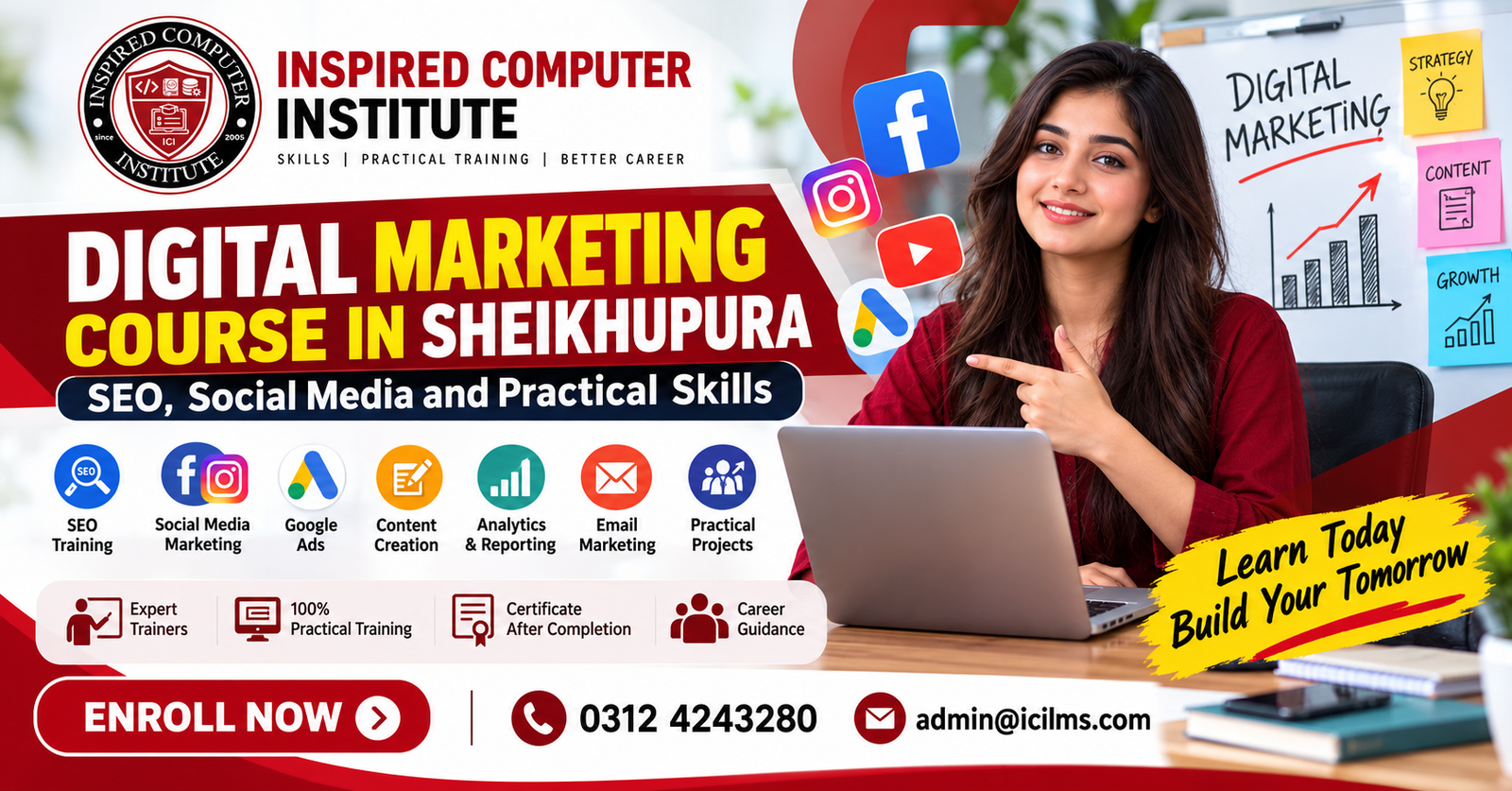
Digital Marketing Course in Sheikhupura: SEO, Social Media and Practical Skills
Komal Shahzadi
- October 19, 2026
- Comment 0
Digital Marketing Course in Sheikhupura: SEO, Social Media and Practical Skills
1. Introduction to Digital Marketing Training in Sheikhupura
The way businesses attract customers has changed dramatically over the past few years. Whether someone runs a clothing shop, manages a small manufacturing business, sells products online, or offers professional services, having a strong online presence can make a real difference. Customers increasingly use search engines, social media platforms, websites, and online reviews to decide which businesses deserve their attention. This shift has created a growing need for people who understand how to promote products and services through digital channels. For students, job seekers, business owners, and aspiring freelancers in Sheikhupura, enrolling in a digital marketing course in Sheikhupura can be a practical way to develop skills that apply to a wide range of industries.
Sheikhupura has a diverse business environment, including retail shops, educational institutions, service providers, manufacturers, and small businesses that want to reach customers beyond their immediate surroundings. Many of these organizations can benefit from better search engine visibility, engaging social media content, and well-planned online advertising. However, simply creating a Facebook page or uploading photographs to Instagram does not guarantee sales. Businesses need people who understand their target audience, choose suitable marketing channels, measure campaign performance, and improve their strategies using real data. That is where structured digital marketing training becomes valuable.
A good course should do more than introduce marketing terminology. It should help you understand search engine optimization (SEO), social media marketing, content creation, paid advertising, website optimization, and performance analytics. Ideally, you should also receive opportunities to complete practical assignments, work with marketing tools, and develop projects that demonstrate your abilities. These experiences can help you prepare for employment, freelance projects, internships, or the challenge of promoting your own business. The most useful training is not necessarily the course with the most impressive advertisements; it is the one that gives you a clear learning path and helps you turn knowledge into demonstrable skills.
If you are comparing digital marketing and SEO training options in Sheikhupura, start by identifying what you want to achieve. Do you want to manage social media accounts, become an SEO specialist, find remote work, or attract more customers to a local business? Your answer will help you choose a course that fits your goals rather than spending money on lessons that do not address your needs.
2. What Is Digital Marketing and Why Does It Matter?
Digital marketing is the process of promoting products, services, brands, and ideas through online channels. These channels include search engines, social media platforms, websites, email, online advertising networks, and other digital communication tools. Unlike traditional marketing methods that may rely on printed advertisements, billboards, or physical distribution, digital marketing allows businesses to reach specific audiences, test different approaches, and measure many aspects of their campaigns. For example, a clothing retailer can use social media to showcase new arrivals, optimize its website so customers can find products through Google, and run advertisements targeting people who are interested in particular styles. Each activity serves a purpose, but the strongest results often come when the activities work together.
Imagine that a customer in Sheikhupura needs a service and searches for it online. The businesses appearing prominently in search results may receive the first visits, calls, and inquiries. Another potential customer might discover the same service through a Facebook recommendation or an Instagram video. A third person might click an advertisement after searching for a particular product. These customer journeys demonstrate why businesses need more than one promotional method. Digital marketing helps organizations appear where potential customers are already spending their time and makes it possible to communicate with those customers in relevant ways.
An effective digital marketing course in Sheikhupura should explain how different channels complement each other. SEO can attract people who are actively looking for information or services. Social media marketing can build awareness and encourage conversations with potential customers. Content marketing can answer questions and establish credibility, while paid advertising can help businesses reach selected audiences more quickly. Analytics then helps marketers evaluate which activities generate meaningful results instead of judging success solely by likes, views, or website visits.
Digital marketing is also useful because it encourages experimentation. If a campaign is not producing enough inquiries, a marketer can examine its audience, message, landing page, budget, and conversion process to identify possible improvements. This does not mean every campaign will succeed immediately. Marketing results depend on competition, product quality, pricing, customer trust, budget, and many other factors. Nevertheless, learning to test ideas and interpret evidence gives you a more reliable foundation than making decisions based entirely on guesswork.
For learners, understanding this broader picture is essential. Rather than treating SEO, social media, and advertising as unrelated subjects, you can learn to use them as connected parts of a marketing strategy designed to achieve a specific business objective.
3. How Digital Marketing Creates Career Opportunities
One of the biggest reasons people explore digital marketing is its flexibility. The skills involved can be applied to local employment, agency work, freelance services, e-commerce, personal projects, and remote positions. A small business may need someone to manage its Facebook and Instagram accounts, while an online store may need help improving product pages and search visibility. A marketing agency might recruit an assistant to research keywords, prepare reports, or schedule content. These roles differ in responsibility, but they all rely on the ability to communicate clearly, understand customer behavior, and use digital tools effectively.
For students and recent graduates, digital marketing can offer a practical complement to formal education. You do not necessarily need an advanced technical background to begin learning the fundamentals. Skills such as writing, research, creativity, organization, and analytical thinking are useful starting points. However, developing professional competence requires consistent practice. Understanding the definition of SEO is not the same as conducting keyword research, auditing a website, improving page titles, or explaining why a page is struggling to attract organic traffic. Employers and clients generally need evidence that you can perform relevant tasks, not simply confirm that you attended a class.
A structured course can help you build that evidence by assigning projects with clear objectives. You might develop a content calendar for a local business, research keywords for a service website, create sample advertisements, or prepare a performance report. These projects can become the foundation of a portfolio that demonstrates what you have learned. As your experience grows, you can specialize in areas that suit your strengths, such as technical SEO, content marketing, paid media, social media management, or marketing analytics.
Freelancing is another possible route, especially for people who want to work with clients outside their city. Yet it is important to approach this opportunity realistically. Completing a course does not automatically produce paying clients, and remote work can be competitive. You will need to develop communication skills, understand project requirements, set reasonable expectations, and deliver work consistently. Some beginners start with internships or supervised assignments before offering independent services.
A digital marketing course in Sheikhupura can therefore serve as a starting point rather than a guarantee of employment or income. The best results usually come when structured learning is combined with independent practice, portfolio development, professional communication, and a willingness to keep learning as digital platforms change.
4. What You Will Learn in a Digital Marketing Course
Before enrolling in a digital marketing program, it helps to understand what the curriculum should cover. Digital marketing is a broad field, and a course that focuses exclusively on social media posts may not provide enough preparation for someone who wants to work as a well-rounded digital marketer. Similarly, a program that concentrates entirely on SEO may be suitable for someone pursuing search optimization but less appropriate for a learner who wants to manage complete marketing campaigns. The right curriculum depends on your career goals, existing knowledge, and the type of work you hope to perform after training.
A comprehensive digital marketing course in Sheikhupura should introduce you to the major marketing channels and explain how to use them for different business objectives. You should learn how to identify a target audience, research competitors, understand customer needs, and develop a marketing strategy. These fundamentals matter because successful marketing begins with knowing whom you want to reach and what action you want that audience to take. Without this foundation, even attractive content and expensive advertisements can fail to generate meaningful results.
The course should also cover keyword research, on-page SEO, technical SEO fundamentals, content planning, social media management, paid advertising concepts, and web analytics. Depending on the program, you may receive introductory training in email marketing, conversion rate optimization, local SEO, and e-commerce marketing. Familiarity with tools such as Google Search Console, Google Analytics, Google Trends, and keyword research platforms can help you understand how professionals investigate problems and measure performance. Specific tools may change, so the most important lesson is learning the principles behind their use rather than memorizing every button.
Practical assignments are particularly valuable. For example, your instructor could ask you to prepare an SEO plan for a local service business, develop a month-long social media calendar, or analyze the performance of a sample advertising campaign. You should learn how to explain your decisions, interpret the results, and recommend improvements. These exercises turn theoretical concepts into skills you can demonstrate to a potential employer or client.
Before paying for training, request a detailed syllabus and ask how much time is allocated to practical work. Find out whether students receive feedback on assignments and whether the course includes a final project. A well-organized curriculum should help you progress from foundational concepts to increasingly realistic tasks, allowing you to build confidence without becoming overwhelmed.
5. Search Engine Optimization (SEO) Training
Search engine optimization, commonly known as SEO, is one of the most valuable subjects to study when comparing digital marketing courses. SEO involves improving a website so that search engines can discover, understand, and potentially display its pages for relevant searches. Unlike paid search advertisements, organic search visibility does not require payment for each click, although effective SEO can require substantial time, expertise, content development, and technical work. The goal is not simply to attract more visitors; it is to attract people whose needs match the information, products, or services a website provides.
A quality SEO course should begin with keyword research. You need to understand how people phrase their searches, why search intent matters, and how to choose topics that match a website’s purpose. Consider a business offering training in Sheikhupura. Someone searching for a general definition of digital marketing may want introductory information, while someone searching for a digital marketing course in Sheikhupura may be comparing institutes, course fees, practical training, and career opportunities. These searches reflect different needs. Understanding that difference helps you create content that answers real questions rather than repeating a keyword without providing useful information.
The next area is on-page SEO. You should learn how to structure headings, write descriptive title tags, create useful meta descriptions, organize URLs, add relevant internal links, and produce content that answers searchers’ questions. You should also understand image optimization, mobile usability, page experience, and the importance of a logical website structure. Keyword placement should feel natural, and content should be written primarily for readers. Repeating the same phrase excessively can make an article difficult to read and is not a reliable way to improve rankings.
Technical SEO introduces you to issues that can affect crawling and indexing. These include broken links, redirect problems, duplicate pages, XML sitemaps, robots.txt, canonical tags, and page loading performance. Beginners do not need to master every technical issue immediately, but they should know how to identify common problems and when to seek specialist assistance. Google Search Console is particularly useful for reviewing search performance, indexing information, and certain website issues.
Off-page SEO and local SEO also deserve attention. Off-page SEO includes activities that help establish a website’s reputation, including earning relevant, editorially appropriate backlinks. Local SEO focuses on helping businesses appear for geographically relevant searches through accurate business information, useful location pages, customer reviews, and an appropriately managed Google Business Profile when eligible.
The best SEO training combines these topics with real exercises. Ask whether students perform keyword research, conduct a website audit, optimize sample pages, and evaluate results over time. SEO is a long-term process, so a responsible course should not promise guaranteed first-page rankings within a few days. Instead, it should teach you how to make informed improvements, monitor performance, and adapt to changing search behavior.
6. Social Media Marketing and Advertising
Social media marketing is another major component of a practical digital marketing curriculum. Platforms such as Facebook, Instagram, LinkedIn, TikTok, and YouTube offer different ways to reach audiences, but each platform has its own content formats, audience expectations, advertising options, and measurement methods. A strategy that works for a clothing brand may not be suitable for a professional training institute or an industrial supplier. Learning to select the right platform is therefore just as important as learning to publish content.
A strong social media module should teach you how to create a content strategy based on business goals. You might plan educational posts to answer common customer questions, short videos to demonstrate a product, testimonials to build trust, or promotional posts to communicate an offer. A content calendar can help organize publishing dates, campaign themes, creative assets, and calls to action. Rather than posting randomly whenever inspiration strikes, you learn to create a consistent plan that supports a larger marketing objective.
Social media management also requires an understanding of audience engagement. Responding to comments, handling customer questions, monitoring messages, and maintaining a consistent brand voice can influence how people perceive a business. Students should learn how to communicate professionally, protect customer privacy, and respond appropriately to criticism. They should also understand that a large number of followers does not automatically translate into sales. A smaller, relevant audience that trusts a business can sometimes be more valuable than a much larger audience with little interest in its products.
Paid social advertising introduces another set of skills. Depending on the platforms covered, you may learn about campaign objectives, audience selection, budgets, creative testing, placements, conversion tracking, and performance analysis. For example, a local training institute might want to generate inquiries from prospective students, whereas an online store might focus on purchases. Those objectives require different campaign setups and measurement methods.
Practical training should include examples of advertisements, audience research, and campaign reports. If live advertising accounts are available, instructors should explain budget controls and obtain appropriate authorization before launching campaigns. Students should never assume that a campaign is successful simply because it receives impressions or likes. They need to evaluate whether it produces relevant inquiries, purchases, bookings, or other outcomes connected to the business objective.
When choosing a digital marketing course in Sheikhupura, ask whether social media lessons cover both organic content and paid advertising. These skills complement each other, but they are not interchangeable. Organic content supports ongoing engagement and brand communication, while paid campaigns can expand reach among selected audiences. Understanding both can make you more useful to businesses seeking a coordinated digital marketing strategy.
7. Content Marketing and Copywriting
Content marketing involves creating and distributing useful information to attract, educate, and retain a relevant audience. That information might appear in blog posts, videos, product descriptions, email newsletters, social media updates, tutorials, or downloadable guides. Effective content does not merely fill a website with words. It addresses a genuine question, helps someone make a decision, explains a product, or solves a problem. For this reason, content marketing is closely connected to SEO, social media, brand positioning, and customer experience.
Copywriting is the related skill of writing persuasive material that encourages readers to take a particular action. A landing page might encourage visitors to register for a course, an advertisement might invite customers to request a quotation, and a product description might explain why an item is worth purchasing. Good copywriting requires a clear understanding of the audience, the offer, the problem being solved, and the next step the reader should take. Persuasion works best when it is supported by relevant facts rather than exaggerated claims.
In a practical training program, you should learn how to research topics, organize information, write engaging introductions, develop useful headings, and create clear calls to action. You should also understand the difference between writing for a person and optimizing content for discoverability. Search terms can help you identify the subjects people care about, but they should not dictate every sentence. An article that repeats keywords without adding insight is unlikely to build lasting trust with its audience.
For example, an institute targeting people interested in digital marketing education could publish an informative guide comparing SEO training, social media marketing, course duration, and practical projects. That guide could help prospective students understand their options while giving search engines clearer information about the page’s subject. The same article could be repurposed into short social media posts, a video script, and answers to frequently asked questions. This approach helps businesses make better use of their research and creative work.
Students should also learn to fact-check information, avoid unsupported statistics, respect copyright, and disclose relevant limitations. AI writing tools may assist with brainstorming, outlining, or editing, but human review remains essential. Content must be accurate, original in its expression, useful to the intended audience, and consistent with the publisher’s expertise. No writing technique can honestly guarantee that a detector will classify an article as human-written.
A good content marketing module should leave you with finished work that you can show in a portfolio. Writing a well-researched article, preparing a content calendar, or creating a landing page provides more meaningful evidence of ability than simply listing content marketing among your completed course topics.
8. Google Ads, Paid Campaigns, and Analytics
Paid advertising can help businesses reach prospective customers without waiting for organic visibility to develop, but it requires careful planning and monitoring. Google Ads allows advertisers to run different campaign types, including search advertising and other available formats, depending on their objectives and account setup. Social platforms also offer paid promotion options. A digital marketer needs to understand which channel fits the target audience, how to define a meaningful campaign objective, and how to control spending while evaluating results.
A course covering paid advertising should explain campaign structure, keyword selection for search campaigns, audience targeting where applicable, ad copy, bidding approaches, budget allocation, and conversion tracking. Students should learn why a relevant landing page matters. If an advertisement promises detailed information about a training course but sends visitors to a generic homepage with no clear course details, the experience can discourage inquiries even when the advertisement attracts clicks. Strong campaigns connect the advertisement, landing page, offer, and intended customer action.
Analytics is the part of digital marketing that helps you understand what happens after a campaign begins. Google Analytics can help analyze website traffic and user interactions when appropriately configured, while Google Ads reports show advertising performance. Google Search Console provides information about organic search visibility and website search performance. Each tool answers different questions, and students should understand the limitations of the available data before drawing conclusions.
Consider a hypothetical campaign that receives 500 clicks but produces only two inquiries. Rather than immediately increasing the budget, a marketer should investigate the situation. Were the clicks relevant? Did the landing page load properly? Was the offer clear? Did the contact form work on mobile devices? Were conversions tracked accurately? The answers can reveal whether the issue involves targeting, messaging, website usability, or measurement.
Students should become familiar with key metrics such as impressions, click-through rate, cost per click, conversion rate, cost per lead, and return on advertising spend where revenue data is available. These metrics should be interpreted in context. A low cost per click does not necessarily mean a campaign is profitable, and a high click-through rate does not guarantee that visitors will become customers.
Practical assignments might include creating a sample campaign plan, reviewing a demonstration account, calculating conversion rates, and preparing a report with recommendations. If a course includes live campaigns, ask whether the advertising budget is included in the fee and who controls the account. You should never spend money on an advertising campaign without understanding the budget, permissions, tracking arrangements, and risks.
Paid advertising and analytics are valuable additions to SEO and social media skills because they teach you to connect marketing activity with measurable business outcomes. This combination is particularly useful for marketers who want to support businesses with lead generation, e-commerce sales, and customer acquisition.
9. Practical Training vs. Theoretical Learning
One of the most important questions to ask before joining a digital marketing institute is whether the course provides practical training or focuses mainly on lectures. Theory gives you the vocabulary and concepts needed to understand digital marketing, but practice teaches you how to apply those concepts when a real problem appears. You might understand what a keyword is after a ten-minute explanation, for example, yet still struggle to choose appropriate keywords for a competitive website. Similarly, learning the definition of a conversion rate does not automatically prepare you to investigate why a landing page attracts visitors but generates few inquiries.
A practical digital marketing course in Sheikhupura should allow students to complete tasks that resemble actual marketing work. These tasks can include researching competitors, creating an SEO content plan, optimizing sample website pages, preparing social media creatives, developing advertising strategies, and analyzing performance reports. You do not need access to a large company’s confidential marketing accounts to begin learning. Public websites, demonstration datasets, sample campaigns, and projects for a personal website can provide useful practice when instructors structure the exercises properly.
For example, imagine that your assignment is to help a local bakery attract more customers through digital channels. You might begin by identifying its target audience and examining what nearby competitors communicate online. Next, you could prepare a list of relevant search terms, propose improvements to the bakery’s website, and create a weekly social media calendar featuring products, customer questions, and seasonal promotions. You might then develop a sample advertising plan and identify the metrics you would monitor to evaluate its effectiveness. This single project introduces several marketing disciplines while showing you how they work together.
Feedback is another important part of practical learning. When an instructor reviews your work, you can discover whether your keyword choices match search intent, whether your content communicates a clear message, and whether your recommendations are realistic. Without feedback, beginners may repeat the same mistakes without recognizing them. A good training environment encourages questions, explains the reasoning behind corrections, and gives students opportunities to improve their work.
Before enrolling, ask whether you will build a portfolio, complete individual assignments, and receive feedback from someone with relevant experience. Find out whether the institute provides access to appropriate tools and whether you will work on a real project, a supervised simulation, or your own website. These distinctions matter because a course advertised as practical may still provide only limited hands-on experience.
Ultimately, the strongest learning approach combines theory, demonstrations, guided exercises, independent projects, and performance review. Theory helps you understand the rules of the game; practical work teaches you how to play it. If your goal is employment or freelancing, prioritize a course that gives you repeated opportunities to solve problems rather than simply memorize definitions.
10. How to Choose the Best Digital Marketing Institute in Sheikhupura
Choosing a training institute requires more than comparing advertisements or selecting the shortest course. Two programs may use the same title while offering very different levels of instruction, practical work, and student support. One might provide a structured curriculum with individual assignments and portfolio projects, while another might cover numerous topics superficially. To make an informed decision, evaluate the curriculum, instructor experience, teaching methods, class schedule, available resources, and transparency of the institute’s claims.
Start by examining the syllabus. A course suitable for beginners should introduce digital marketing fundamentals before progressing to subjects such as keyword research, on-page SEO, social media management, advertising, and analytics. If your primary interest is SEO, check whether the program covers search intent, content optimization, technical SEO basics, Search Console, local SEO, and performance reporting. If you want a broader marketing role, look for a balanced curriculum that includes social media, content creation, paid advertising, and measurement.
Next, ask about the instructor’s practical experience. Someone who has worked on websites, managed campaigns, or completed client projects may be able to explain real-world challenges more effectively than someone who teaches only from presentations. However, professional experience should be evaluated alongside teaching ability. Ask how lessons are delivered, how questions are handled, and whether the instructor reviews individual assignments. If possible, request a demonstration class before making a financial commitment.
Location and convenience also matter. If you live in Sheikhupura, an institute within reasonable travelling distance may make it easier to attend classes regularly. Compare in-person options with online courses that provide live instruction, recorded lessons, or instructor support. An online program can be useful if it offers a well-organized learning experience, while classroom training may suit students who prefer direct interaction and a scheduled routine. Neither format is automatically superior; the best choice depends on your circumstances and learning preferences.
Check the fee structure carefully. Ask whether registration, course materials, software, certification, examination, or advertising expenses require separate payments. Request written details about the total cost, course duration, class frequency, and refund or cancellation policy. Be cautious of claims that every student will secure a job, become an expert within a few days, or earn a guaranteed income immediately after graduation.
Finally, investigate student work and feedback where possible. Genuine examples of completed projects can reveal more about the training quality than promotional slogans. Ask whether students leave with an SEO audit, a content plan, a social media strategy, or another portfolio-ready project.
The best institute for you is the one that matches your learning goals, provides transparent information, and helps you develop demonstrable skills. Compare at least two or three suitable options using the same criteria, and make your decision based on evidence rather than pressure to register quickly.
11. Digital Marketing Course Fees, Duration, and Requirements
Course fees and durations vary between training providers, so it is important to verify current details directly with the institute you are considering. The cost can depend on the number of subjects covered, the experience of the instructors, the availability of individual feedback, the teaching format, and whether practical projects or additional resources are included. A short introductory workshop may cost less than an extensive program covering SEO, social media advertising, analytics, and portfolio development. However, paying a higher fee does not automatically guarantee better instruction.
When comparing a digital marketing course in Sheikhupura, look at the total value rather than the advertised price alone. A lower-priced course may be suitable if it teaches the fundamentals clearly and provides useful exercises. A more expensive program may be worthwhile if it includes extensive practical work, personalized feedback, mentorship, and access to relevant learning resources. The key question is whether the additional cost provides benefits that support your specific goals.
Duration is another consideration. Some programs are designed as short introductions, while others spread their curriculum across several months. Your progress will depend on the depth of the material, your existing knowledge, the time you spend practicing, and the complexity of your chosen specialization. Completing introductory lessons can help you understand the basics, but developing professional competence requires additional projects and continued learning. SEO, in particular, benefits from repeated observation because meaningful search performance changes often take time to evaluate.
Most beginner courses do not require an advanced degree or extensive technical knowledge. Basic computer literacy, internet access, a willingness to research, and the ability to communicate clearly are useful starting points. Familiarity with spreadsheets, document editors, and website management systems can help, but many learners develop these abilities during training. If a course requires specific equipment, software, or previous experience, ask the institute to explain those requirements before registering.
Students should also ask whether a laptop is necessary for practical sessions. A smartphone can be useful for managing social media content and reviewing advertisements, but a computer generally makes tasks such as keyword research, website auditing, spreadsheet analysis, and report preparation easier. Reliable internet access is particularly important if the course includes online tools or remote assignments.
Before making a payment, request a written breakdown of the syllabus, duration, weekly timetable, total fee, certification arrangements, and any extra charges. Ask what happens if you miss a class and whether you can review recorded material or attend a replacement session.
Treat your course fee as an investment in learning, not as a promise of immediate financial returns. A sensible decision balances affordability, teaching quality, practical experience, and the time you can realistically dedicate to study.
12. Freelancing and Remote Work Opportunities
Freelancing allows digital marketers to provide services to clients without necessarily joining a traditional full-time organization. These clients may include local shops, educational institutes, service providers, online stores, startups, or businesses operating in other countries. Depending on their experience, freelancers can offer services such as keyword research, SEO content planning, website audits, social media management, copywriting, email marketing, and campaign reporting. Some work independently, while others collaborate with designers, developers, writers, and advertising specialists.
For beginners in Sheikhupura, freelancing may seem attractive because it can provide access to opportunities beyond the local job market. However, it is important to understand that freelance work involves more than technical marketing skills. You must also communicate with clients, clarify project requirements, establish deadlines, manage revisions, and explain what your services can realistically achieve. A client who requests SEO work, for example, should understand that no ethical professional can guarantee a specific Google ranking by a fixed date.
A sensible starting point is to select one or two services that you can deliver competently. You might begin with keyword research and on-page SEO recommendations, or with social media content planning and monthly performance reports. Developing a clear service offer makes it easier to explain your value to potential clients. As you gain experience, you can expand into related services instead of attempting to sell every digital marketing service immediately.
Your portfolio is especially important when you have limited professional experience. Create sample projects that demonstrate your process and explain the decisions behind your recommendations. You could conduct an SEO audit of your own website, prepare a content calendar for a fictional business, or analyze a publicly available website using appropriate tools. Clearly label hypothetical projects as samples and never present invented results as genuine client achievements.
Freelancers can look for opportunities through professional networking, legitimate freelance marketplaces, referrals, local business relationships, and direct outreach. When approaching a business, identify a specific problem you can help address rather than sending a generic message promising more sales. For example, you might explain that a website has unclear page titles or that its social media content lacks consistent calls to action. Your observations should be accurate, respectful, and accompanied by practical suggestions.
Remote work also requires discipline. You may need to manage different time zones, organize files, track project progress, and protect client information. Written agreements can help clarify deliverables, payment arrangements, revision limits, and project timelines.
A digital marketing course in Sheikhupura can give you the foundation for freelancing, but consistent practice and reliable client service are what help you build a sustainable reputation. Start with manageable projects, learn from feedback, and increase the complexity of your work as your capabilities grow.
13. Career Options After Completing the Course
Digital marketing includes several specializations, so you do not have to pursue every subject at the same time. Your ideal direction may depend on whether you enjoy research, writing, visual communication, technical problem-solving, or interpreting data. A well-rounded beginner course helps you understand the major disciplines before you decide where to focus. Afterward, you can build deeper expertise through practical projects, further study, and supervised work.
An SEO executive focuses on improving a website’s organic search performance. Typical tasks can include keyword research, competitor analysis, on-page optimization, internal linking, technical checks, content planning, and performance reporting. An SEO professional needs patience because rankings and organic traffic can fluctuate, and improvements are not always immediate. Strong research skills and attention to detail are especially useful in this role.
A social media manager develops content plans, schedules posts, coordinates creative work, communicates with audiences, and reviews performance across relevant platforms. Depending on the organization, the role may also involve short-form video planning, community management, and paid social campaigns. People who enjoy communication, visual storytelling, and organized project management may find this specialization appealing.
A content writer or copywriter creates articles, website pages, product descriptions, advertising copy, and other marketing materials. The work requires clear writing, audience research, fact-checking, and an understanding of search intent or persuasive communication. Writers who develop SEO knowledge can often contribute more effectively to website content projects because they understand how content structure and search relevance influence discoverability.
A digital marketing assistant or executive may support multiple channels, including social media, email campaigns, website updates, reporting, and basic advertising tasks. This can be a useful entry point for people who want broad experience before specializing. Other potential paths include paid advertising, email marketing, e-commerce marketing, conversion optimization, and marketing analytics.
The table below summarizes several common career directions and the skills they typically require.
| Career path | Main responsibilities | Useful beginner skills |
|---|---|---|
| SEO executive | Keyword research, on-page optimization, audits | SEO fundamentals, research, analytics |
| Social media manager | Content planning, publishing, engagement | Writing, content calendars, platform knowledge |
| Content writer | Articles, website pages, blog content | Research, writing, editing, SEO basics |
| PPC specialist | Paid search campaigns and optimization | Advertising principles, budgeting, conversion tracking |
| Digital marketing assistant | Support across multiple marketing channels | Organization, communication, reporting |
| Marketing analyst | Performance measurement and insights | Spreadsheets, analytics, data interpretation |
| Freelance digital marketer | Project-based marketing services | A chosen specialization, communication, portfolio |
Job titles and responsibilities vary between employers. Some organizations combine several of these roles, while larger teams divide the work among specialists. Salaries also depend on experience, location, employer, technical ability, and the quality of your work. It is better to investigate current job advertisements and required qualifications than to rely on generic salary promises.
When choosing your first career direction, pay attention to the tasks you enjoy most during training. If you like investigating why pages rank poorly, SEO may suit you. If you enjoy communicating with audiences, social media may be a stronger fit. If you prefer working with budgets, experiments, and numerical reports, paid advertising or analytics may be worth exploring.
14. How to Build a Digital Marketing Portfolio
A digital marketing portfolio is a collection of projects that demonstrates what you can do. It is particularly useful for beginners because a course certificate alone cannot show how effectively you apply the concepts you have learned. A portfolio gives employers and clients a way to evaluate your research, decision-making, communication, and practical skills. You do not need dozens of projects to begin; a few carefully prepared examples can provide a strong foundation.
Start with a project that matches your preferred specialization. If you are interested in SEO, choose a website you own or have permission to analyze. Conduct keyword research, identify relevant search intent, review the page structure, and prepare recommendations for improvement. Your report should explain the problems you identified, why they matter, and what changes you would prioritize. If you cannot access the site’s private analytics, clearly state that your analysis is based on publicly observable information rather than claiming knowledge of its traffic or conversions.
For social media, create a sample strategy for a local business. Define its intended audience, identify suitable platforms, develop a content calendar, and prepare several sample posts. Explain how the content supports the business objective and identify the metrics you would monitor. You might include sample captions, visual concepts, and a response framework for common customer questions. If the project is hypothetical, label it clearly as a concept project rather than a campaign completed for a paying client.
You can also create a sample paid advertising plan. Identify the campaign objective, outline relevant audience or keyword considerations, propose an appropriate budget structure, and describe how you would track conversions. Do not fabricate campaign results. A well-reasoned plan can demonstrate your understanding even when you have not yet managed a live campaign.
Present each project in a simple, professional format. Include the business problem, your approach, the work completed, and the reasoning behind your recommendations. If you have access to genuine performance data, explain the period measured and any limitations. Avoid sharing private client information without permission, and remove confidential details from reports before displaying them publicly.
Your portfolio can live on a personal website, a professional profile, or a well-organized digital document. Make it easy for someone to understand your skills without searching through dozens of unrelated files. Update it whenever you complete a stronger project or develop a new capability.
During a digital marketing course in Sheikhupura, ask whether instructors help students create portfolio-ready assignments. If they do not, build your own projects alongside the lessons. This habit will help you connect learning with professional goals and provide concrete examples when you begin applying for internships, jobs, or freelance opportunities.
15. Common Mistakes Beginners Should Avoid
Learning digital marketing can be exciting, but beginners sometimes expect results before they have developed the necessary skills. One common mistake is trying to learn every platform and specialization simultaneously. SEO, paid advertising, social media management, copywriting, and analytics each require practice, and switching between too many subjects can make it difficult to build competence in any one area. Start with the fundamentals, explore the major disciplines, and then devote extra time to the skills most relevant to your goals.
Another mistake is believing that completing a course automatically guarantees a job or a steady freelance income. Training can provide structure and direction, but employers and clients also consider practical ability, communication, reliability, and evidence of completed work. Instead of waiting for a certificate to open every door, use your learning period to create projects, request feedback, and improve your professional presentation. Even a small portfolio can help you explain your capabilities more clearly than a list of course topics.
Beginners also sometimes confuse activity with achievement. Publishing ten social media posts does not necessarily mean a campaign is successful, just as attracting website visitors does not automatically generate customers. Marketing objectives should guide the metrics you track. If the goal is lead generation, relevant inquiries and qualified leads may matter more than likes. If the goal is e-commerce sales, purchases and profitability may be more meaningful than impressions alone.
In SEO, keyword stuffing is another common problem. Repeating the same phrase excessively can make content awkward and unhelpful. Search optimization should support the reader’s experience, not replace it. Use relevant keywords naturally, answer the intended question, organize the page logically, and provide information that genuinely helps the audience. Similarly, avoid buying questionable backlinks or using deceptive techniques that can put a website’s reputation at risk.
A further mistake is relying on outdated tutorials without checking current platform documentation. Digital marketing tools and policies evolve, so a lesson recorded several years ago may not reflect the latest interface or available features. Use reliable documentation to confirm important details and focus on transferable principles that remain useful even when a platform changes.
Finally, do not overlook professional communication. Clients appreciate marketers who ask sensible questions, explain limitations, meet deadlines, and report problems honestly. Never promise guaranteed rankings, overnight success, or a specific income without a sound basis. Be transparent about what you can deliver and how you will measure progress.
The most effective way to avoid these mistakes is to approach learning as a continuous process. Practice consistently, evaluate your work, learn from unsuccessful experiments, and improve your methods. A good digital marketing course in Sheikhupura should help you develop that mindset rather than encouraging unrealistic expectations.
16. Conclusion: Is a Digital Marketing Course in Sheikhupura Worth It?
Choosing a digital marketing course in Sheikhupura can be a worthwhile step if you want to develop practical skills in SEO, social media marketing, content creation, online advertising, and performance analytics. These disciplines help businesses communicate with customers, improve online visibility, and make better-informed marketing decisions. They also offer several possible career directions for students, job seekers, entrepreneurs, and people interested in freelancing. However, the value of a course depends on the quality of its instruction, the relevance of its curriculum, and the effort you put into applying what you learn.
Before enrolling, think carefully about your main objective. If you want to improve a business website’s visibility, look for detailed SEO training that covers keyword research, on-page optimization, technical fundamentals, and performance monitoring. If you enjoy creating content and communicating with audiences, social media management and copywriting may be more appealing. If you want to understand paid campaigns, prioritize training in advertising objectives, budgets, conversion tracking, and analytics. A broad beginner program can introduce you to these areas before you decide which specialization deserves the most attention.
Practical experience should be a major part of your decision. Look for a course that provides assignments, instructor feedback, realistic examples, and opportunities to develop a portfolio. Compare the syllabus, teaching format, duration, total fees, and available support rather than relying on promotional claims. Ask clear questions about what you will be able to do by the end of the program and what resources will be available to help you continue learning afterward.
Remember that digital marketing is not a shortcut to guaranteed employment or instant income. Results depend on your ability to solve problems, communicate professionally, adapt to changing platforms, and demonstrate genuine competence. You may need additional practice, internships, personal projects, or entry-level assignments before you feel confident working independently. That is a normal part of developing a new professional skill set.
For learners in Sheikhupura, the most useful approach is to start with a clear goal, choose suitable training, and practice consistently. Build a small portfolio, study reliable documentation, and learn to explain the reasoning behind your recommendations. Whether you eventually work with local businesses, join a marketing team, manage an online store, or pursue freelance projects, the combination of structured learning and practical experience will give you a stronger foundation for moving forward.
20 Frequently Asked Questions About Digital Marketing Courses in Sheikhupura
1. What is a digital marketing course in Sheikhupura?
A digital marketing course in Sheikhupura is a training program designed to teach students how to promote businesses, products, or services through online channels. Depending on the institute, the curriculum may include SEO, social media marketing, content creation, Google Ads, analytics, email marketing, and website optimization. Some programs focus on introductory concepts, while others provide specialized or advanced training. Before enrolling, check the syllabus and confirm how much practical work is included. The best course for you is one that matches your career goals and gives you opportunities to apply your knowledge through assignments and projects.
2. Who should join a digital marketing course?
Digital marketing training can suit students, recent graduates, job seekers, business owners, freelancers, and professionals who want to expand their skills. It can also help people who manage websites or social media accounts and want to understand how to improve their results. Beginners generally do not need an advanced technical background, although basic computer skills and a willingness to learn are helpful. Before choosing a program, consider whether you want to pursue employment, start freelancing, promote your own business, or specialize in a particular marketing discipline. Your goal will help you select the most relevant curriculum.
3. What topics are covered in digital marketing training?
A comprehensive course may cover marketing fundamentals, audience research, keyword research, SEO, social media management, content marketing, copywriting, paid advertising, analytics, and campaign planning. Some institutes also introduce local SEO, email marketing, e-commerce promotion, and conversion optimization. The exact subjects vary, so you should request the current syllabus before registering. Pay attention to how deeply each topic is covered and whether students complete practical assignments. A course that introduces many subjects without providing enough time to practice may be less useful than a well-structured program with a balanced curriculum.
4. What is the difference between digital marketing and SEO?
Digital marketing is the broader discipline of promoting businesses through online channels, including search engines, social media, paid advertising, email, and content. SEO is one component of digital marketing that focuses on improving a website’s visibility in organic search results. For example, an SEO specialist may research keywords, optimize web pages, and investigate indexing problems, while a digital marketing executive may coordinate SEO with social media and advertising campaigns. If you want a broad understanding of online promotion, consider a comprehensive course. If your main interest is organic search performance, look for a program with detailed SEO training.
5. How long does a digital marketing course take to complete?
The duration depends on the institute, curriculum, class frequency, and amount of practical work. Some programs offer short introductory training, while more comprehensive courses may extend over several weeks or months. The advertised completion time does not necessarily indicate how long it will take you to develop professional competence. You will also need time to practice, complete projects, and understand the tools used in your chosen specialization. Ask the institute for its timetable, total teaching hours, assignment requirements, and opportunities to review missed lessons. Choose a schedule that allows you to study consistently without neglecting your other responsibilities.
6. What are the fees for a digital marketing course in Sheikhupura?
Course fees vary according to the training provider, course duration, curriculum, instructor support, and practical resources. Short workshops may have different pricing from comprehensive programs that cover SEO, social media advertising, and analytics. There is no single fee that applies to every institute in Sheikhupura, so request current pricing directly from the providers you are comparing. Ask whether registration, study materials, certification, software, or advertising expenses cost extra. Compare the overall value of each program rather than choosing exclusively by price. A reasonably priced course with useful practical assignments may be more beneficial than an expensive course that offers limited hands-on experience.
7. Can I learn digital marketing without previous experience?
Yes. Many digital marketing courses are designed for beginners and start with basic concepts before introducing more advanced tasks. You can begin by learning how online marketing works, how customers search for information, and how businesses use websites and social media to communicate with audiences. As you progress, you can practice keyword research, write sample content, create social media calendars, and analyze example campaign reports. Basic computer literacy, internet access, curiosity, and consistent practice are helpful. You do not need to master every subject immediately. Focus on understanding the fundamentals, completing assignments, and gradually building confidence with the tools and techniques used in digital marketing.
8. Is SEO included in a digital marketing course?
Many comprehensive digital marketing courses include SEO, but the depth of instruction varies between providers. Some programs cover only introductory concepts, while others teach keyword research, search intent, on-page optimization, internal linking, technical SEO fundamentals, local SEO, and performance analysis. If your main objective is to become an SEO professional, check whether the syllabus includes practical website audits and work with tools such as Google Search Console. Ask whether you will learn to identify crawling and indexing issues and interpret search performance reports. A course that combines theoretical instruction with hands-on exercises can help you understand how SEO techniques are applied to real websites.
9. Which is better for beginners: SEO or social media marketing?
Neither is universally better because the two disciplines involve different skills and objectives. SEO may suit people who enjoy research, writing, website analysis, and investigating how search engines discover content. Social media marketing may appeal to people who enjoy communication, creative planning, visual content, and audience engagement. SEO often requires patience because organic visibility can take time to develop, while social media campaigns can produce engagement more quickly without guaranteeing business results. If you are unsure which path to choose, consider a beginner course that introduces both subjects. Complete a small project in each area, then decide which skills you want to develop further.
10. Can I become a freelancer after completing a digital marketing course?
Yes, you can begin pursuing freelance opportunities after training, provided you develop the skills required to deliver a service reliably. A course can teach the fundamentals, but clients usually need evidence that you can complete specific tasks. Start by selecting a manageable service, such as keyword research, content planning, on-page SEO recommendations, or social media scheduling. Build sample projects, communicate clearly, and set realistic expectations about what your work can achieve. You may need additional practice before handling complex projects independently. Freelancing income is not guaranteed, and building a sustainable client base can take time, so treat training as the beginning of the process rather than an automatic source of earnings.
11. Can students earn money while learning digital marketing?
Some students begin earning through internships, supervised projects, part-time roles, or small freelance assignments while they are still learning. However, the timing depends on their skills, available opportunities, communication abilities, and the quality of their work. It is usually sensible to develop competence in one specific service before accepting projects that carry significant responsibility. For example, you might begin by preparing content calendars or conducting basic keyword research under supervision. Avoid promising clients outcomes you cannot reliably deliver. Concentrate on learning, building a portfolio, and obtaining feedback. As your practical experience improves, you can pursue more complex projects and better understand the value of your services.
12. Do I need a laptop for digital marketing training?
A laptop or desktop computer is strongly recommended for most practical digital marketing tasks. Although some social media activities can be managed using a smartphone, computers generally make keyword research, website auditing, spreadsheet analysis, report writing, and campaign management easier. A computer also allows you to work across multiple browser tabs and compare information more efficiently. Before enrolling, ask the institute whether it provides computers during practical sessions or expects students to bring their own devices. If you plan to study online, check the technical requirements and make sure your equipment can comfortably handle the tools used in the course. Reliable internet access is also important.
13. Is an online digital marketing course better than classroom training?
Both formats can work well, and the best option depends on your learning preferences and circumstances. Classroom training may offer scheduled lessons, direct interaction, and opportunities to ask questions immediately. Online training can provide greater flexibility and may let you revisit recorded lessons when needed. However, neither format guarantees quality by itself. An effective online program should provide organized material, practical assignments, feedback, and reliable instructor support. Similarly, a classroom course should offer more than presentations and attendance records. Compare the syllabus, teaching methods, practical exercises, and total cost before deciding. Choose the format you can attend consistently and use to develop measurable skills.
14. Will I receive a certificate after completing the course?
Some institutes provide certificates of completion, while others may offer assessments or additional certification arrangements. The exact terms depend on the provider, so confirm them before registering. A certificate can demonstrate that you completed a training program, but it does not automatically prove professional competence or guarantee employment. Employers and clients may also want to see your portfolio, understand your practical experience, and evaluate how you approach marketing problems. If certification is important to you, ask who issues it, whether an assessment is required, and whether additional fees apply. Prioritize learning quality and practical experience alongside the value of the certificate itself.
15. What career opportunities are available after digital marketing training?
Potential career paths include SEO executive, social media manager, content writer, digital marketing assistant, paid advertising specialist, email marketing assistant, and marketing analyst. Some learners also use their skills to promote their own businesses or provide freelance services. Entry-level responsibilities vary depending on the employer, and some positions require additional experience or specialized knowledge. Reviewing current job advertisements can help you identify the skills employers expect in your preferred role. During training, build projects related to that role and document your work clearly. A focused portfolio, strong communication, and practical ability can help you demonstrate your readiness for suitable opportunities.
16. How long does it take to learn SEO?
You can learn basic SEO concepts relatively quickly, but developing practical expertise usually requires sustained practice. The time needed depends on your previous experience, the complexity of the websites you work with, and how consistently you study. Beginners can start with keyword research, search intent, title tags, headings, internal linking, and content optimization. Later, they can explore technical SEO, indexing, structured data, and performance analysis. Evaluating SEO results also takes time because rankings and organic traffic can change for many reasons. Rather than relying on a fixed deadline, set learning milestones and complete projects that demonstrate your progress.
17. Can I promote a local business in Sheikhupura using digital marketing?
Yes. Digital marketing can help local businesses in Sheikhupura reach customers who search for relevant products and services online. Depending on the business, useful activities may include local SEO, an accurate Google Business Profile, a helpful website, social media content, customer reviews, and targeted advertising. For example, a training institute could publish course information, answer common questions, and make its contact details easy to find. A restaurant might showcase its menu and location, while a service provider could publish helpful guides addressing common customer problems. The best strategy depends on the business’s audience, budget, competition, and objectives. Measure meaningful outcomes, such as qualified inquiries and bookings, instead of focusing exclusively on online engagement.
18. Which tools should I learn during digital marketing training?
Useful tools depend on your chosen specialization. Google Search Console helps you examine organic search performance and certain indexing issues, while Google Analytics can help you analyze website activity when configured appropriately. Google Trends provides information about search interest over time, and keyword research platforms can assist with topic discovery and competitive analysis. Social media management tools may help with content scheduling and reporting, while advertising platforms provide campaign management and performance information. You do not need to master every available tool at once. Start with the tools that support your course projects and learn how to interpret their outputs. Understanding marketing principles is more valuable than simply memorizing software interfaces.
19. How can I choose a reliable SEO training institute in Sheikhupura?
Begin by checking the syllabus, instructor experience, teaching format, and amount of practical work included. A reliable provider should explain what the course covers, what students are expected to learn, and how progress is assessed. Ask whether you will complete keyword research, on-page optimization exercises, website audits, and performance reports. Check the total fee, class schedule, certificate arrangements, and any additional costs before making a payment. If possible, attend a demonstration class and examine examples of student projects. Be cautious of providers that guarantee specific Google rankings, immediate employment, or fixed freelance earnings. Choose an institute based on transparent information and evidence of useful instruction.
20. What should I do after completing a digital marketing course in Sheikhupura?
Start by selecting one or two areas in which you want to develop deeper expertise. Complete practical projects, create a professional portfolio, and review your work to identify gaps in your knowledge. If you are interested in SEO, you might build a small website and practice keyword research, content optimization, and Search Console analysis. If social media is your preferred area, create a sample content strategy and explain how you would measure its results. Apply for suitable internships or entry-level roles, connect with local businesses, and explore freelance opportunities when you are ready. Continue studying reliable documentation because platforms and marketing practices evolve. Your next goal should be to demonstrate what you can do, not simply collect another certificate.