Currently Empty: ₨ 0
Computer Education in Lahore and Sheikhupura: Best IT Courses, Skills, Fees and Career Opportunities
Komal Shahzadi
- October 9, 2026
- Comment 0
Computer Education in Lahore and Sheikhupura: Best IT Courses, Skills, Fees and Career Opportunities
1. Introduction to Computer Education in Lahore and Sheikhupura
Computer education has become one of the most valuable investments for students, job seekers, business owners, and working professionals across Pakistan. Whether someone wants to secure an office job, launch an online business, become a software developer, or explore freelancing, computer skills are often the starting point. In Punjab, Lahore and Sheikhupura represent two different but closely connected educational environments, each offering opportunities for people interested in building technology-related careers.
Lahore, the provincial capital of Punjab, has a well-established educational ecosystem with universities, private computer academies, software companies, technology communities, and professional training centers. Students can explore everything from basic computer literacy to advanced fields such as artificial intelligence, cybersecurity, data science, and software engineering. The city’s larger technology sector can also create opportunities for internships, professional networking, workshops, and industry exposure.
Sheikhupura, located near Lahore, offers a different experience. Many students prefer learning computer skills locally because traveling to Lahore regularly can be expensive and time-consuming. Local training centers, vocational education providers, and online learning platforms can help residents develop essential digital skills without relocating. For beginners, affordable and accessible training can be just as important as the number of courses available.
The comparison between computer education in Lahore and Sheikhupura is not simply about deciding which city is better. A student who wants to learn Microsoft Excel for an office position may have completely different requirements from someone planning to become a machine learning engineer. Likewise, a working professional may need flexible evening classes, while a university student may prioritize internships and advanced technical laboratories.
Understanding these differences helps learners make informed decisions about their education, expenses, and future employment.
This guide explores the courses available in both cities, important computer skills, training costs, professional certifications, freelancing opportunities, and potential career paths. It also explains how students can choose suitable institutes and develop practical abilities that employers and clients value.
2. Why Computer Education Matters in Pakistan
Computer education is no longer limited to people who want to become programmers or IT engineers. Digital technology influences almost every industry in Pakistan, including banking, healthcare, education, manufacturing, retail, logistics, agriculture, and government administration. Employees increasingly use computers to maintain records, prepare reports, communicate with customers, manage financial transactions, and organize daily business operations.
Consider a small manufacturing company in Sheikhupura. Its employees may need Microsoft Excel to track production, accounting software to manage expenses, and digital communication tools to coordinate orders. Meanwhile, a business in Lahore might require web developers, digital marketers, graphic designers, and IT support specialists. Although their requirements differ, both businesses depend on employees who understand technology.
This growing dependence makes computer literacy and professional IT training important for people from different educational backgrounds.
Students who complete basic computer courses can improve their ability to prepare assignments, conduct online research, create presentations, and use digital learning platforms. Job seekers can strengthen their applications by demonstrating familiarity with office software, professional email communication, data management, and online collaboration tools.
Computer education also supports entrepreneurship. Someone who understands digital marketing can promote a small business through social media, while a person with web development skills can create websites for local shops and service providers. A graphic designer can prepare advertisements, product catalogs, and branding materials without relying entirely on outside agencies.
However, learning computer skills does not automatically guarantee employment. The quality of training, practical experience, communication skills, portfolio development, and market demand all influence career outcomes.
This is why students in Lahore and Sheikhupura should focus on career-oriented computer education rather than collecting certificates without understanding how to apply their knowledge.
The most useful computer courses combine theoretical concepts with hands-on assignments, real-world problems, and opportunities to practice independently. When students can demonstrate what they have learned, their training becomes more meaningful to employers and potential clients.
3. Growing Demand for Digital Skills
Digital skills are becoming increasingly relevant as Pakistani businesses adopt online systems, e-commerce platforms, cloud-based software, and digital communication technologies. Organizations that previously depended on paper records may now use spreadsheets, accounting applications, inventory management software, and customer relationship management systems.
This transition creates opportunities for people who can operate, maintain, and improve these technologies.
In Lahore, software development companies, digital agencies, technology startups, educational institutions, and corporate offices provide a relatively broad environment for technology professionals. Skills such as programming, website development, database management, software testing, and digital marketing can be useful across different organizations.
Sheikhupura’s industrial and commercial activities create demand for another important set of abilities. Manufacturing businesses, warehouses, distributors, schools, hospitals, and retail establishments may require employees who understand office applications, data entry, inventory systems, accounting software, and computer troubleshooting.
Advanced digital skills can also support remote work, allowing professionals to serve employers and clients outside their hometown.
According to the Pakistan Economic Survey 2024–25, Pakistan’s ICT services exports reached approximately US$2.825 billion during July–March FY2025, compared with approximately US$2.283 billion during the corresponding period a year earlier. This reflects the economic significance of the country’s expanding technology services sector, although it does not mean every IT graduate will find a job immediately.
For students, the lesson is clear: technology skills can open doors, but specialization matters.
A beginner may start with typing, Microsoft Office, and internet fundamentals before moving into graphic design, web development, or digital marketing. Someone who already understands programming might pursue cloud computing, cybersecurity, or data analysis.
Employers generally look beyond course names. They want to know whether a candidate can solve problems, communicate effectively, complete tasks accurately, and adapt to unfamiliar tools.
Students who combine technical knowledge, practical experience, and professional communication are often better prepared for competitive job markets than those who rely on certificates alone.
4. Importance of Practical Computer Training
Imagine learning to drive by reading a book about cars but never sitting behind the steering wheel. You might understand traffic signs and engine components, yet struggle when asked to drive through a busy street. Computer education works in much the same way.
Students can memorize software definitions, programming commands, and keyboard shortcuts, but genuine competence develops through practice.
This is why practical computer training in Lahore and Sheikhupura should be a priority when selecting a course or training institute.
For example, a Microsoft Excel student should learn how to create budgets, organize employee records, calculate totals, use formulas, and prepare charts. Simply watching an instructor demonstrate spreadsheet features is not enough. Students need opportunities to make mistakes, correct them, and solve problems independently.
Similarly, someone studying web development should build functional websites rather than only copying code from tutorials. A graphic design student should create posters, logos, brochures, and social media graphics. A digital marketing learner should understand how to plan campaigns, research audiences, analyze performance, and interpret results.
Practical assignments help students identify their weaknesses before entering the job market.
They also create evidence of learning. A portfolio containing completed projects can be more persuasive than a certificate that provides little information about actual skills.
For students in Sheikhupura, practical training can be particularly valuable when local employment opportunities require immediate workplace readiness. A small business hiring an office assistant may expect that employee to prepare invoices, organize files, and manage spreadsheets from the first week.
In Lahore, technology employers may evaluate candidates through coding tests, design assignments, technical interviews, or portfolio reviews.
Both environments reward demonstrated ability.
Before enrolling, students should ask whether a training center provides individual computer access, supervised exercises, project-based assessments, updated software, and constructive feedback.
A course that allows students to practice consistently can deliver greater long-term value than a more expensive program built mainly around lectures.
5. Computer Education Opportunities in Lahore
Lahore is one of Pakistan’s major centers for higher education, professional training, and technology-related business activity. Students interested in computer education can explore universities, technical institutes, vocational programs, private academies, online courses, and professional certification pathways.
This diversity is one of Lahore’s strongest advantages.
A student interested in a four-year computer science degree can investigate university programs, while someone seeking employment within a shorter period may prefer a focused course in web development, graphic design, Microsoft Office, or IT support.
Lahore’s education market also offers opportunities for learners at different stages of their careers. School students can begin with basic digital literacy, university graduates can pursue professional certifications, and experienced employees can upgrade their skills through specialized training.
The city’s larger commercial environment may help students connect classroom learning with practical industry requirements.
For instance, students learning digital marketing can observe how local businesses promote their products through search engines and social platforms. Web development students may find opportunities to build websites for small companies, while graphic design learners can develop portfolios around real business needs.
However, Lahore’s size also creates challenges.
Training quality varies considerably between institutions, and higher fees do not always indicate better teaching. Some academies advertise employment guarantees or unrealistic earning potential, making careful research essential.
Students should evaluate instructors, course outlines, laboratory facilities, class sizes, and project requirements before making financial commitments.
Travel is another consideration. Lahore’s traffic and commuting distances can make daily attendance difficult, particularly for students traveling from Sheikhupura.
Hybrid and online courses may reduce these difficulties, although practical subjects still benefit from reliable equipment and instructor feedback.
Overall, computer courses in Lahore offer substantial variety, especially for students seeking advanced specialization, formal degrees, professional networking, and exposure to a larger technology ecosystem.
6. Popular Computer Courses in Lahore
Students searching for the best computer courses in Lahore will encounter programs covering beginner, intermediate, and advanced technology skills. Choosing among them depends on educational background, career goals, available time, and personal interest.
Basic computer courses generally introduce operating systems, file management, typing, internet browsing, email communication, and Microsoft Office applications. These programs can be suitable for school graduates, administrative workers, and people who have limited previous experience with computers.
Graphic design courses commonly cover visual communication, typography, color theory, branding, and tools such as Adobe Photoshop, Illustrator, or alternative design software. Students may learn to produce logos, social media posts, packaging concepts, and promotional materials.
Web development remains another popular option. Beginners often start with HTML, CSS, and JavaScript before progressing toward responsive design, backend development, databases, and modern development frameworks.
Digital marketing courses may include search engine optimization, content strategy, social media marketing, paid advertising, analytics, and email marketing. These skills can support employment in agencies, corporate marketing departments, and independent client services.
More advanced learners may investigate Python programming, data analysis, artificial intelligence, cybersecurity, networking, cloud computing, and mobile application development.
The following table compares common course categories and their typical learning objectives.
| Computer Course | Main Skills | Possible Career Direction |
|---|---|---|
| Basic Computer Course | Typing, files, email, internet | Office assistant |
| Microsoft Office | Word, Excel, PowerPoint | Administrative support |
| Graphic Design | Visual design, branding, editing | Graphic designer |
| Web Development | HTML, CSS, JavaScript | Web developer |
| Digital Marketing | SEO, advertising, analytics | Digital marketer |
| Python Programming | Coding, automation, problem-solving | Junior developer |
| Data Analytics | Excel, SQL, dashboards | Data analyst |
| Cybersecurity | Network security, risk assessment | Security support roles |
| Computer Networking | Routers, networks, troubleshooting | Network technician |
| Video Editing | Editing, sound, visual storytelling | Video editor |
Course names alone should not determine a student’s decision. Two institutes may advertise identical programs while teaching very different material.
A strong course should explain what learners will be able to create, demonstrate, or perform by the end of their training.
7. Universities and IT Training Institutes in Lahore
Lahore has several established educational institutions offering computer science, information technology, software engineering, and related academic programs. These institutions differ in admission requirements, qualifications, course structures, fees, and accreditation status.
Among the recognized names students may investigate are the University of Engineering and Technology (UET) Lahore, University of the Punjab, COMSATS University Islamabad’s Lahore Campus, University of Central Punjab, and Information Technology University.
These institutions are relevant for students interested in formal higher education rather than only short-duration vocational courses.
The National University of Computer and Emerging Sciences, commonly known as FAST-NUCES, also operates a Lahore campus and is widely associated with computing education.
Students considering degree programs should verify the latest admission criteria, program offerings, recognition, and applicable accreditation through official institutional and regulatory sources.
A university degree generally involves broader academic study, including programming, mathematics, algorithms, databases, software engineering, and theoretical computer science. It may also provide opportunities for research, internships, and postgraduate education.
Short-term training institutes serve a different purpose.
Organizations and training initiatives associated with TEVTA, NAVTTC, and other public or private skills-development providers may offer vocational courses relevant to computer education. Availability, funding, eligibility, and enrollment periods can change, so students should check current announcements.
Private academies may offer flexible schedules, evening classes, and narrowly focused training in specific software tools.
For someone who wants to become a software engineer, a recognized degree combined with independent projects may provide a strong foundation. For someone seeking an office administration position, a shorter Microsoft Office course could be more practical.
Neither route is universally superior.
The appropriate choice depends on the student’s desired career, available budget, educational qualifications, and willingness to invest time in learning.
Before paying fees, learners should verify whether the institute is registered where required, whether its certificates have meaningful recognition, and whether graduates can demonstrate practical skills.
8. Computer Education Opportunities in Sheikhupura
Sheikhupura offers important opportunities for students who want to acquire computer skills without relocating to a larger city. Its proximity to Lahore provides an additional advantage because learners can begin their education locally and explore advanced programs in Lahore when necessary.
For many families, accessibility plays a major role in educational decisions.
A student who lives in Sheikhupura may find it easier to attend a nearby computer training center than to travel several hours daily for classes in Lahore. Reduced transportation expenses and shorter commuting times can make consistent attendance more manageable.
Computer education in Sheikhupura can be particularly useful for students pursuing entry-level employment, office administration, small-business management, graphic design, and online freelancing.
Local educational options may include private computer academies, vocational training providers, college-based programs, and online learning opportunities. However, the availability of specific courses should be confirmed directly with institutions because offerings can change.
The city’s commercial and industrial environment also creates practical applications for computer training.
Businesses involved in manufacturing, distribution, retail, education, and services need employees capable of managing documents, spreadsheets, inventory information, and digital communication.
A learner who develops strong Excel skills, for example, may become better prepared for administrative and reporting responsibilities. Someone trained in graphic design may support local businesses with promotional materials and social media content.
Online education has expanded the range of subjects accessible to Sheikhupura residents. Students can learn programming, web development, digital marketing, and data analytics through remote courses, provided they have suitable devices, internet access, and the discipline to practice.
Still, online learning is not always a complete substitute for supervised instruction.
Beginners may benefit from local instructors who can answer questions immediately and guide them through unfamiliar software.
The most effective educational strategy may involve combining accessible local training with online resources and occasional specialized workshops in Lahore.
9. Popular Computer Courses in Sheikhupura
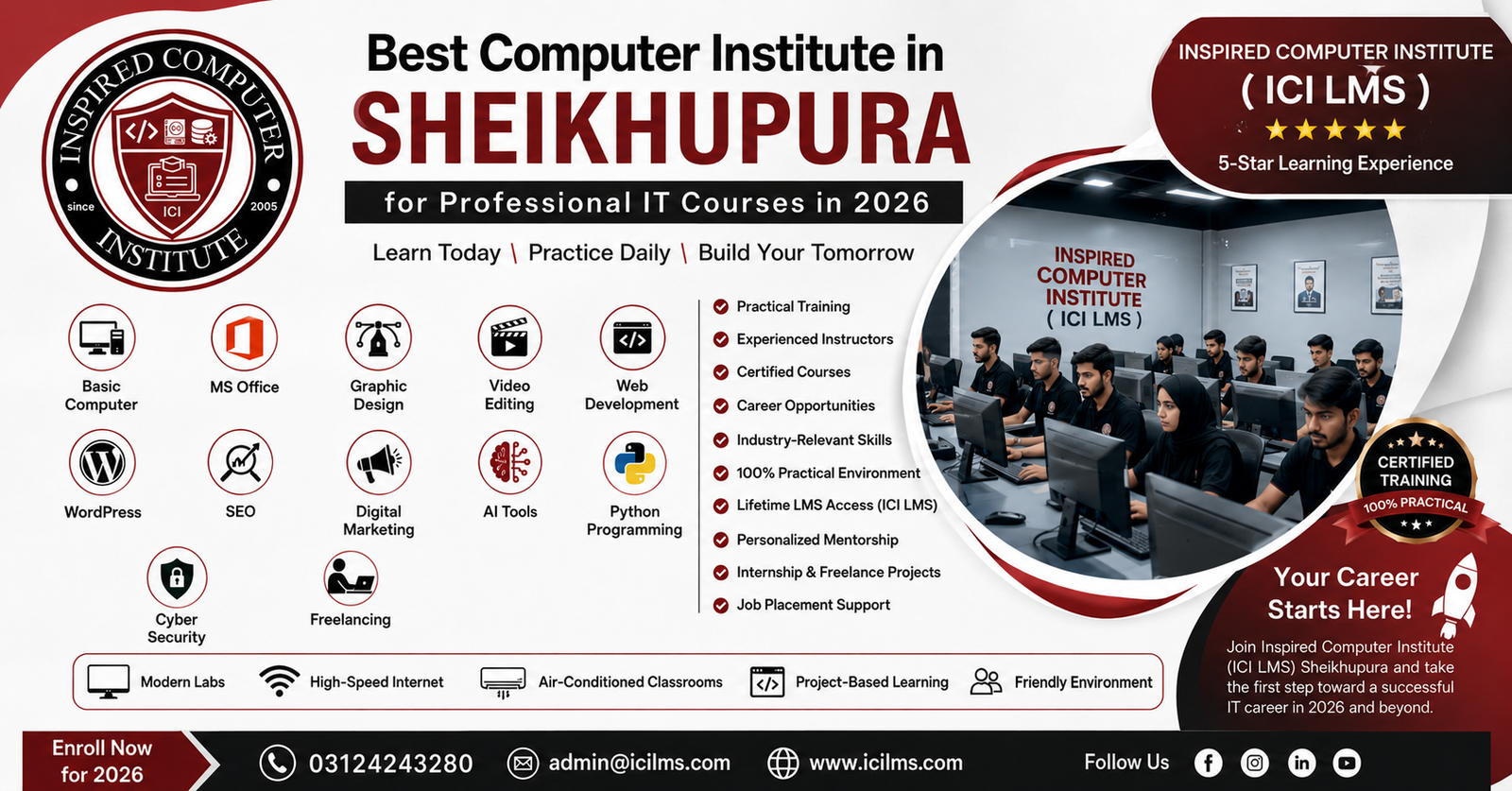
Students exploring computer courses in Sheikhupura often benefit from starting with programs that match practical employment needs. Basic computer literacy, office software, graphic design, and introductory web development can provide useful foundations for further learning.
Microsoft Office training is especially relevant for administrative work.
Students typically learn Microsoft Word for document preparation, Excel for spreadsheets and calculations, and PowerPoint for presentations. These applications are used in schools, offices, retail businesses, manufacturing companies, and service organizations.
Typing and data-entry courses can help beginners develop keyboard accuracy, document formatting skills, and confidence with digital records. However, students should recognize that basic data entry alone may offer limited long-term career growth, particularly as automation tools become more common.
Graphic design is another attractive field because it combines creativity with commercial applications.
Students can learn how to create promotional banners, business cards, product advertisements, and social media graphics. These abilities may support employment with local businesses or independent freelance work.
Web design and development courses can introduce learners to the structure and appearance of websites. Students interested in this pathway should understand that professional development requires consistent coding practice and more than basic familiarity with website-building tools.
Digital marketing and SEO training can also be useful for small-business owners and aspiring freelancers.
A local clothing retailer, for example, may need help improving online visibility, preparing social media campaigns, and managing customer inquiries.
Students should be cautious about institutes advertising immediate online earnings after completing short courses. Freelancing requires marketable skills, communication, client acquisition, and a record of reliable work.
For beginners in Sheikhupura, a sensible approach is to master fundamental computer operations before selecting a specialization.
This progression builds confidence and reduces the risk of spending money on advanced courses that assume knowledge the student has not yet developed.
10. Accessibility and Affordability of Local Training
Affordability is one of the most important factors influencing computer education decisions in Sheikhupura. Students may have limited budgets, family responsibilities, or work commitments that make expensive programs difficult to attend.
Local training can reduce some of these barriers.
A student who enrolls near home may spend less on transportation, meals, and accommodation compared with someone attending classes in Lahore. Even when tuition fees are similar, the total cost of education can differ significantly.
However, it would be misleading to assume that every course in Sheikhupura is cheaper than its equivalent in Lahore. Fees depend on the institute, instructor qualifications, facilities, course duration, and type of certification.
Some specialized programs in Lahore may offer competitive pricing, scholarships, or subsidized training that makes them financially attractive.
Students should therefore compare the complete cost of computer education, not just the advertised tuition fee.
This includes registration charges, examination fees, software requirements, transportation, internet expenses, and the cost of a computer or laptop when needed.
Accessibility also involves scheduling.
Working students may need evening or weekend classes, while women with family responsibilities may prioritize safe transportation, suitable class timings, or reliable online alternatives.
For students in smaller communities, learning environments that provide individual attention can be especially valuable. Smaller classes may allow instructors to identify weaknesses and provide personalized feedback, although class size alone does not guarantee quality.
Government-supported vocational initiatives can sometimes reduce training costs, but admission conditions and program availability vary.
Learners should check official TEVTA and NAVTTC channels for current opportunities rather than relying on outdated advertisements.
The central question is not simply, “Which institute charges the lowest fee?”
A better question is, “Which course provides the strongest practical learning experience within my budget?”
A moderately priced course with qualified instructors, adequate equipment, and meaningful projects may provide better value than a cheaper program offering little supervised practice.
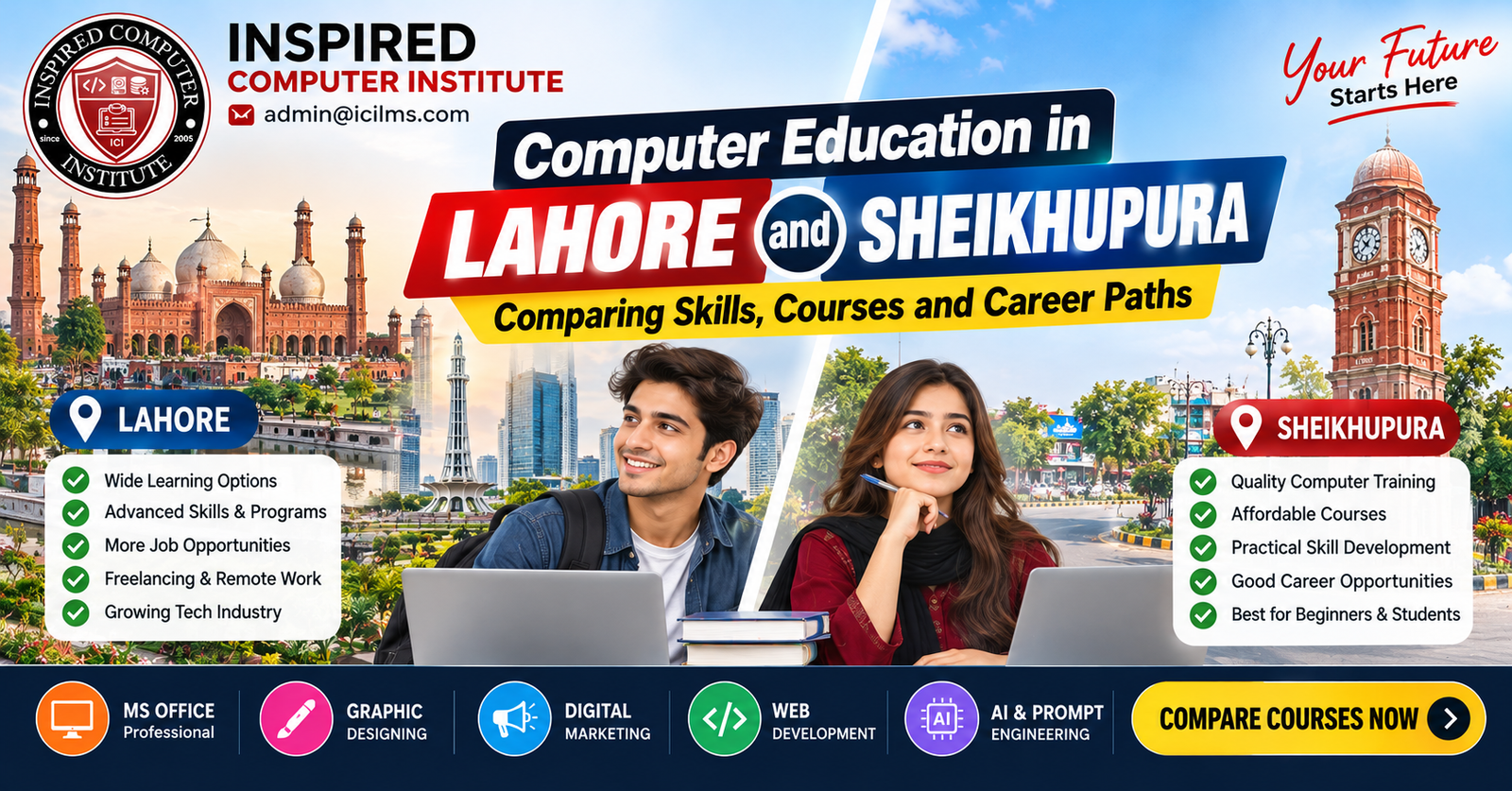
11. Lahore vs. Sheikhupura: Comparing Computer Education
Comparing computer education in Lahore and Sheikhupura requires looking beyond the number of institutes operating in each city. Students should consider course diversity, teaching quality, transportation, practical facilities, industry exposure, and long-term career goals.
Lahore generally provides a broader educational ecosystem.
Its universities, technology businesses, specialized training providers, and professional communities can make it easier to explore advanced subjects and connect with people working in the IT industry.
Sheikhupura may provide greater convenience for residents who want accessible training close to home.
For a student pursuing basic computer literacy, office applications, or introductory graphic design, a well-equipped local training center may meet their needs without requiring daily travel.
For someone interested in specialized cybersecurity laboratories, advanced software engineering programs, or university-level computer science education, Lahore may offer more options.
The difference becomes clearer when we examine how students plan to use their qualifications.
An individual preparing for an administrative position may value practical Excel exercises and typing accuracy. A future software developer may prioritize programming projects, computer science fundamentals, and access to experienced technical mentors.
Neither learner necessarily benefits from choosing the most expensive or most prestigious institution.
Employment opportunities also vary.
Lahore’s larger concentration of software companies and digital agencies can create more possibilities for industry exposure, though competition may also be substantial. Sheikhupura’s commercial and industrial organizations may offer opportunities involving office management, accounting support, inventory systems, and technical assistance.
Remote employment can reduce the importance of physical location for certain digital professions, but employers still evaluate candidates based on competence and reliability.
Ultimately, students should compare training outcomes rather than city reputation.
A disciplined learner in Sheikhupura who completes substantial projects may outperform a poorly prepared student attending a recognized institute in Lahore.
The city matters, but the student’s learning strategy matters just as much.
12. Course Availability, Fees, and Learning Facilities
Course availability, training costs, and educational facilities can strongly influence the quality of a student’s learning experience. While Lahore and Sheikhupura offer overlapping computer education pathways, their broader educational environments are not identical.
The following comparison summarizes general differences. It is a planning guide, not a verified comparison of every institution.
| Comparison Factor | Lahore | Sheikhupura |
|---|---|---|
| Course Variety | Broad range of beginner and advanced programs | Local options may be more concentrated in foundational and vocational subjects |
| Universities | Multiple established universities with computing programs | Fewer local higher-education options |
| Specialized Training | Greater potential availability | May require online study or travel |
| Tuition Fees | Wide range depending on provider | Varies by provider; local study may reduce total costs |
| Travel Expenses | Can be significant for commuters | Often lower for local residents |
| Industry Networking | Larger technology and corporate ecosystem | More locally focused opportunities |
| Practical Facilities | Wide variation, including specialized labs | Facilities depend on individual centers |
| Freelancing Preparation | Available through multiple pathways | Possible through local and online training |
| Internships | Larger pool of technology-sector organizations | Potentially fewer specialized local opportunities |
| Learning Flexibility | Classroom, hybrid, and online options | Local classroom and online options |
Students should avoid treating this table as a substitute for investigating individual institutions.
A private academy in Lahore may have outdated computers, while a smaller training center in Sheikhupura may provide modern equipment and dedicated instructors.
Similarly, an institute that advertises an advanced programming course may offer only introductory material.
A useful evaluation method is to request the complete syllabus and examine whether it includes current tools, supervised exercises, and a final project.
Prospective students can also ask to observe a class or speak with recent graduates.
When comparing fees, request a written breakdown of all charges and ask whether the institute provides computers during lessons.
The cost of purchasing a suitable laptop may be substantial for students studying programming, design, or video editing.
Good facilities support learning, but expensive equipment alone cannot replace effective teaching.
The strongest educational environment is one where students receive clear instruction, regular practice, constructive feedback, and opportunities to solve real problems.
13. Essential Computer Skills for Students and Professionals
Before selecting an advanced specialization, students should develop a foundation of computer skills that remains useful across different careers. These abilities are relevant whether someone studies in Lahore, Sheikhupura, or through an online platform.
Computer literacy begins with understanding operating systems, folders, file formats, software installation, internet browsing, and basic troubleshooting.
Students should know how to organize documents, create backups, manage downloads, and protect personal information.
Microsoft Office or equivalent productivity software is another important foundation. Word processing helps users prepare professional documents, spreadsheets support calculations and reporting, and presentation software allows people to communicate ideas visually.
Excel deserves particular attention because it is used across administration, accounting, sales, inventory management, and data analysis.
Students can begin with formulas, sorting, filtering, and charts before progressing toward pivot tables, lookup functions, and data-cleaning techniques.
Professional communication is equally important.
Many people understand software but struggle to write clear emails, explain technical problems, or communicate with clients. Strong English communication can be especially useful for international freelancing, although local language communication also matters in many Pakistani workplaces.
Cybersecurity awareness should be part of basic training.
Students need to recognize phishing attempts, use strong passwords, enable multifactor authentication, and understand the risks of sharing sensitive information.
Digital research skills are another essential ability. Not everything published online is accurate, and learners should know how to evaluate sources, compare information, and identify misleading claims.
Artificial intelligence tools are increasingly relevant, but students should use them thoughtfully. AI can assist with brainstorming, coding explanations, writing drafts, and data organization, yet its outputs still require verification.
Problem-solving connects all these skills.
An employee who can investigate an error, understand unfamiliar software, and find a reliable solution becomes more adaptable.
The strongest foundation combines technical confidence with curiosity, communication, security awareness, and independent learning.
These qualities help students move beyond operating computers toward using technology productively.
14. Best Computer Courses for Career Development
Choosing the best computer course depends on what a student wants to accomplish. A course that is ideal for a creative person may not suit someone who enjoys mathematics, logical reasoning, or business administration.
For students seeking entry-level office employment, Microsoft Office and advanced Excel can be practical starting points.
These skills support administrative tasks, documentation, reporting, and data organization. Learners can strengthen their qualifications by adding accounting software, professional communication, and business writing.
Students who enjoy creative work may prefer graphic design or video editing.
Graphic design combines visual judgment with technical software skills. Video editing requires storytelling, pacing, audio editing, and an understanding of how content is presented across different platforms.
For people who enjoy solving logical problems, programming and web development can offer a deeper technical pathway.
Web development students should begin with HTML, CSS, and JavaScript before studying databases, APIs, version control, and backend technologies.
Python can be a useful language for beginners interested in programming, automation, data processing, and artificial intelligence.
Digital marketing is suitable for learners interested in business growth, customer behavior, content creation, and online advertising.
A strong digital marketing course should cover SEO fundamentals, analytics, campaign planning, audience research, and performance measurement rather than promising instant online income.
Data analytics may appeal to students comfortable working with numbers and structured information.
Learning Excel, SQL, data visualization, and basic statistics can prepare students for more advanced analytical work.
Cybersecurity and networking are relevant for people interested in protecting systems, diagnosing technical issues, and understanding computer infrastructure.
These fields require consistent practice and, for some roles, formal qualifications or recognized certifications.
The most effective career-development strategy is to choose one primary skill and build supporting abilities around it.
For example, a web developer can benefit from basic SEO knowledge, while a graphic designer can benefit from understanding marketing principles.
Combining complementary skills makes students more versatile without forcing them to learn every technology at once.
15. Freelancing and Online Earning Opportunities
Freelancing has become an attractive career option for students and professionals who want to provide services to clients without depending entirely on traditional office employment.
For residents of Lahore and Sheikhupura, online work can create opportunities to serve customers in other Pakistani cities and international markets.
However, freelancing is a business model, not a guaranteed source of income.
Successful freelancers need marketable skills, strong communication, reliable delivery, and the ability to attract and retain clients.
Popular service categories include graphic design, website development, content writing, search engine optimization, video editing, social media management, and virtual assistance.
Platforms such as Upwork and Fiverr allow freelancers to present their services, although competition can be intense and platform policies change over time.
A beginner should avoid creating a profile that claims expertise in several unrelated fields.
Instead, it is usually more effective to develop a focused service.
For example, a graphic designer might specialize in restaurant menus, business presentations, or social media advertisements. A web developer could focus on websites for local service businesses.
A clear specialization helps potential clients understand what the freelancer offers.
Portfolio development is essential.
Students can create sample projects even before obtaining paid clients. A website developer might build a demonstration business website, while a digital marketer could prepare a sample content strategy for a fictional brand.
These examples should be presented honestly as practice projects.
Client communication is another critical factor. Freelancers need to understand project requirements, discuss deadlines, explain revisions, and manage expectations.
Payment protection and account security also matter. Students should understand platform rules, avoid suspicious payment requests, and never share sensitive credentials with unknown clients.
Online earning advertisements sometimes promise large monthly incomes after completing a short course. Such claims should be treated cautiously.
Income depends on skill level, demand, pricing, reputation, consistency, and market conditions.
For students in Sheikhupura, freelancing can reduce geographic barriers. For learners in Lahore, it can complement internships or employment.
In both cities, sustainable progress comes from learning a valuable skill and delivering dependable work.
16. Career Paths After Completing Computer Courses
Computer education can lead toward several career paths, but the opportunities available depend on the depth of training and the learner’s practical abilities.
Someone who completes a basic computer course may pursue administrative support, office assistance, or data-management responsibilities.
These roles often require accurate typing, document preparation, email communication, and familiarity with spreadsheets.
A student who develops stronger Excel and reporting skills may explore positions involving inventory management, sales reporting, or operations support.
Graphic design students can work toward roles in advertising agencies, printing businesses, digital marketing teams, and freelance creative services.
Web development learners may pursue junior developer positions after building a portfolio and demonstrating proficiency with relevant technologies.
Software engineering and advanced programming careers typically require more extensive preparation, particularly for roles involving complex applications, system architecture, or large development teams.
Digital marketing offers pathways into SEO, content marketing, social media management, paid advertising, and marketing analytics.
Students interested in technical infrastructure may pursue IT support, computer networking, systems administration, or cybersecurity.
Data analysis can become another career direction for learners who build competence in spreadsheets, SQL, statistics, and visualization tools.
| Career Path | Recommended Skills | Typical Preparation |
|---|---|---|
| Office Assistant | Word, Excel, email | Basic computer training |
| Data Entry Operator | Typing, accuracy, spreadsheets | Foundational computer course |
| Graphic Designer | Design principles, editing software | Portfolio-based design training |
| Web Developer | HTML, CSS, JavaScript, databases | Structured programming training |
| Digital Marketing Specialist | SEO, analytics, advertising | Marketing course and projects |
| IT Support Technician | Hardware, operating systems, networking | Technical training |
| Data Analyst | Excel, SQL, statistics | Intermediate to advanced training |
| Software Developer | Programming, algorithms, databases | Extensive technical preparation |
| Cybersecurity Professional | Networks, security concepts, risk management | Specialized training and experience |
| Freelancer | Specialized skill, communication, client management | Portfolio and practical experience |
Career development rarely follows a perfectly straight line.
A person may begin as an office assistant, become highly skilled in Excel, and later transition into reporting or data analysis.
Likewise, a graphic designer may develop web design skills and eventually work on user interface projects.
The key is to view an initial computer course as the beginning of professional development rather than the final destination.
17. How to Choose the Right Computer Training Institute
Selecting a computer training institute is one of the most important decisions students make during their educational journey.
An attractive advertisement, impressive certificate design, or promise of quick employment should not be the main reason for enrolling.
Students should begin by defining their objectives.
Do they want basic computer literacy, a professional skill for freelancing, preparation for university studies, or training for a specific job?
Once the goal is clear, comparing institutes becomes easier.
The first factor to investigate is the course syllabus. It should explain the topics covered, software used, practical assignments, and expected learning outcomes.
Instructor experience also matters.
A capable teacher should be able to explain concepts clearly, demonstrate practical applications, and provide feedback when students struggle.
Students should ask about the instructor’s qualifications and relevant professional experience rather than assuming that every trainer has industry expertise.
Facilities deserve attention as well.
For classroom-based programs, students should confirm whether each learner receives adequate computer access and whether the required software is available.
Class size can affect individual attention, particularly for beginners.
Another important consideration is assessment.
Courses that include assignments, practical examinations, and final projects give students opportunities to demonstrate progress.
Certificates should be evaluated carefully. A certificate from a private academy does not automatically carry the same recognition as an accredited qualification or an industry certification.
Students should verify claims about affiliations, accreditation, and employment assistance.
When possible, speaking with former students can provide useful information about teaching quality and actual outcomes.
Reviews may help, but they should not be accepted uncritically.
Fees, refund policies, class schedules, transportation, and course duration should be confirmed in writing.
For students comparing Lahore and Sheikhupura, the best institute is the one that offers relevant instruction, realistic costs, practical learning, and a schedule they can maintain consistently.
18. Challenges Facing Computer Education in Both Cities
Despite the opportunities available, computer education in Lahore and Sheikhupura faces several challenges that can affect student outcomes.
One major concern is the gap between theoretical teaching and practical workplace requirements.
Some courses emphasize memorization or software demonstrations without giving students enough opportunities to complete independent projects.
As a result, learners may receive certificates but struggle when asked to perform real tasks.
Another challenge is uneven access to equipment.
Students studying graphic design, video editing, programming, or data-intensive subjects may require computers capable of running demanding applications.
Limited hardware access can reduce practice time and slow progress.
Internet reliability and affordability can also influence online learning, particularly when courses require large downloads, live classes, or cloud-based development environments.
Financial limitations remain significant.
Tuition fees are only one part of the educational cost. Students may also need transportation, software, examination fees, and personal devices.
Career guidance is another area that deserves attention.
Beginners are sometimes encouraged to choose courses based on social media trends rather than their interests, aptitude, or realistic employment prospects.
For example, artificial intelligence may sound exciting, but advanced AI development often requires programming, mathematics, statistics, and substantial practice.
Students who lack these foundations may become discouraged if they enter an advanced course too early.
Misleading marketing creates additional risks.
Advertisements promising guaranteed jobs or unusually high freelancing earnings can encourage unrealistic expectations.
A responsible training provider should explain both the opportunities and the effort required to succeed.
Students also need to recognize that technology changes rapidly.
Learning one software version or programming framework is not enough for an entire career.
Continuous learning, adaptability, and critical thinking are essential.
Addressing these challenges requires cooperation among educational institutions, employers, public training programs, and learners themselves.
Better practical instruction, transparent course information, accessible equipment, and realistic career counseling can help students make more productive educational investments.
19. Future of Computer Education in Lahore and Sheikhupura
The future of computer education in Lahore and Sheikhupura will be shaped by changing technology, evolving business needs, and growing access to digital learning resources.
Artificial intelligence is already influencing how people write code, analyze information, create content, and automate routine tasks.
This does not eliminate the need for computer education.
Instead, it increases the importance of understanding technology well enough to use new tools responsibly and evaluate their results.
Students who learn programming fundamentals, data literacy, cybersecurity awareness, and problem-solving techniques will be better positioned to adapt as software changes.
Lahore is likely to remain an important destination for advanced computing education because of its established universities, larger technology ecosystem, and range of professional training providers.
Sheikhupura can benefit from the expansion of affordable vocational education, remote learning, and stronger connections between local businesses and training centers.
Hybrid education may become particularly valuable.
Students could complete foundational lessons online while attending practical workshops, assessments, or mentorship sessions in person.
This model can reduce commuting requirements without sacrificing all the benefits of classroom instruction.
Another promising direction is industry-aligned training.
For example, institutes serving Sheikhupura’s industrial community could emphasize spreadsheet reporting, inventory systems, accounting applications, networking, and digital operations.
Institutions in Lahore could expand specialized pathways in software development, cloud infrastructure, cybersecurity, data engineering, and artificial intelligence.
However, advanced subjects should not overshadow basic digital literacy.
Many learners still need reliable instruction in office applications, online safety, professional communication, and everyday computer use.
Future-ready education should support both beginners and advanced learners.
Partnerships between training centers and employers could also improve outcomes by providing internships, practical projects, and clearer information about workplace expectations.
Students themselves will need to adopt a lifelong-learning mindset.
The most valuable qualification will increasingly be the ability to learn unfamiliar tools, solve meaningful problems, and apply knowledge in changing environments.
20. Conclusion
Computer education in Lahore and Sheikhupura offers valuable opportunities for students, job seekers, entrepreneurs, and working professionals who want to develop relevant digital skills.
Both cities can support career development, although their educational environments differ.
Lahore provides access to a larger collection of universities, technology businesses, specialized courses, and professional communities. These advantages may be especially useful for students interested in advanced technical education, formal degrees, and industry exposure.
Sheikhupura offers the convenience of local learning and opportunities to develop practical computer skills without necessarily relocating or commuting daily.
For many students, this accessibility can make education more affordable and sustainable.
The best choice depends on individual circumstances.
A learner seeking basic office skills may benefit from a reliable local institute, while someone pursuing advanced software engineering may need a more specialized program.
Online courses can complement either pathway by expanding access to learning materials and technical subjects.
Whatever the location, students should prioritize practical training, instructor quality, realistic course outcomes, and consistent independent practice.
Certificates may help demonstrate participation or qualifications, but completed projects and genuine competence provide stronger evidence of ability.
Computer education is most effective when learners understand why they are studying a particular subject and how they plan to use it.
With clear goals, appropriate training, and a commitment to continuous improvement, students in Lahore and Sheikhupura can build skills that support employment, entrepreneurship, and long-term professional growth.
Frequently Asked Questions (FAQs)
FAQ 1. Which city is better for computer education, Lahore or Sheikhupura?
Lahore generally offers a wider selection of universities, advanced IT programs, specialized academies, and technology-related networking opportunities. Sheikhupura may be more convenient for residents seeking basic computer training or vocational courses close to home. The better choice depends on the student’s budget, preferred course, commuting requirements, and career objectives. A good local institute with practical training can be more useful than an expensive course that does not match the learner’s needs.
FAQ 2. What are the best computer courses in Lahore for beginners?
Beginners can consider basic computer literacy, Microsoft Office, graphic design, introductory web development, and digital marketing. Microsoft Word, Excel, PowerPoint, email communication, and file management provide a useful foundation for many office-based roles. Students interested in programming can begin with Python or HTML, CSS, and JavaScript. The best starting point depends on whether the learner prefers administrative work, creative projects, business activities, or technical problem-solving.
FAQ 3. Are computer courses available in Sheikhupura?
Computer training opportunities in Sheikhupura may be available through local private academies, vocational education providers, colleges, and online learning platforms. Common areas to investigate include basic computer operations, Microsoft Office, typing, graphic design, and introductory digital skills. Course availability and teaching quality differ between providers. Students should contact institutes directly to confirm current batches, fees, instructor qualifications, practical facilities, and certification details before enrolling.
FAQ 4. How much do computer courses cost in Lahore?
Computer course fees in Lahore vary significantly depending on the institution, course duration, teaching format, specialization, and included resources. Basic office software programs generally require less specialized equipment than advanced technical training, although individual pricing can differ. Universities and professional certification pathways have separate fee structures. Students should request current written quotations and compare registration charges, examination fees, software access, and transportation costs rather than relying on unverified fee estimates.
FAQ 5. Are computer courses in Sheikhupura cheaper than Lahore?
Studying locally in Sheikhupura may reduce total expenses for residents by lowering transportation and accommodation costs. However, this does not guarantee that every local institute charges less tuition than providers in Lahore. Government-supported training, scholarships, and online courses can also influence affordability. Students should compare the full cost of each program, including travel, equipment, internet access, and examination charges, before deciding which option offers better value.
FAQ 6. Which computer course is best for getting a job in Pakistan?
The most suitable course depends on the type of job a student wants. Microsoft Office and advanced Excel can support administrative work, while web development and programming are relevant to software-related careers. Graphic design, digital marketing, networking, and data analytics offer additional pathways. No course guarantees employment. Employers may also consider educational qualifications, practical experience, communication abilities, technical assessments, and the quality of completed projects.
FAQ 7. Can I learn freelancing after completing a computer course?
Yes, computer training can provide the technical foundation for freelancing, particularly in graphic design, website development, SEO, content creation, video editing, and virtual assistance. However, completing a course is only the beginning. Freelancers also need portfolios, client communication skills, pricing knowledge, and an understanding of platform policies. Building a dependable reputation takes time, and earnings can vary considerably between individuals and projects.
FAQ 8. Is a computer science degree better than a short computer course?
A computer science degree and a short computer course serve different purposes. A recognized degree usually provides broader theoretical and technical education, including algorithms, programming, mathematics, and software engineering. Short courses focus on narrower skills and can be useful for professional development or specific job requirements. Students pursuing complex technical careers may benefit from formal education, while those seeking immediate practical abilities may prefer targeted training.
FAQ 9. Can students learn programming in Sheikhupura?
Students in Sheikhupura can learn programming through suitable local training providers, online courses, and independent practice. Beginners may start with Python or web development fundamentals before exploring advanced subjects. Reliable internet access and a suitable computer are helpful, but expensive equipment is not always necessary for introductory programming. Learners should practice regularly, complete projects, and use version-control tools as their skills improve.
FAQ 10. Which computer skills are most useful for office jobs?
Microsoft Word, Excel, PowerPoint, email communication, file management, and accurate typing are useful for many administrative positions. Excel is particularly valuable for organizing records, preparing reports, and performing calculations. Employees may also benefit from accounting software, online collaboration platforms, and basic cybersecurity awareness. The exact requirements depend on the employer, so students should review relevant job advertisements when deciding which skills to prioritize.
FAQ 11. Is graphic design a good career option in Lahore and Sheikhupura?
Graphic design can be a worthwhile career for people who enjoy visual communication and creative problem-solving. Designers may work with advertising agencies, printing businesses, marketing teams, local companies, or freelance clients. Strong portfolios, typography knowledge, layout skills, and an understanding of branding are important. Competition can be substantial, so learners should develop original projects and understand client requirements rather than relying exclusively on software tutorials.
FAQ 12. Can I get an IT job without a university degree?
Some technology roles and employers accept candidates who demonstrate strong practical skills without holding a university degree. Web development, technical support, design, and certain digital marketing positions may offer such opportunities. Other employers and specialized roles may require formal qualifications or certifications. Students without degrees should focus on substantial projects, relevant experience, professional communication, and a portfolio that demonstrates their ability to perform real work.
FAQ 13. What is the best age to start learning computer skills?
There is no single ideal age for learning computer skills. School students can begin with typing, digital safety, basic applications, and age-appropriate programming activities. College students may explore career-oriented technical courses, while working adults can learn software relevant to their jobs. Older learners can also benefit from computer literacy training. The important factors are suitable instruction, regular practice, and a learning pace that matches the individual’s experience.
FAQ 14. Are online computer courses effective for students in Sheikhupura?
Online computer courses can be effective when students have suitable devices, reliable learning resources, and enough motivation to practice independently. They can provide access to subjects that may not be offered locally. However, beginners sometimes struggle without immediate instructor feedback. Combining online lessons with local mentorship, practical assignments, peer communities, and regular assessments can help improve understanding and maintain progress.
FAQ 15. How long does it take to complete a computer course?
Course duration depends on the subject, depth of instruction, and number of training hours. Introductory computer courses may take several weeks or months, while professional development programs can require much longer. Advanced programming, data analytics, and cybersecurity skills often involve ongoing learning beyond an initial course. Students should compare total instructional hours, practical assignments, and expected competencies rather than judging programs solely by their advertised duration.
FAQ 16. Which IT skills are suitable for freelancing in Pakistan?
Web development, graphic design, SEO, video editing, content writing, social media management, and certain forms of data analysis can support freelance services. The best option depends on personal strengths and client demand. Students should avoid choosing a skill only because someone advertises high earnings. A focused portfolio, professional communication, and reliable project delivery are usually more useful than attempting to offer numerous unrelated services.
FAQ 17. Do computer training institutes provide recognized certificates?
Some institutions issue their own completion certificates, while others offer qualifications associated with recognized awarding bodies or industry certification programs. These documents do not necessarily have equivalent recognition. Students should verify the issuing organization, assessment requirements, accreditation claims, and employer relevance. A certificate can support an application, but employers may still require practical demonstrations, interviews, or technical tests before offering employment.
FAQ 18. Which computer course is best for women in Lahore and Sheikhupura?
Women can pursue any computer specialization based on their interests, qualifications, and professional goals. Graphic design, programming, digital marketing, office applications, data analytics, and cybersecurity are all possible options. Students may also consider class schedules, transportation, learning environments, and online alternatives when choosing an institute. The most appropriate course is one that offers quality instruction and supports the learner’s desired career path.
FAQ 19. Will artificial intelligence replace computer-related jobs?
Artificial intelligence is changing many computer-related tasks, particularly repetitive work, basic content production, and parts of software development. However, its effects vary by occupation and organization. Skills involving problem-solving, system design, security, human judgment, and responsible AI use remain important. Students should learn to work with AI tools while developing strong technical foundations instead of depending entirely on automated outputs.
FAQ 20. How can students choose between studying computers in Lahore and Sheikhupura?
Students should begin by identifying the specific skill or qualification they need. They can then compare local and Lahore-based programs according to course content, instructor experience, practical facilities, fees, travel time, and certification recognition. Speaking with former students and reviewing completed projects can provide additional insight. The strongest option is the one that delivers relevant, affordable, and consistent training while supporting realistic long-term career goals.