Currently Empty: ₨ 0
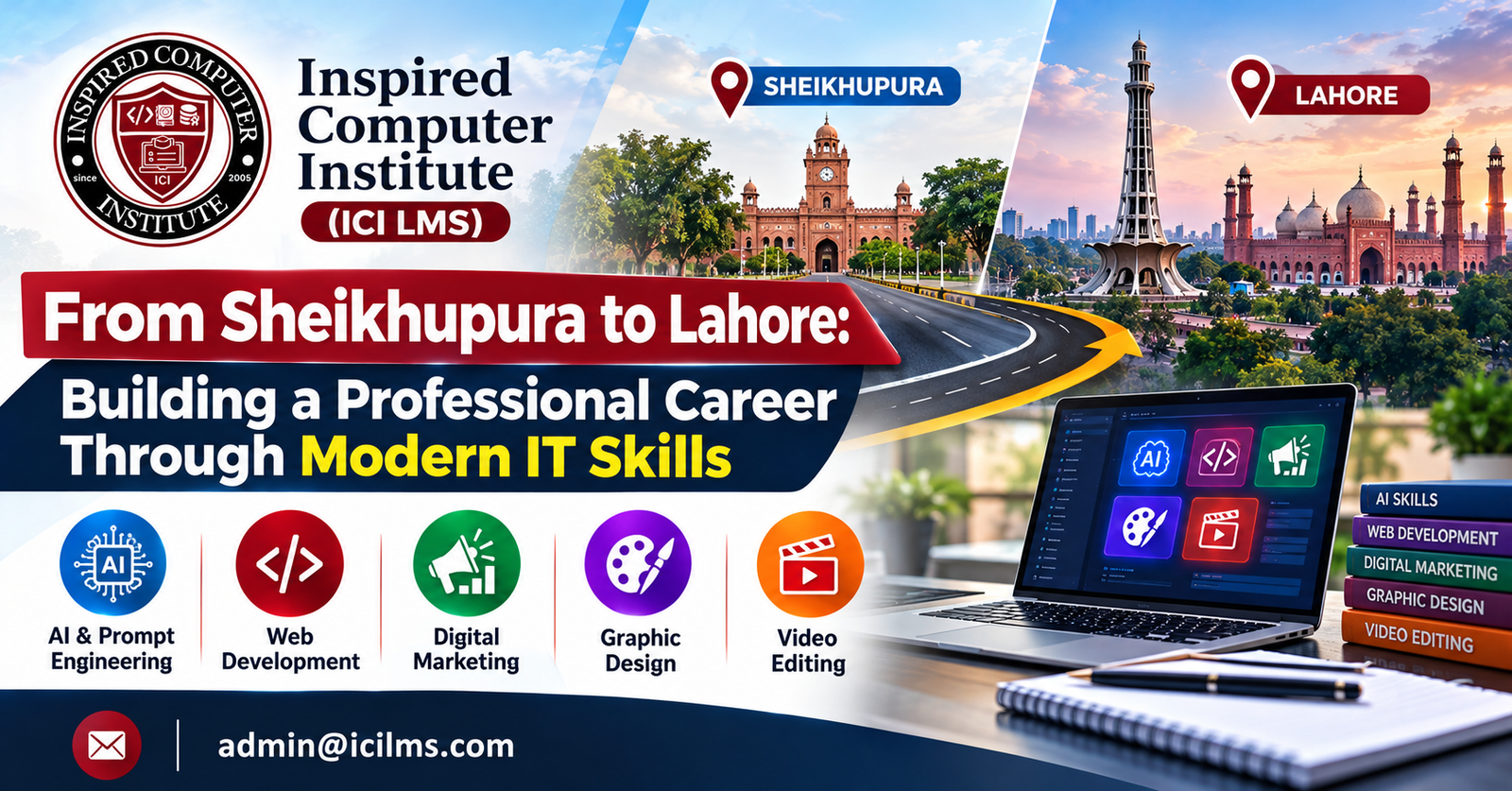
From Sheikhupura to Lahore: Building a Professional Career Through Modern IT Skills
Komal Shahzadi
- October 10, 2026
- Comment 0
From Sheikhupura to Lahore: Building a Professional Career Through Modern IT Skills
Introduction: Why Modern IT Skills Matter for Career Growth
Imagine living in Sheikhupura, finishing your education, and wondering what comes next. You might want a stable job, a respectable income, and the opportunity to support your family without having to leave your hometown permanently. Perhaps you have watched people build careers online, work with international clients, or join technology companies in Lahore, and you are wondering how to follow a similar path. The good news is that modern IT skills can open professional opportunities for people in Sheikhupura, Lahore, and other parts of Pakistan, even if they do not have access to expensive universities or influential professional connections. What matters is identifying a suitable career direction, learning consistently, and demonstrating your abilities through practical work.
The technology industry has changed the traditional idea of career development. In the past, many people believed that professional success required moving to a large city, obtaining a specific degree, and finding employment through personal contacts. Those routes still matter, but the internet has created additional possibilities. A student in Sheikhupura can learn programming, digital marketing, graphic design, data analytics, or other technology-related skills using online resources. With a reliable internet connection, a suitable computer, and a disciplined learning routine, that student can develop a portfolio, apply for jobs in Lahore, or explore remote work opportunities with businesses outside Pakistan.
This journey is not simply about learning how to use software. Building a professional IT career means solving problems, communicating clearly, adapting to change, and producing work that businesses value. A certificate might help you demonstrate your commitment, but employers and clients also want evidence that you can complete real projects. That is why practical training, professional communication, and continuous improvement are essential parts of the process.
For young people, graduates, career changers, and working professionals across Punjab, the path from Sheikhupura to Lahore can represent much more than a geographical journey. It can be a transition from uncertainty to direction, from theoretical knowledge to practical expertise, and from limited local opportunities to a wider professional world. By understanding the available career paths and making thoughtful decisions, you can begin building a future in technology one skill, one project, and one opportunity at a time.
Understanding the IT Career Landscape in Punjab
Punjab has a diverse economic landscape that includes manufacturing, retail, education, logistics, healthcare, agriculture, and services. Businesses in these sectors increasingly depend on digital tools to communicate with customers, manage information, promote products, and improve operations. This creates opportunities for people who understand how technology can solve everyday business problems. A manufacturing company may need inventory software, an educational institution may require a website, and a small retailer may want to sell products online. Each of these needs can create work for someone with the right technical and digital skills.
Lahore occupies an important position in this environment because it has a substantial concentration of businesses, educational institutions, software companies, startups, and digital service providers. That concentration can make it easier to discover internships, attend professional events, meet potential employers, and collaborate with experienced people. However, Lahore is not the only place where an IT career can begin. Someone living in Sheikhupura can develop valuable skills locally and travel to Lahore when necessary, while others may pursue online training and remote employment from home.
The important distinction is between access to opportunities and readiness to benefit from them. Living near a major technology hub does not automatically create professional success. A person who has no practical skills may struggle to secure employment even in Lahore, while a capable developer, designer, or digital marketer living in Sheikhupura may attract clients from different cities or countries. Geography influences the opportunities available, but skills, experience, communication, and persistence influence how effectively those opportunities can be used.
A sensible strategy is to understand both local and metropolitan markets. Start by examining the services businesses in your area need, then compare those needs with the opportunities available in Lahore. Look for recurring requirements such as websites, online advertising, business software, customer support, data reporting, and technical maintenance. This research can help you choose a skill that has practical applications rather than selecting a field simply because it is popular on social media.
Career Opportunities in Sheikhupura
Sheikhupura offers a useful starting point for people who want to enter the technology industry without immediately relocating. Its businesses, educational institutions, retailers, and industrial operations may need assistance with digital administration, websites, online promotion, software, and technical support. These needs do not necessarily require every professional to work for a large technology company. Smaller businesses can also benefit from skilled individuals who understand their operations and can introduce practical digital improvements.
Consider a local business that relies entirely on telephone calls and walk-in customers. A professional who can create a simple website, establish a business profile, improve local search visibility, and maintain social media pages could help that business become easier to discover online. Similarly, a student who learns spreadsheet automation and data analysis may help a small company organize sales records or produce more useful reports. These examples show how IT skills can create opportunities by connecting technical knowledge with real business needs.
People starting in Sheikhupura can also explore internships, junior administrative technology roles, computer support, basic web development, graphic design, and digital marketing. Availability will vary by employer, and not every opening will offer strong long-term prospects. Therefore, job seekers should evaluate whether a position provides practical experience, opportunities to learn, fair working conditions, and a realistic path toward greater responsibility.
Another option is to build experience through small projects. You might design promotional materials for a neighborhood shop, create a website for a community organization, or help an educational center improve its online presence. Agree on the project scope, payment, deadlines, and ownership of the finished work before starting. If you complete the project successfully, request permission to include it in your portfolio and ask for a testimonial describing the value you provided.
Starting locally can be particularly helpful because you can communicate directly with clients and understand their needs. You can learn how to ask questions, manage revisions, explain technical decisions, and deliver work on time. These professional habits transfer easily to larger companies and international projects. Rather than viewing Sheikhupura as a limitation, treat it as a practical environment in which to develop your first skills, build confidence, and gather evidence of your ability.
Why Lahore Is a Major Destination for IT Professionals
Lahore attracts technology students and professionals because it brings together software companies, startups, digital agencies, training providers, universities, and businesses that increasingly depend on digital services. This concentration can provide access to internships, entry-level positions, mentorship, and professional relationships that may be harder to find in smaller markets. It can also expose newcomers to different working environments, development processes, customer expectations, and technologies.
For someone moving from Sheikhupura, Lahore may offer opportunities to work alongside experienced developers, designers, marketers, analysts, and project managers. Observing how these professionals handle deadlines, collaborate with colleagues, review work, and communicate with clients can accelerate learning beyond what an individual might gain from studying alone. A junior developer, for example, may improve considerably by participating in code reviews and learning how an experienced team tests and maintains software.
However, relocating should be a financial and professional decision rather than an emotional reaction to the idea that every successful career must begin in a large city. Rent, transport, food, utilities, and other living expenses can consume a significant portion of an entry-level salary. Before accepting an offer, compare the actual compensation with the expected costs of living and commuting. Ask about working hours, training, probation periods, salary payment schedules, and the responsibilities attached to the position.
You should also investigate employers carefully. A company with a professional-looking website does not automatically provide a healthy workplace, and an attractive job title does not guarantee meaningful experience. Speak with current or former employees when possible, review the employment agreement, and avoid opportunities that demand suspicious upfront payments or extensive unpaid work without a clear and legitimate arrangement.
For many people, the strongest approach is to prepare in Sheikhupura and pursue targeted opportunities in Lahore. Learn the fundamentals, complete a few projects, improve your CV, and apply for positions that match your current abilities. Once you have a credible offer or a clear professional reason to relocate, you can make a more informed decision. Lahore can be a valuable stepping stone, but the ultimate objective is to develop skills and experience that continue to create opportunities wherever you live.
The Most Valuable Modern IT Skills to Learn
Choosing the right IT skill can feel like standing in a crowded marketplace where everyone claims to have the best product. One person recommends programming, another insists that digital marketing is the fastest route to earning money, and someone else promises that artificial intelligence will replace every traditional career. Listening to all these opinions can leave you confused before you have even started. The better approach is to evaluate each field according to your interests, learning style, available resources, and the kind of work you would enjoy doing consistently. The best IT skill is not necessarily the trendiest one; it is the skill you can develop to a professional standard and use to solve real problems.
Modern technology careers cover a wide range of activities. Developers create websites and applications, digital marketers help businesses attract customers, designers communicate ideas visually, analysts turn data into useful insights, and cloud specialists help organizations manage computing infrastructure. Artificial intelligence introduces additional possibilities across many of these fields. These professions have different entry requirements, learning curves, and long-term development paths, so comparing them carefully is more useful than trying to learn everything at once.
Your starting resources also matter. If you own a basic computer and have limited funds, you might begin with web development, graphic design, spreadsheet analysis, or SEO using accessible learning materials. If you have a stronger mathematical background, data analytics or software engineering may be attractive. If you enjoy communication, research, and understanding customer behavior, digital marketing could be a natural fit. None of these paths requires you to know everything on the first day, but each demands patience and regular practice.
Before investing in an expensive course, spend some time exploring the field through free tutorials and small exercises. Build a simple webpage, design a sample advertisement, analyze a spreadsheet, or create a basic keyword research report. Notice which activities hold your attention even when they become difficult. Then investigate actual job advertisements and freelance projects to understand which tools, technical abilities, and professional habits employers request.
The goal is to select one primary skill and develop enough supporting knowledge to work effectively. A web developer benefits from understanding basic SEO, for instance, while a digital marketer benefits from understanding website performance and analytics. This combination can make you more useful to employers without forcing you to become an expert in every discipline. Focus creates depth, and carefully selected complementary skills create flexibility.
Web Development and Software Engineering
Web development is a practical career option for people who enjoy building things, solving logical problems, and understanding how digital products work. Websites are used by educational institutions, online stores, service providers, manufacturers, and countless other organizations. These businesses need more than attractive homepages. They may require contact forms, product catalogs, booking systems, customer dashboards, payment integrations, or custom applications that make their daily operations easier.
A beginner can start by learning HTML, CSS, and JavaScript. HTML provides the structure of a webpage, CSS controls its presentation, and JavaScript introduces interactivity. Together, these technologies form a foundation for front-end development. Once you understand them, you can explore responsive design, accessibility, browser developer tools, version control with Git, and frameworks such as React. Back-end development introduces another set of concepts, including servers, databases, APIs, authentication, and application security.
The most effective way to learn programming is to build increasingly useful projects. Start with a personal portfolio website, then create a landing page for a fictional business. After that, build a product catalog, a simple task manager, or an application that stores information in a database. Each project should teach you something new and give you an opportunity to solve problems independently. Copying a tutorial can introduce a concept, but modifying the project and explaining how its parts work will help demonstrate genuine understanding.
Software engineering also involves professional habits that beginners sometimes overlook. Developers need to read documentation, test their work, troubleshoot errors, write maintainable code, and collaborate with other people. A program that works only on the developer’s computer is not necessarily ready for a client. Learning to use version control, write clear documentation, protect sensitive information, and check applications on different devices can distinguish a thoughtful developer from someone who only knows how to reproduce examples.
For someone living in Sheikhupura, web development can create several possible routes into employment. You might work with a local agency, apply to software companies in Lahore, develop websites for small businesses, or eventually pursue remote contracts. However, the market is competitive, and basic website-building knowledge alone may not be enough to stand out. Employers and clients increasingly look for people who can understand requirements, deliver reliable results, and maintain their work after launch.
A strong portfolio is therefore essential. Include three or four carefully developed projects rather than a large collection of unfinished exercises. Explain the problem each project addresses, describe the technologies you used, and show screenshots or live demonstrations where appropriate. If you can explain why you made particular technical decisions and how you resolved problems, you give potential employers a clearer picture of your capabilities.
Digital Marketing, SEO, and Content Strategy
Not everyone wants to spend the day writing code, and that is perfectly fine. Digital marketing offers another route into the technology sector for people who enjoy communication, research, creativity, and understanding how customers make decisions. Businesses need to attract audiences online, communicate their value, and turn attention into meaningful actions such as inquiries, bookings, or purchases. Digital marketers help them achieve these goals through search engines, websites, social media, email, and paid advertising.
Search engine optimization (SEO) is particularly useful for people interested in combining research with content creation and technical problem-solving. SEO involves improving a website’s ability to appear for relevant search queries. This work can include keyword research, search intent analysis, content planning, internal linking, technical checks, page experience improvements, and performance measurement. An SEO professional must understand that ranking for a keyword is not the ultimate business objective. The real purpose is to help the right audience discover useful information and take relevant action.
Consider a training institute in Sheikhupura that offers computer courses but receives few inquiries through its website. An SEO specialist might research phrases people use when looking for computer training, examine competing pages, improve the institute’s course descriptions, organize its website structure, and make contact information easier to find. The specialist could also track impressions, clicks, visitor behavior, and inquiries to determine whether the changes are helping. This example illustrates how SEO combines technical understanding, writing, audience research, and measurement.
Content marketing expands this work by creating useful material that addresses audience needs. A technology company may publish tutorials, comparison guides, case studies, or answers to frequently asked questions. A content strategist decides which subjects deserve attention, what information readers need, and how each page supports the organization’s broader goals. Strong content is specific, trustworthy, easy to navigate, and genuinely useful rather than simply repeating keywords.
Digital marketers can also learn Google Analytics, Google Search Console, advertising platforms, email marketing tools, and basic conversion optimization. These tools help professionals evaluate performance and identify areas for improvement. Learning to interpret results is especially important because businesses increasingly want evidence that marketing activities contribute to measurable outcomes.
For beginners, a sensible portfolio project might involve creating a complete SEO plan for a local business. Research relevant keywords, examine the current website, propose improvements, prepare a content calendar, and explain how results should be measured. Clearly label recommendations that have not yet been implemented, and never invent traffic or ranking improvements. If you obtain permission to work with a real business, document the starting situation and track actual results over time.
SEO and digital marketing can be suitable for people in Sheikhupura who want to serve local clients or apply for positions at Lahore-based agencies. Remote work is another possibility, although success requires strong writing, analytical thinking, and consistent communication. Search platforms and marketing tools change frequently, so professionals must keep learning. Those who combine sound fundamentals with honest reporting and a focus on business outcomes can build a career that grows alongside the industry.
Graphic Design, UI/UX, and Video Editing
Visual communication has become central to how businesses present themselves online. From social media advertisements and product packaging to websites and mobile applications, organizations need visual material that attracts attention and communicates information clearly. This creates opportunities for people who enjoy design, storytelling, and creative problem-solving. However, professional design is more than decorating a page or adding attractive colors. It involves understanding the audience, choosing the right visual hierarchy, and making information easy to understand.
Graphic designers create materials such as brand identities, brochures, social media graphics, advertising creatives, and presentation layouts. Beginners can explore tools such as Canva and Adobe Photoshop or Illustrator, depending on their goals and resources. Yet software knowledge alone will not make someone a strong designer. You also need to learn typography, contrast, alignment, spacing, composition, color relationships, and consistency. These principles help explain why some designs look professional while others feel confusing, even when both use similar software.
UI/UX design focuses more directly on digital products. User interface design concerns the visible elements people interact with, while user experience design examines how effectively and comfortably people complete tasks. A designer might map a customer’s journey through an online store, develop wireframes, create interactive prototypes, and test whether users can find information easily. Tools such as Figma can support this process, but the real value comes from understanding user needs and making informed design decisions.
Video editing provides another creative path. Businesses use short videos to explain products, advertise services, educate customers, and communicate on social platforms. Editors may work with footage, audio, subtitles, transitions, color correction, pacing, and motion graphics. Learning a professional editing application is useful, but understanding storytelling is just as important. A technically polished video can still fail if its message is unclear or its pacing does not match the audience.
People in Sheikhupura can begin by developing sample projects for imaginary businesses or by collaborating with local organizations that need visual materials. A portfolio might include a small brand identity, a social media campaign, a mobile application prototype, and a short promotional video. Each example should demonstrate a different skill while maintaining a consistent level of quality. If you work with a real client, obtain permission before publishing confidential material or using the client’s brand in your portfolio.
Creative professionals also need to understand project management. Clients may provide incomplete briefs, request revisions, or change priorities after work has started. Asking clear questions, agreeing on deliverables, setting revision limits, and communicating progress can prevent misunderstandings. Keep original files organized, use suitable file formats, and maintain backups so that projects can be updated later.
The strongest designers combine creativity with business awareness. They can explain why a design choice suits a particular audience, how a layout supports a goal, and what problem a visual solution addresses. As you progress, consider specializing in an area such as e-commerce graphics, product design, brand identity, or short-form video. A clear specialty can help potential clients understand your services and recognize the value you bring.
Data Analytics, Artificial Intelligence, and Cloud Computing
Data analytics, artificial intelligence, and cloud computing are important areas of modern technology, but they are not identical career paths. Data analysts help organizations understand information, AI practitioners build or apply systems that perform tasks such as prediction and language processing, and cloud specialists manage computing resources and services. Each field has different entry requirements, so beginners should understand the fundamentals before investing heavily in advanced training.
Data analytics is often a practical starting point for people who enjoy working with numbers and finding patterns. You can begin with spreadsheets, including formulas, sorting, filtering, pivot tables, and charts. Next, learn SQL to retrieve information from databases and explore a visualization tool such as Power BI or Tableau. Python can become useful when you need to automate repetitive work, clean larger datasets, or perform more advanced analysis. A portfolio project might examine sales trends, customer retention, inventory movement, or public economic data.
Artificial intelligence introduces opportunities to automate tasks, summarize information, analyze text, generate content, and support decision-making. Professionals can begin by learning how AI tools work, where they are useful, and where they may fail. More advanced work may require Python, statistics, machine learning concepts, data preparation, model evaluation, and an understanding of responsible data use. Simply knowing how to write prompts is not the same as being qualified to develop AI systems, although effective use of AI tools can strengthen many existing professions.
Cloud computing allows organizations to use computing resources and managed services without operating every part of their infrastructure themselves. Beginners can study networking, operating systems, security basics, virtualization, and cloud concepts before exploring platforms such as Amazon Web Services, Microsoft Azure, or Google Cloud. Entry-level cloud learning should emphasize hands-on practice, cost management, identity permissions, and security. A cloud certification may help demonstrate structured learning, but it does not replace practical knowledge.
These fields can appear intimidating because their advanced applications involve considerable technical depth. The solution is to break the learning process into manageable stages. Someone interested in data science could first learn spreadsheets and SQL, then basic statistics, and later Python and machine learning. Someone interested in cloud engineering could begin with networking and Linux before learning deployment and infrastructure management. A structured progression reduces confusion and makes it easier to identify gaps in your knowledge.
For career seekers in Sheikhupura and Lahore, these skills may be valuable across industries, including manufacturing, finance, logistics, retail, education, and technology services. A factory might use analytics to monitor production, a retailer might forecast demand, and a software company might use cloud infrastructure to run an application. These are examples of potential applications, not guarantees of available local vacancies.
Before choosing one of these paths, review real job advertisements and note the skills employers repeatedly request. Build small projects using publicly available or appropriately authorized data, document your methods, and explain your findings in plain language. When using AI tools, verify important claims and avoid exposing confidential information. The professionals most likely to remain valuable are those who combine technical knowledge with sound judgment, practical problem-solving, and the ability to explain their work clearly.
How to Choose the Right IT Career Path
Selecting an IT career becomes easier when you stop asking which profession is universally best and start asking which one fits your circumstances. A student with a strong interest in mathematics may enjoy programming or analytics, while someone who likes writing and research may prefer SEO or content strategy. A visually creative person might thrive in graphic design or UI/UX, whereas someone who enjoys troubleshooting computers and networks could explore IT support or cloud infrastructure. Your interests provide a starting point, but you should also consider the practical realities of learning and employment.
Begin by evaluating your current situation. Do you have a laptop or desktop computer, or are you relying mainly on a smartphone? How many hours can you study each week? Are you comfortable reading technical material in English? Can you afford a paid course, or do you need to begin with free resources? These questions do not determine your potential, but they help you build a plan you can realistically maintain.
Next, compare possible career paths using consistent criteria. Look at the skills required, the cost of learning, the availability of beginner-friendly projects, the types of jobs advertised, and the amount of time you can commit. Avoid relying entirely on income screenshots or success stories published by training providers. A person earning well from freelancing may have years of experience, a strong portfolio, repeat clients, and specialist knowledge that are not visible in a short social media post.
A useful approach is to conduct a two-week career experiment. Spend the first few days learning the basics of one field, then complete a small practical task. Repeat the process with another field if you are uncertain. At the end, assess which activity you enjoyed, which concepts you understood most easily, and which projects you would be willing to continue developing. The purpose is not to become an expert in fourteen days; it is to make a more informed choice before committing months to a learning path.
Once you choose, give yourself enough time to build real competence. Constantly switching from programming to SEO, then design, then AI can create the illusion of progress without producing a marketable skill. It is fine to explore different fields initially, but after selecting a direction, establish a primary learning plan and complete projects that demonstrate measurable progress.
You can use the following comparison as a starting point:
| IT career path | Useful starting skills | Suitable for people who enjoy |
|---|---|---|
| Web development | HTML, CSS, JavaScript | Building websites and solving logical problems |
| SEO and digital marketing | Keyword research, content, analytics | Research, communication, and business growth |
| Graphic design | Layout, typography, design software | Visual creativity and communication |
| UI/UX design | Wireframing, prototyping, user research | Understanding users and improving digital products |
| Data analytics | Spreadsheets, SQL, visualization | Numbers, patterns, and evidence-based decisions |
| AI and machine learning | Python, mathematics, statistics | Technical experimentation and analytical work |
| Cloud computing | Networking, Linux, security fundamentals | Infrastructure, systems, and troubleshooting |
Remember that this table is a guide, not a ranking of guaranteed earnings or job availability. Salaries and hiring requirements vary by experience, employer, specialization, and economic conditions. A carefully selected path supported by practical work is usually more useful than chasing whichever skill appears most profitable this month.
Education, Certifications, and Practical Training
Formal education can provide a valuable foundation for an IT career, particularly in fields that require a deeper understanding of mathematics, algorithms, computer systems, or software engineering principles. Degrees and diplomas may also help candidates qualify for employers that have specific educational requirements. However, a degree is not the only way to begin learning technology, and a person without a computer science background can still develop useful professional skills through structured study and practical projects.
If you are completing your secondary education or considering university, research relevant programs in computer science, software engineering, information technology, data science, and related disciplines. Compare the curriculum, tuition fees, admission requirements, faculty, facilities, and internship opportunities rather than selecting an institution based on reputation alone. For learners who need to remain in Sheikhupura, commuting to Lahore may be an option, but you should calculate the cost and time involved before making a commitment.
Short courses and certifications can provide a more focused route into particular skills. A web development course may introduce front-end technologies, while a digital marketing program may cover SEO, advertising, and analytics. Cloud providers also offer structured certification pathways, and software companies publish documentation and learning materials that can support independent study. Choose courses that include exercises, assignments, feedback, and practical projects rather than relying exclusively on prerecorded lectures.
Free learning resources can be especially valuable when your budget is limited. Official documentation, educational videos, coding exercises, public datasets, and open-source projects allow you to practice without committing to expensive training packages. You can also look for training initiatives from recognized educational institutions, employers, or public programs, checking their current eligibility requirements and availability before enrolling.
The most important distinction is between consuming educational content and developing usable skills. Watching a tutorial can make a concept feel familiar, but familiarity is not the same as being able to apply it independently. After each lesson, close the tutorial and attempt a related task on your own. If you become stuck, investigate the problem, consult documentation, and try again. This process develops the troubleshooting ability that many professional roles require.
Create a weekly study schedule that fits around your existing responsibilities. Even one or two focused hours each day can add up to meaningful progress when maintained consistently. Divide your time between learning new concepts, practicing them, reviewing earlier work, and completing projects. Keep a record of what you have learned and which areas remain difficult, because visible progress can help you stay motivated during challenging periods.
Finally, treat certifications as supporting evidence rather than proof of complete professional readiness. A certificate may help demonstrate that you studied a subject or passed an assessment, but employers may still ask you to solve problems, discuss projects, or complete technical tests. Your strongest preparation combines structured education, practical experience, and the ability to explain your work confidently.
Building a Strong Portfolio and Professional Network
Learning a modern IT skill is an important achievement, but how will a potential employer know what you can actually do? This is where a professional portfolio becomes valuable. A portfolio gives employers and clients concrete evidence of your abilities instead of asking them to rely entirely on your CV or educational qualifications. Whether you are applying for a junior developer position in Lahore or searching for your first freelance client from Sheikhupura, a well-organized portfolio can help you demonstrate your readiness for professional work.
Start by selecting projects that reflect the career path you have chosen. If you are learning web development, create a responsive website, a business landing page, and a small application that solves a practical problem. If you specialize in SEO, prepare a keyword research report, a content strategy, and a technical website audit. A graphic designer might showcase a brand identity, advertising materials, and social media creatives, while a data analyst could present dashboards supported by clearly explained findings.
Quality matters more than quantity. Three complete projects that demonstrate your ability to identify a problem, plan a solution, and deliver a polished result can be more persuasive than fifteen unfinished exercises. Each portfolio entry should explain the project’s purpose, your responsibilities, the tools you used, the challenges you encountered, and the decisions you made. If you have measurable results, include them accurately and explain how they were obtained. Never invent client testimonials, business outcomes, or employment experience to make your portfolio look impressive.
You can host a developer portfolio through a website or an appropriate code repository. Designers can use an online portfolio platform, while digital marketers and analysts can present case studies as web pages or downloadable reports. Keep your contact information current and make sure your links work. A recruiter should not need to solve a mystery to find your best work.
Professional networking is equally important. You do not need to know influential people before you begin building relationships. Attend relevant events in Lahore when practical, participate in technology communities, connect with professionals on LinkedIn, and contribute thoughtfully to discussions about your chosen field. Ask specific questions, share useful work, and show genuine interest in learning from experienced people rather than immediately asking strangers for jobs.
You can also build relationships within Sheikhupura. Local business owners, teachers, graduates, and entrepreneurs may know organizations that need websites, digital marketing, technical support, or other services. Offer practical solutions, communicate professionally, and follow through on commitments. A small project completed reliably can lead to a referral, a repeat client, or a useful recommendation.
Most importantly, remember that networking is a long-term activity, not a shortcut around competence. People are more likely to recommend someone who communicates clearly, respects deadlines, handles feedback constructively, and delivers dependable work. Your portfolio demonstrates what you can do, while your professional relationships help more people discover it.
Freelancing, Remote Work, and International Clients
Freelancing has created another possible route for people who want to develop an IT career without moving immediately to Lahore. Instead of joining one employer, freelancers provide services to different clients under agreed project terms. Depending on their skills, they might develop websites, design graphics, manage advertising campaigns, edit videos, analyze data, or provide technical support. Remote employment offers a related but different arrangement: a person works for an organization from another location, often under a regular employment agreement.
For someone living in Sheikhupura, these arrangements can reduce the need for daily commuting or relocation. They may also create access to clients outside the local market. However, remote work is not automatically easier than office employment. Freelancers must find clients, negotiate prices, manage projects, handle payments, maintain records, and deal with periods when work is limited. Remote employees also need reliable communication, self-management, and the ability to collaborate effectively across distance.
The first step is to choose a service that solves a clear problem. Instead of advertising yourself as someone who can do everything related to technology, describe a specific offer. A beginner web developer might build responsive websites for small businesses. An SEO specialist might provide keyword research and on-page optimization, while a video editor might focus on short promotional videos for online businesses. Specific services make it easier for potential clients to understand what you provide.
Next, create a professional profile and a portfolio that supports your claims. Platforms such as Upwork and Fiverr can help freelancers discover potential projects, but competition can be substantial, and success is not guaranteed. You can also approach businesses directly through legitimate professional channels or find work through referrals. Avoid sending identical, vague proposals to dozens of prospects. Instead, demonstrate that you understand the client’s problem and explain how your skills could help address it.
Your first projects may be relatively small, but they should still be managed professionally. Agree on the scope, timeline, price, payment terms, revision policy, and ownership of the deliverables before beginning. Use written agreements appropriate to the project, protect account credentials, and keep records of communications and payments. Be cautious of clients who request substantial unpaid work, demand upfront fees to release a job, or pressure you into sharing sensitive information.
Financial planning is particularly important for freelancers. Income can fluctuate, and the amount a client pays is not the same as take-home earnings. Account for software subscriptions, internet expenses, platform fees, taxes, payment processing, equipment, and time spent finding work. Check current Pakistani tax and payment requirements through reliable official sources or a qualified adviser, especially if you receive income from abroad.
For international work, communication skills are essential. You do not need a particular accent, but you should be able to understand project requirements, write clear messages, ask relevant questions, and report progress honestly. If a deadline becomes difficult to meet, tell the client early rather than disappearing. Reliability helps build repeat business, and repeat business can be more sustainable than constantly searching for new customers.
A practical approach is to develop your primary skill while gradually learning how to sell and manage your services. Begin with small, manageable projects, collect genuine feedback, improve your workflow, and increase your rates when your quality and experience justify it. Freelancing works best as a professional business built on expertise and trust, not as a promise of instant online income.
Finding IT Jobs in Lahore and Sheikhupura
Searching for an IT job requires more than uploading your CV and waiting for an employer to respond. You need to identify suitable roles, understand what employers expect, present your skills clearly, and prepare to demonstrate your abilities during the selection process. A targeted approach can save time and help you discover opportunities that match your current experience.
Start by exploring established job platforms, company career pages, professional networks, and reputable recruitment agencies. LinkedIn, Rozee.pk, Mustakbil, and Indeed may provide useful starting points for finding vacancies in Pakistan, although available listings and platform coverage change over time. Search for specific job titles rather than relying only on the broad term “IT jobs.” Depending on your skills, relevant searches might include junior web developer, SEO executive, graphic designer, IT support technician, data analyst intern, or software engineering trainee.
When evaluating a vacancy, read the responsibilities carefully. A job title can mean different things at different companies, and some entry-level positions combine several functions. Identify the required technical skills, educational qualifications, experience level, location, and working arrangements. If an advertisement requests years of experience you do not have, consider whether it is still realistic to apply, but prioritize positions that genuinely match your current capabilities.
Your CV should be concise, accurate, and tailored to the role. Include your relevant education, technical skills, projects, certifications, and any practical experience you can substantiate. Describe achievements through specific actions rather than vague statements. For example, explain that you built a responsive portfolio website using HTML, CSS, and JavaScript instead of simply claiming that you are an expert in web development.
Portfolio links should be easy to find. If you have no formal employment experience, personal projects, supervised training assignments, and legitimate volunteer work can still demonstrate useful skills. Make it clear which projects were independent exercises and which were completed for actual clients. Employers generally benefit more from an honest account of your experience than from inflated claims that may fall apart during an interview.
Preparing for interviews involves both technical and interpersonal practice. Developers may need to explain their code or solve programming problems. SEO candidates might be asked to review a website, interpret search performance, or propose a content strategy. Designers may need to discuss their portfolio and justify design decisions, while data analysts could be asked to interpret a chart or explain how they would clean a dataset. Research the employer and practice explaining your projects in clear, straightforward language.
For candidates traveling from Sheikhupura to Lahore, logistics deserve attention. Ask whether the role is fully on-site, hybrid, or remote, and calculate commuting costs before accepting an offer. If interviews require travel, try to coordinate appointments efficiently and keep copies of your documents. Before resigning from an existing job or relocating, verify the offer and clarify the terms of employment.
Be cautious about recruitment scams. Legitimate employers may charge fees for optional services in some contexts, but a supposed job offer that requires suspicious payments, sensitive banking credentials, or unexplained deposits deserves careful scrutiny. Verify the company through independent channels and avoid sending money simply because someone promises guaranteed employment.
The job search can take time, particularly when you are entering a competitive field. Track applications, note which CV version you submitted, follow up politely when appropriate, and review feedback from interviews. If you receive few responses, improve your application materials and target roles more carefully. If you reach interviews but do not receive offers, practice the areas where you struggled. Each application can provide information that helps you improve your next attempt.
Overcoming Challenges and Planning Long-Term Career Growth
Every professional career includes difficult periods, and IT is no exception. Beginners often struggle with confusing technical concepts, inconsistent motivation, limited budgets, unreliable internet access, or uncertainty about which learning resource to trust. People in smaller cities may also find that certain internships or specialized jobs require travel to Lahore. These challenges are real, but they become easier to manage when you treat them as planning problems rather than evidence that you cannot succeed.
One common mistake is expecting immediate results. You might complete a course and discover that employers still want practical experience. You might publish a freelance profile and receive no inquiries for several weeks. You might spend hours debugging a program that refuses to work. None of these experiences automatically means you chose the wrong field. Professional ability develops through repeated attempts, feedback, and increasingly difficult projects.
Create realistic milestones rather than relying on a vague goal such as becoming successful in IT. Your first milestone might be completing the fundamentals of a chosen skill. Your second might involve building a small project without following a tutorial step by step. Your third could be publishing a portfolio, receiving feedback from an experienced person, or applying for a suitable internship. Once you achieve these milestones, set new ones based on the gaps you discover.
Financial discipline also supports long-term progress. Avoid borrowing large amounts for expensive training without understanding the course quality, likely costs, and alternatives. Compare several providers, examine the curriculum, ask about practical assignments, and verify any claims about job placement. Where possible, use free resources to test your interest before paying for specialized instruction.
English communication can influence your professional opportunities, particularly when working with international clients or multinational companies. If English is not your strongest language, practice reading technical documentation, writing short project updates, and explaining your work aloud. You can improve gradually without waiting until your English becomes perfect. Clear communication, honest expectations, and a willingness to ask questions are often more useful than trying to sound impressive.
Long-term career growth requires continuous learning. Technology changes, but the fundamentals of problem-solving, security, communication, and understanding user needs remain valuable. Review developments in your chosen field, study new tools when they solve relevant problems, and avoid adopting every trend simply because it receives attention online. A web developer may eventually specialize in application security or cloud deployment, while a digital marketer may deepen their knowledge of analytics or conversion optimization.
You should also learn to evaluate your own progress. Every few months, review your projects, feedback, job applications, income where relevant, and remaining skill gaps. Ask whether your current learning plan is moving you toward your goals. If the evidence suggests that you need to change direction, make an informed adjustment rather than switching impulsively.
Finally, remember that career development is not limited to technical achievement. Professional integrity, respectful communication, teamwork, and dependable delivery influence how others experience working with you. A person who consistently solves problems and treats people well can build valuable professional relationships over time.
The journey from Sheikhupura to Lahore does not need to happen in a single dramatic move. It can unfold through small, deliberate steps: learning a skill at home, completing a practical project, gaining feedback, securing an internship, developing professional connections, and eventually pursuing more advanced responsibilities. Your long-term advantage comes from combining technical ability with the discipline to keep improving.
Conclusion: Turn Modern IT Skills Into a Professional Future
Building a professional career through modern IT skills is a realistic goal for people in Sheikhupura who are willing to learn, practice, and adapt. Lahore can offer access to a broader range of employers, training opportunities, and professional networks, but you do not necessarily have to relocate before beginning your journey. You can start with the resources available to you, develop a clear area of expertise, and build evidence of your abilities through practical projects.
The first priority is choosing a suitable career path. Web development, software engineering, SEO, digital marketing, graphic design, UI/UX, data analytics, artificial intelligence, and cloud computing all offer different possibilities. Rather than chasing every trend, select one field that matches your interests and investigate what employers and clients actually need. Build a strong foundation before moving into advanced topics, and use projects to turn theoretical knowledge into practical competence.
Your education and certifications can support this process, but they should work alongside hands-on experience. A well-organized portfolio, a credible CV, strong communication skills, and genuine professional relationships can help you demonstrate your readiness for employment. As you gain experience, you can pursue opportunities with local businesses, Lahore-based companies, remote employers, or freelance clients, depending on your circumstances.
There will be setbacks. You may need to revise your CV, rebuild a project, learn a difficult concept, or apply for several positions before receiving an offer. Treat these experiences as opportunities to improve your approach. Avoid unrealistic income promises, verify job offers carefully, and make financial decisions based on evidence rather than excitement.
Most importantly, start with a manageable action. Choose a skill, identify a trustworthy learning resource, set aside regular study time, and begin your first project. You do not need to master the entire technology industry before taking the next step.
From Sheikhupura to Lahore, your professional future can grow through consistent learning, practical experience, and a willingness to solve meaningful problems. The journey may take time, but every completed project, improved skill, and professional connection can bring you closer to a sustainable career.
Frequently Asked Questions (20 FAQs)
1. How can I start an IT career in Sheikhupura?
Start by identifying one IT skill that matches your interests and career goals. Explore web development, digital marketing, graphic design, data analytics, or IT support through reputable free learning resources and beginner courses. Practice consistently, complete practical projects, and create a portfolio that demonstrates what you can do. Once you have foundational skills, investigate local businesses, internships, Lahore-based vacancies, and legitimate remote opportunities.
2. Is Lahore a good city for IT jobs in Pakistan?
Lahore is an important technology and business center in Pakistan, with software companies, startups, digital agencies, educational institutions, and organizations that use technology in their operations. This can provide opportunities for internships, entry-level employment, and professional networking. However, the number of suitable vacancies varies by specialization and experience. Research current listings and compare expected salaries with commuting or living expenses before deciding to relocate.
3. Which IT skill is best for beginners in Sheikhupura?
There is no single best skill for everyone. Web development may suit people who enjoy logical problem-solving, while SEO and digital marketing may appeal to those who prefer research and communication. Graphic design can suit visually creative learners, and spreadsheet-based data analytics may be a useful starting point for people who enjoy working with information. Explore a few fields briefly, then concentrate on the one you can practice consistently.
4. Can I get an IT job without a university degree?
Yes, some IT employers and clients consider candidates without a university degree, particularly when they can demonstrate relevant skills and practical experience. However, other employers require specific qualifications, and certain technical careers benefit substantially from formal education. Check the requirements for your target roles and develop a strong portfolio, CV, and practical foundation. A degree is neither a guarantee of employment nor irrelevant to every position.
5. How long does it take to learn modern IT skills?
The learning timeline depends on the field, your previous experience, your study schedule, and the level of competence you want to achieve. You may learn basic concepts in a few weeks, but becoming ready for professional work generally requires sustained practice and project experience. Advanced specializations can take considerably longer. Focus on measurable progress, such as completing projects independently, rather than expecting a particular number of months to guarantee a job.
6. Can I learn IT skills online from Sheikhupura?
Yes. Online courses, official documentation, video tutorials, coding platforms, and professional communities can help you learn from Sheikhupura. You will need a suitable device, reliable internet access, and a structured learning routine. Some fields can be explored on a smartphone, but a laptop or desktop computer is more practical for programming, data analysis, design, and many professional workflows.
7. What is the average salary of an IT professional in Lahore?
IT salaries in Lahore vary considerably by job title, experience, employer, technical specialization, and the responsibilities of the position. Junior employees, experienced specialists, technical managers, and senior engineers can earn very different amounts. Rather than relying on a single average, review recent job advertisements, salary surveys, and offers for your specific role. Compare the full compensation package and expected living costs before accepting a position.
8. Is freelancing a good career option for people in Sheikhupura?
Freelancing can be a useful option because it allows qualified professionals to work with clients outside their immediate location. However, freelancers must also manage client acquisition, pricing, deadlines, payments, and fluctuating income. Begin with a clearly defined service, build a portfolio, and learn professional project management. Treat freelancing as a business that requires consistent effort rather than a guaranteed source of quick money.
9. Which programming language should I learn first?
For web development, HTML and CSS are useful starting points, followed by JavaScript. If your goal is data analysis or an introduction to machine learning, Python may be a suitable first programming language. Other paths may require SQL, Java, C#, or different technologies. Choose a language according to your target career rather than attempting to learn several languages simultaneously without building practical projects.
10. Is digital marketing a good career in Pakistan?
Digital marketing can be a useful career option for people who enjoy research, communication, content creation, and understanding customer behavior. Businesses may need help with SEO, paid advertising, social media, email campaigns, and analytics. Opportunities vary by employer and experience level, so learn the fundamentals and develop a portfolio using realistic projects. Strong analytical skills, ethical practices, and an understanding of business objectives can improve your professional prospects.
11. Do I need expensive equipment to learn IT skills?
Not necessarily. A basic computer can support many beginner activities, including web development, SEO, spreadsheet analysis, and entry-level graphic design. More demanding work, such as advanced video editing or certain machine learning projects, may require better hardware. Before buying expensive equipment, identify the actual requirements of your chosen field and use accessible tools or cloud resources where appropriate.
12. Are IT certifications enough to get a job?
Certifications can demonstrate that you have studied a subject or passed a recognized assessment, but they do not guarantee employment. Employers may also assess your practical skills, communication, problem-solving ability, and relevant experience. Combine certifications with a portfolio, realistic projects, and interview preparation. Choose credentials that are relevant to your intended role instead of collecting certificates without a clear career objective.
13. How can students build an IT portfolio without clients?
Students can build portfolio projects independently using fictional business scenarios, personal ideas, public datasets, and practice assignments. A developer might create a sample e-commerce website, while an SEO student could prepare a keyword research report for an imaginary business. Clearly identify these as practice projects rather than paid client work. Focus on demonstrating your process, technical decisions, and ability to complete a project.
14. What are the best websites to find IT jobs in Lahore?
LinkedIn, Rozee.pk, Mustakbil, Indeed, and official company career pages are useful places to investigate vacancies in Pakistan. You can also explore reputable recruitment agencies and professional communities relevant to your specialization. Search by specific job titles, review requirements carefully, and verify employers before sharing sensitive information. Platform listings change frequently, so no single website should be your only source.
15. Can I work remotely for an international company from Sheikhupura?
Yes, some international employers hire remote workers who live in Pakistan, provided they can meet the company’s hiring, technical, legal, and time-zone requirements. Availability depends on the role and employer. Build relevant experience, improve written communication, and prepare a professional portfolio. Before accepting a position, confirm the employment arrangement, payment method, contractual obligations, and any applicable tax requirements.
16. Is artificial intelligence a good career choice for beginners?
Artificial intelligence can be a promising field, but the right entry point depends on your background and goals. Beginners may start by learning Python, mathematics, statistics, data handling, and basic machine learning concepts. People in other professions can also learn to use AI tools responsibly to improve their existing work. Avoid assuming that a short prompting course alone qualifies you for advanced AI engineering roles.
17. How can I improve my English for an IT career?
Practice reading technical documentation, writing professional emails, explaining projects, and participating in relevant discussions. You can begin with short daily exercises and gradually move toward mock interviews and project presentations. Focus on clarity, grammar, useful technical vocabulary, and the ability to ask questions. You do not need a particular accent to communicate professionally with colleagues or clients.
18. How can I avoid fake IT training institutes and job scams?
Research the institution or employer independently, examine the course curriculum or written job offer, and look for credible reviews and verifiable contact information. Be suspicious of guaranteed jobs, unrealistic income promises, unexplained recruitment charges, or demands for sensitive financial credentials. Ask specific questions about training, assessments, fees, and employment terms. If an opportunity seems questionable, verify it through independent channels before paying or sharing personal information.
19. What should I include in my IT CV?
Include your contact information, relevant education, technical skills, certifications, practical projects, and work experience you can substantiate. Tailor the CV to the vacancy and describe your responsibilities and achievements clearly. Add portfolio links or relevant repositories when appropriate. If you are a beginner, highlight projects that demonstrate your abilities rather than filling the document with unrelated information or exaggerated claims.
20. What is the best way to build a successful IT career from Sheikhupura to Lahore?
Begin by selecting a clear career direction and learning its core skills through structured study and consistent practice. Develop a portfolio, seek feedback, improve communication, and apply for relevant internships or entry-level opportunities. Compare Lahore-based employment with local and remote alternatives, taking financial and personal circumstances into account. Continue building your expertise as you gain experience, and treat each project and professional relationship as an opportunity to improve.