Currently Empty: ₨ 0
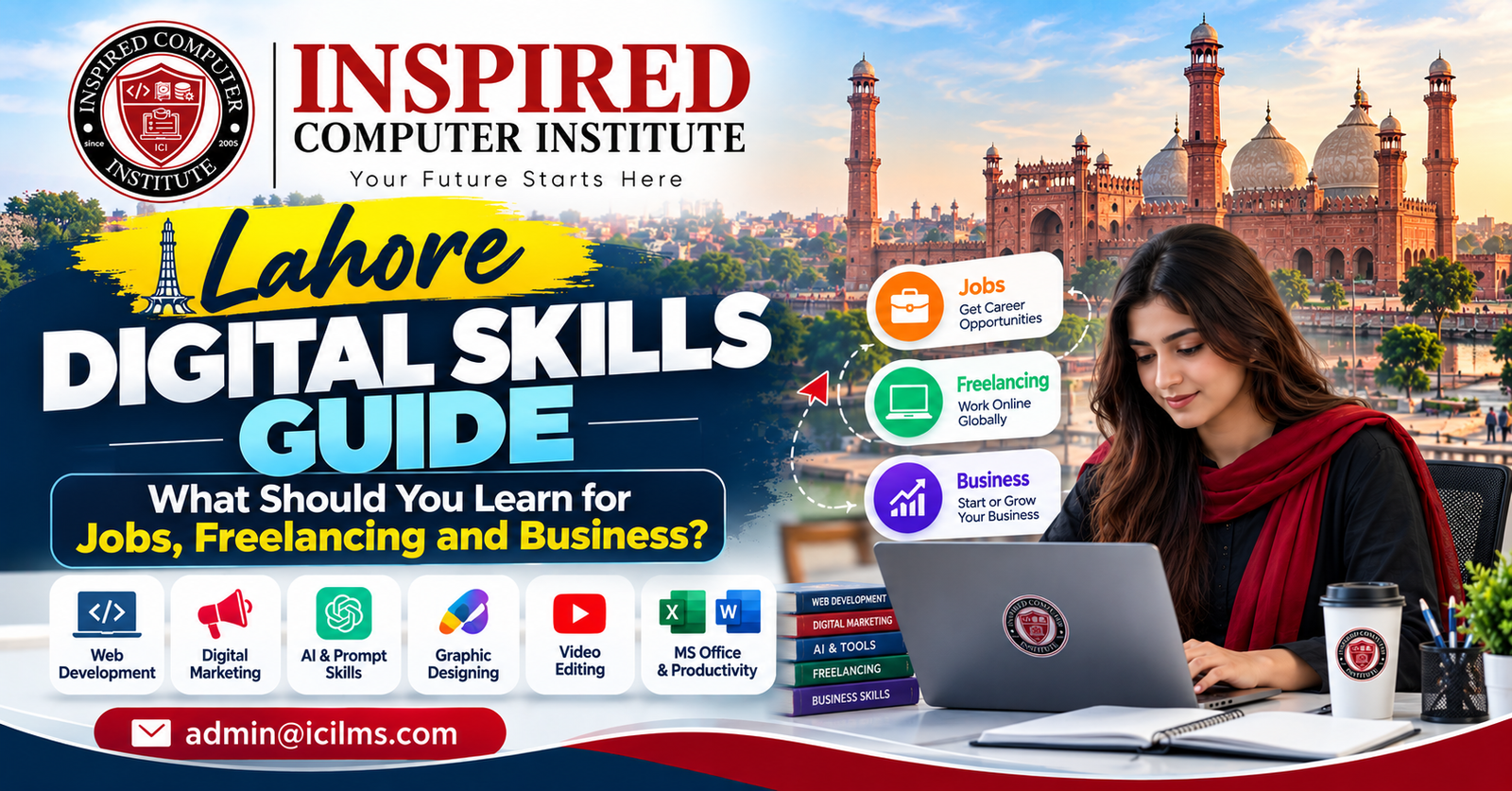
Lahore Digital Skills Guide: What Should You Learn for Jobs, Freelancing and Business?
Komal Shahzadi
- October 5, 2026
- Comment 0
Lahore Digital Skills Guide: What Should You Learn for Jobs, Freelancing and Business?
Choosing a digital skill in Lahore can feel strangely similar to standing in the middle of Hafeez Center with twenty shopkeepers telling you that their product is exactly what you need. One person recommends digital marketing, another says web development is the only sensible choice, somebody on YouTube insists that AI has made everything else obsolete, and a friend may be convinced that Amazon, Shopify, graphic design, or video editing is the shortcut to earning in dollars. The result? Many beginners spend months jumping from course to course without becoming employable in any one field.
There is a better way to approach the decision.
The best digital skill is not necessarily the skill receiving the most attention on social media. It is the one that sits at the intersection of market demand, your natural strengths, your preferred way of working, and a realistic path to earning. A university student looking for a remote job has different needs from a shop owner in Lahore who wants more customers. A freelancer hoping to work with overseas clients needs a different combination of abilities from someone seeking an office-based position in Gulberg, Johar Town, DHA, or another commercial area.
This Lahore digital skills guide explores the major skills worth considering for employment, freelancing, remote work, and entrepreneurship. Rather than treating courses as lottery tickets, we’ll look at what people actually do with these skills, how different abilities complement each other, and how you can move from learning theory to producing work somebody is willing to pay for.
Why Digital Skills Matter More Than Ever in Lahore
Lahore has always been a major center for education, commerce, media, retail, services, and entrepreneurship. Digital technology has added another layer to that economy. Software companies need developers and designers. Restaurants need social media campaigns. Clinics want to appear in Google searches. Property businesses require leads. Clothing brands sell through websites and social platforms. Export-oriented companies need employees who can communicate online, analyze information, manage campaigns, and work with international customers.
That creates an important distinction. A digital career in Lahore does not necessarily mean working for a technology company. Almost every industry now uses technology in some form. A dentist may need an SEO specialist. A manufacturer may need someone who understands B2B lead generation. A school can employ a content creator. An e-commerce brand may need designers, performance marketers, customer-support professionals, developers, and data analysts at the same time.
Digital skills also create geographical flexibility. If your expertise can be delivered through a laptop, your potential market extends beyond Lahore. A developer sitting in Lahore can build a website for a business in Dubai. A designer can prepare a brand identity for a client in London. A Pakistani SEO professional can manage an American website without ever entering the client’s office. That does not make international freelancing effortless—the competition is serious—but it changes the size of the opportunity.
The most useful mindset, therefore, is to stop asking, “Which course will make me money?” A course cannot guarantee income. Ask instead, “Which valuable problem can I learn to solve?” Businesses pay for results: better websites, stronger branding, qualified leads, useful content, accurate data, efficient processes, increased sales, or reduced costs. The closer your digital skill is to solving one of those problems, the stronger its commercial potential becomes.
Understanding Lahore’s Digital Job, Freelancing and Business Landscape
The same digital skill can produce three very different careers. Imagine that you learn SEO. You could become an employee at a Lahore marketing agency, work independently for foreign clients, or use SEO to attract customers to your own company. The technical foundation overlaps, but the way you package and apply the skill changes dramatically.
For employment, companies typically care about whether you can fit into an existing workflow. That means technical knowledge matters alongside reliability, communication, teamwork, reporting, and familiarity with common professional tools. Entry-level candidates often make the mistake of collecting certificates while having nothing tangible to demonstrate. Employers are generally more interested when you can show what you built, designed, analyzed, ranked, edited, or improved.
Freelancing introduces another challenge: you are both the specialist and the salesperson. Being an excellent video editor does not automatically teach you how to find clients, write proposals, price projects, conduct discovery calls, define revisions, manage deadlines, or request testimonials. These commercial abilities are part of freelancing rather than optional extras.
Running a business adds another dimension. Entrepreneurs do not necessarily need expert-level mastery of every digital discipline. A Lahore business owner may receive far more value from understanding marketing funnels, analytics, AI tools, e-commerce, and customer acquisition at a practical level while outsourcing advanced technical work. Knowing enough to make good decisions can itself become a competitive advantage.
Digital Skills for Traditional and Remote Jobs
If your main objective is employment, start by studying actual job roles rather than random course titles. Search for positions such as junior web developer, SEO executive, social media executive, graphic designer, UI/UX designer, data analyst, content writer, performance marketer, video editor, e-commerce executive, or business development executive. Look at the recurring requirements. Those repeated requirements are effectively a free curriculum supplied by the market.
Employability usually comes from a skill stack rather than a single isolated ability. A content writer who understands SEO is more useful for many marketing roles than a writer who knows nothing about search. A graphic designer who can create short-form video assets becomes useful across more campaigns. A developer who understands Git, deployment, APIs, databases, and basic UI principles is more employable than someone who has memorized syntax without completing applications.
Remote jobs raise the importance of written communication and self-management. When your manager cannot walk over to your desk, your updates must be clear. You need to document progress, ask sensible questions, manage deadlines, and communicate problems early. English fluency does not mean using unnecessarily complicated vocabulary; in professional environments, clear English beats fancy English.
One practical strategy is to choose a target role first and reverse-engineer it. If you want to become a junior data analyst, for example, you might focus on spreadsheets, SQL, visualization, statistics, and a suitable BI tool. Build several projects demonstrating those capabilities and then apply for roles matching that portfolio. This approach is far more focused than studying “computer skills” broadly for a year and hoping an employer eventually figures out where you belong.
Digital Skills for Freelancing and International Clients
Freelancing is attractive because it potentially gives Lahore-based professionals access to customers in markets with higher purchasing power. Yet the internet is full of unrealistic portrayals of freelance work. Creating an account on Upwork, Fiverr, LinkedIn, or another platform does not magically create clients. You enter a global marketplace where thousands of people may offer similar services.
Specialization can help you stand out. Compare “I do digital marketing” with “I help dental clinics generate local search leads through Google Business Profile optimization and SEO.” The second statement immediately tells a potential buyer who you serve, what you do, and what outcome you pursue. You do not have to remain in one niche forever, but specificity often makes getting early clients easier.
Freelancers should develop four layers of competence: the core service, communication, sales, and delivery. If you offer WordPress development, WordPress is only the core. You also need to understand requirements, estimate timelines, protect project scope, collect content, present progress, handle feedback, test the finished site, and support handover. A freelancer who masters those details feels safer to hire.
Do not ignore direct client acquisition either. Freelancing platforms can be useful, but LinkedIn networking, professional communities, referrals, cold outreach, partnerships, and your own website can diversify your pipeline. The ultimate objective is not merely to “be on Fiverr.” It is to build a reputation for solving a particular type of problem reliably enough that clients pay you, return to you, and recommend you.
Digital Skills for Entrepreneurs and Local Businesses
For entrepreneurs, digital skills have a different purpose: leverage. You may not want to become a full-time SEO consultant, but understanding keyword research can help you identify what potential customers search for. You might never become a professional web developer, yet knowing conversion principles can prevent you from spending money on an attractive website that produces no inquiries.
Consider a Lahore-based restaurant. Useful digital capabilities might include Google Business Profile management, food photography, short-form video creation, social media advertising, customer database management, review generation, analytics, and online ordering. A property company may care more about lead generation, landing pages, CRM systems, video content, paid advertising, and WhatsApp follow-up. A clothing brand may prioritize product photography, Shopify or another commerce platform, performance advertising, inventory workflows, and email or messaging campaigns.
This is why business owners should avoid collecting disconnected skills. Begin with the customer journey. How does someone discover you? Why do they trust you? How do they contact or buy from you? How do you follow up? Why do they return? Digital tools should strengthen those stages.
AI has made this approach even more important. Businesses can now accelerate content ideation, customer-support workflows, reporting, research, documentation, and repetitive administrative processes. But automation amplifies whatever system already exists. Automating a bad process simply helps you make the same mistake faster. Learn the business problem first, then select technology that solves it.
Digital Marketing: A High-Value Skill for Lahore’s Growing Businesses
Digital marketing in Lahore is a broad career category rather than one individual skill. It can include SEO, paid search, social media, content strategy, analytics, email marketing, conversion optimization, lead generation, influencer campaigns, and marketing automation. Beginners sometimes try to master all of these simultaneously and end up being able to explain everything but execute nothing.
A stronger path is to learn the marketing foundation and then specialize. Understand audiences, offers, positioning, funnels, customer journeys, conversion, attribution, and basic analytics. After that, choose an execution channel. You might become especially good at Meta advertising, Google Ads, SEO, email marketing, or organic social media while retaining enough broader knowledge to understand how your work connects with the entire campaign.
Digital marketing is particularly valuable because nearly every commercial organization needs customers. The technology changes, platforms change, algorithms change, and advertising interfaces change, but the underlying commercial problem remains remarkably stable: businesses need profitable ways to reach the right people.
Do not measure your progress only by how many tools you know. Knowing where buttons are inside an advertising dashboard is less important than understanding why an ad succeeds or fails. Learn how to identify an audience, construct an offer, develop creative variations, track meaningful outcomes, interpret performance, and improve campaigns. A marketer who understands customers can adapt when platforms evolve.
SEO, Content Marketing and Local Search
Search engine optimization (SEO) is especially appealing to people who enjoy a combination of research, writing, technical investigation, strategy, and analytics. SEO professionals help websites become more discoverable when people search for relevant information, products, or services. The discipline includes keyword research, content planning, on-page optimization, technical SEO, internal linking, authority building, and performance measurement.
Local SEO has obvious applications in Lahore. Think about the searches people make when they need a nearby dentist, restaurant, photographer, repair service, consultant, gym, academy, salon, or property agent. Businesses appearing prominently for commercially relevant local searches can gain calls, visits, and inquiries. That makes Google Business Profile optimization, reviews, consistent business information, locally useful content, and strong service pages practical skills.
Content marketing extends beyond inserting keywords into articles. Useful content needs to satisfy genuine reader intent. If someone searches for the best way to choose a solar solution, for instance, a strong page should answer the questions that influence that decision instead of repeating “best solar company” every few sentences. Modern SEO rewards a much more reader-centered mindset than old-fashioned keyword stuffing.
For practice, build a small website around a topic you understand. Perform keyword research, publish useful pages, optimize site structure, configure analytics and search performance tools, and monitor what happens. Even if the website never becomes a commercial success, the project gives you something far more valuable than a certificate: evidence that you can apply SEO to a real property and learn from actual results.
Social Media Marketing and Paid Advertising
Social media looks deceptively easy because everyone already uses it. Professional social media marketing, however, involves much more than uploading attractive posts. A marketer must understand audience behavior, content formats, hooks, brand voice, distribution, creative testing, community management, campaign objectives, and measurement.
Paid advertising raises the stakes because mistakes consume real money. Learning Meta Ads or Google Ads should therefore include tracking, campaign structure, targeting, creative strategy, landing pages, conversion measurement, testing, and economics. A campaign that generates thousands of clicks but no profitable customers is not successful simply because its dashboard looks busy.
For Lahore businesses, short-form video deserves particular attention. Restaurants, clothing brands, salons, gyms, property projects, educational institutions, and consumer businesses can communicate enormous amounts of information through visually compelling video. This creates overlapping opportunities for marketers, videographers, editors, designers, copywriters, and creators.
If you choose paid media as a career, learn to speak in business outcomes. Instead of saying, “I achieved 200,000 impressions,” explain what those impressions contributed to leads, purchases, acquisition costs, or revenue when reliable tracking allows it. Businesses rarely wake up wishing for more impressions. They want growth. The marketer who connects campaign metrics to commercial outcomes becomes significantly more valuable.
Web Development and WordPress Skills
Web development remains one of the strongest technical paths because websites and web applications continue to sit underneath an enormous portion of the digital economy. Businesses need corporate websites, e-commerce stores, dashboards, booking systems, portals, landing pages, internal applications, and custom software. Learning to build those assets can open doors to local employment, remote work, agency careers, freelancing, or eventually your own software products.
Beginners have two broad routes. One is WordPress and low-code website development, which can provide a relatively accessible path into building business websites. You can learn hosting, domains, WordPress installation, themes, page builders, performance optimization, security, backups, WooCommerce, basic HTML/CSS, and website maintenance. This route can work particularly well for freelancers serving small and medium businesses.
The other route is deeper software development. Here you learn programming fundamentals and gradually move into front-end, back-end, mobile, or full-stack development. This path generally takes longer before you become commercially competent, but it opens a broader range of engineering opportunities.
Whichever route you choose, avoid tutorial dependency. Watching someone build ten websites can create the illusion of competence. Close the tutorial and build the eleventh yourself. That uncomfortable moment when you cannot remember what comes next is where genuine learning begins. Projects turn passive knowledge into practical skill.
Front-End, Back-End and Full-Stack Development
Front-end developers work on the parts of web applications users interact with. A typical foundation includes HTML, CSS, JavaScript, responsive design, accessibility, Git, APIs, and eventually a modern framework or library relevant to the jobs you are targeting. The objective is not merely to reproduce beautiful screenshots but to build interfaces that behave correctly across devices and real-world conditions.
Back-end development focuses more heavily on servers, databases, application logic, authentication, APIs, security, and integrations. There are multiple viable technology stacks, so beginners should resist endlessly debating which programming language is “best.” Look at your target job market, choose a sensible stack, and become competent enough to build complete projects with it.
Full-stack developers work across both sides. The term can be attractive to beginners because it sounds like maximum employability, but breadth without depth has limitations. You do not need to know every framework. You need enough understanding to build, debug, deploy, maintain, and explain applications.
AI coding assistants are also changing development workflows. That does not eliminate the need for fundamentals. If generated code breaks, introduces security problems, or misunderstands requirements, somebody must recognize the problem. Treat AI as a powerful assistant rather than a substitute for understanding. A developer who can reason about architecture and validate AI-generated work will be far more dependable than someone who can only paste prompts until the application appears to function.
Graphic Design, UI/UX and Video Editing
Creative digital skills offer another practical route into Lahore’s employment and freelance markets. Graphic design, UI/UX design, motion graphics, and video editing overlap but lead to different kinds of work. Graphic designers might produce social media assets, brand identities, packaging, presentations, advertisements, and marketing collateral. UI/UX designers focus more on digital product experiences. Video editors transform raw footage into stories, advertisements, educational videos, reels, podcasts, or YouTube content.
For graphic design, software proficiency is only the beginning. Anyone can learn where the tools are. The real differentiators are typography, hierarchy, composition, color, spacing, brand consistency, and visual communication. If a promotional graphic looks beautiful but viewers cannot understand the offer in two seconds, the design has failed its commercial purpose.
UI/UX requires an even stronger problem-solving mindset. Learn user flows, wireframing, information architecture, interface patterns, responsive behavior, prototyping, accessibility, usability, and research fundamentals. Your portfolio should explain why you made design decisions, not simply display polished screens.
Video editing has become especially attractive because video dominates many content strategies. Editors who understand pacing, storytelling, hooks, sound, subtitles, retention, and platform-specific formats can support creators and businesses around the world. Instead of building a portfolio containing random effects, demonstrate how your editing improves communication. A simple edit that keeps viewers engaged can be more commercially valuable than an effects-heavy sequence that distracts from the message.
Data Analytics, AI and Automation Skills
If you enjoy numbers, patterns, systems, and problem solving, data analytics deserves serious consideration. Businesses generate information through sales, websites, advertisements, customer interactions, operations, and finance. Raw data is like a warehouse full of unopened boxes; it becomes valuable only when somebody organizes it and extracts useful decisions.
A practical analytics learning path can begin with spreadsheets before moving into SQL, data cleaning, visualization, statistics, and tools such as Power BI or other platforms relevant to your target employers. Python can become valuable as your work grows more technical, but beginners should not assume that every analyst must immediately become an advanced programmer.
AI and automation add another layer. Modern professionals can use AI for research assistance, brainstorming, coding support, document analysis, summarization, structured data extraction, content workflows, and repetitive operational tasks. Automation platforms can connect applications so information moves between them with less manual intervention.
The valuable skill is not “knowing ChatGPT.” Millions of people can type a prompt. The more defensible ability is understanding a workflow well enough to redesign it with AI while maintaining accuracy, privacy, quality control, and human oversight. Imagine a company manually copying website leads into a spreadsheet and notifying sales representatives. Someone who can map that process, automate appropriate steps, handle failures, and measure the resulting efficiency is solving a genuine business problem.
E-Commerce Skills for Daraz, Shopify and Online Stores
E-commerce attracts enormous attention in Pakistan because selling online appears to remove many traditional barriers to starting a business. Yet opening a store is the easy part. Sustainable e-commerce involves product selection, sourcing, pricing, merchandising, product photography, copywriting, advertising, logistics, customer service, analytics, conversion optimization, inventory, and cash-flow management.
If you want an e-commerce job, you do not necessarily need to own a store. Businesses need people who can manage product listings, operate platforms, coordinate orders, optimize product pages, run campaigns, analyze store performance, communicate with customers, and improve conversion rates. Learning platforms such as Shopify or Daraz can therefore support both employment and entrepreneurship.
For aspiring business owners, focus heavily on unit economics. If a product sells for PKR 4,000, that does not mean you earned PKR 4,000. Product cost, packaging, delivery, returns, payment charges, advertising, discounts, salaries, software, and overhead can eat through the apparent margin. Revenue screenshots can be seductive while hiding an unhealthy business underneath.
Start small enough to learn cheaply. Validate demand, understand customer objections, improve your product pages, test marketing channels, and document operations. E-commerce is not a magic machine where advertisements enter one side and dollars emerge from the other. It is retail powered by technology, and the old rules still matter: customers must want the product, trust the seller, receive good service, and leave enough margin for the business to survive.
Content Writing, Copywriting and Communication Skills
Writing remains valuable despite rapid advances in generative AI because businesses do not merely need words; they need communication that achieves a purpose. Content writers educate, inform, attract search traffic, and develop authority. Copywriters typically focus more directly on persuasion through advertisements, landing pages, emails, product pages, scripts, and sales materials.
The entry barrier has changed. Producing generic 1,000-word articles is easier than it used to be, which means generic writing has become harder to differentiate. Writers can respond by moving upward in value: better research, subject expertise, interviews, original insights, strong editing, brand voice, strategic thinking, fact-checking, and content that genuinely helps readers.
Communication also matters outside writing careers. Developers write documentation. Designers present rationale. Analysts explain findings. Freelancers write proposals. Managers prepare reports. Entrepreneurs pitch customers. A person who can transform complicated information into clear language possesses a transferable advantage across almost every digital profession.
If English is not currently your strongest skill, do not treat that as a permanent barrier. Read high-quality professional material, write regularly, edit ruthlessly, study how good writers structure arguments, and practice speaking with clarity. You do not need to imitate a foreign accent or stuff messages with sophisticated vocabulary. Simple, precise communication is professional communication.
How to Choose the Right Digital Skill for Your Career Goals
Choosing among all these options becomes easier when you evaluate yourself against the actual work rather than the glamour surrounding the career. Someone who dislikes sitting with technical problems for hours may struggle to enjoy software development simply because developers can earn well. Someone who hates constant client communication may find certain freelance marketing roles exhausting. Someone with strong visual instincts might flourish in design or video.
Ask yourself three questions: What type of problems do I enjoy solving? What kind of working day do I want? What evidence exists that people pay for this skill? Then test your answer cheaply. Spend a week building a basic web page. Edit several videos. Analyze a dataset. Design a mobile interface. Write a search-optimized article. Run keyword research for a local business.
Your reaction to actual practice is more informative than watching motivational videos about the profession.
A useful combination for technically inclined learners might be web development plus AI-assisted workflows. An analytical learner could combine data analytics with SQL and business communication. A creative learner could combine graphic design with video editing. Someone commercially minded might pair digital marketing with analytics and copywriting.
Do not build a skill stack by randomly accumulating software. Combine capabilities that strengthen one another. SEO + content writing, UI/UX + front-end development, video editing + social media strategy, and data analytics + business intelligence all create coherent professional identities. Depth gets you hired; complementary breadth helps you grow.
How to Learn Digital Skills in Lahore Without Wasting Money
Lahore offers universities, training institutes, short courses, bootcamps, online programs, communities, and an almost unlimited supply of free educational material. The difficulty is no longer access to information. The difficulty is identifying a learning path and sticking with it long enough to become competent.
Before paying for a course, inspect the curriculum. Does it teach current, practical skills? Who is the instructor, and can you verify their work? Does the course include projects? Will you receive meaningful feedback? Are students producing credible outcomes, or does the marketing rely on income promises? Be particularly cautious of programs suggesting that a few weeks of classes guarantee a large dollar income.
You can learn many foundations through free or inexpensive resources. Paid training becomes valuable when it gives you structure, expert feedback, accountability, mentorship, networking, or access to realistic projects. You are not paying merely for information because much of that information already exists online.
Use a project-first routine. Learn a concept, apply it immediately, encounter problems, research solutions, and repeat. Allocate more time to doing than watching. If you study design for two hours, spend another two creating something. If you learn JavaScript, write code. If you study SEO, optimize a real site. Knowledge becomes marketable only after you can apply it without someone holding your hand.
Building a Portfolio and Getting Your First Real Project
The classic beginner’s problem is frustrating: clients want experience, but you need clients to get experience. A portfolio breaks that circle because projects can demonstrate capability even before somebody pays you. The key is making portfolio projects realistic enough to resemble commercial work.
A web developer could redesign and build a website for an imaginary Lahore restaurant. An SEO learner could audit a real website and prepare a detailed improvement plan. A data analyst could use a public dataset to create a dashboard and explain meaningful insights. A designer could build a complete identity system instead of uploading disconnected logos. A marketer could develop a campaign strategy with audience research, creatives, landing-page concepts, and measurement plans.
Case studies are particularly powerful. Explain the problem, your approach, tools, decisions, obstacles, outcome, and what you learned. If the project is hypothetical, say so. Never manufacture client results. Credibility takes a long time to build and very little time to destroy.
Your first genuine project might come from a small local company, family connection, university society, nonprofit, internship, or freelance marketplace. You may occasionally choose a discounted project to gain relevant experience, but avoid becoming trapped in endless unpaid work. The objective is to cross the bridge from learning to professional delivery, collect evidence of competence, and gradually increase the quality of clients and assignments you pursue.
Finding Jobs and Freelance Clients After Learning a Skill
Learning without distribution can leave talented people invisible. Once you have basic competence and a respectable portfolio, begin putting your work where employers and clients can discover it. Create a professional LinkedIn presence, prepare a focused CV, maintain an accessible portfolio, participate in relevant communities, and apply consistently to suitable opportunities.
Avoid sending exactly the same application everywhere. If a company needs an SEO executive, highlight SEO projects and results rather than making the recruiter hunt through unrelated certificates. Developers should link to deployed projects and code repositories when appropriate. Designers need carefully selected case studies. Analysts should demonstrate dashboards and explain the business conclusions behind them.
For freelancing, personalized outreach beats spam. Research the prospect and identify a genuine problem before contacting them. “I provide SEO services” gives the recipient little reason to respond. A concise message explaining that you noticed several valuable service pages are difficult to find in search and offering one or two specific observations demonstrates considerably more thought.
Expect rejection and silence. They are normal parts of the process rather than proof that your career choice has failed. Track applications, proposals, responses, interviews, and conversions. If you send 100 carefully targeted applications and receive no interviews, improve your CV, portfolio, positioning, or targeting. Treat job hunting like a funnel: measure where people drop out and improve that stage.
Creating a Long-Term Digital Career Instead of Chasing Trends
Digital careers change quickly, which makes trend chasing tempting. One year everyone talks about Amazon. Then it is NFTs, prompt engineering, automation, short-form content, or some new platform. New opportunities are real, but building your entire career around hype can leave you vulnerable when the market shifts.
Build around durable abilities: problem solving, communication, commercial awareness, technical fundamentals, research, creativity, data literacy, and the capacity to learn. Then add current tools on top. A strong marketer can learn a new advertising platform. A capable programmer can learn another framework. A skilled designer can adapt to new software. Fundamentals act like the foundation of a Lahore house; tools are the furniture. You can replace the furniture without rebuilding the property.
AI should be incorporated into this long-term strategy rather than treated either as magic or as an enemy. Learn where AI improves your speed and where human judgment remains essential. Verify outputs, protect confidential information, understand limitations, and develop expertise that enables you to recognize when an automated answer is wrong.
Over time, aim to move from executing tasks to understanding outcomes. A junior designer may be paid to create graphics. A senior professional helps determine what should be communicated and why. A junior developer implements features; an experienced engineer helps decide how a system should work. A beginner marketer runs campaigns; a strategist decides how customer acquisition supports the business. That progression—from tool operator to problem solver—is one of the strongest forms of career protection.
Conclusion: Which Digital Skill Should You Learn in Lahore?
There is no single best digital skill in Lahore for everyone. The right choice depends on where you want the skill to take you. For technical careers, web development, software engineering, data analytics, AI, and automation offer substantial possibilities. For creative people, graphic design, UI/UX, and video editing provide multiple routes into agencies, brands, freelance work, and remote teams. Commercially minded learners can explore SEO, performance marketing, social media, e-commerce, copywriting, and lead generation.
The mistake to avoid is trying to learn everything at once. Pick one commercially useful core skill. Give yourself enough time to move beyond beginner tutorials. Complete realistic projects, build a portfolio, learn professional communication, and begin testing yourself in the market before you feel perfectly ready.
Your first skill also does not have to become your final career. A content writer may move into SEO strategy. A graphic designer may become a UI/UX specialist. A web developer may specialize in automation. A marketer may become an e-commerce entrepreneur. Careers evolve as experience reveals what you are unusually good at.
Lahore gives you a local market in which to practice, build relationships, find employment, and solve business problems. The internet gives you access to a much larger global marketplace. The bridge between the two is not a certificate or a promise of instant dollar income. It is demonstrable skill, consistent practice, professional communication, and the ability to create measurable value.
FAQs
1. Which digital skill is best for jobs in Lahore?
There is no universal winner, but web development, digital marketing, SEO, data analytics, graphic and UI/UX design, video editing, e-commerce, and software-related skills can all support viable career paths. Search current vacancies for your preferred role and compare recurring requirements before choosing your learning path.
2. Which digital skill is best for freelancing in Pakistan?
Web development, WordPress, SEO, graphic design, video editing, content services, paid advertising, UI/UX, data work, and automation can all be sold remotely. Your portfolio, specialization, communication, and client-acquisition ability are often as important as the core skill itself.
3. Can I learn digital skills without a university degree?
Yes. Many digital fields allow you to demonstrate ability through portfolios, projects, certifications, internships, and practical assessments. Some employers may still require degrees for particular roles, but demonstrable competence can be extremely important in skills-based careers.
4. How long does it take to learn a digital skill?
It depends on the field, your starting point, study hours, and definition of competence. Basic familiarity can take weeks, while becoming independently employable may require months of focused learning and project work. Complex disciplines such as software engineering can require considerably longer to master.
5. Is digital marketing a good career in Lahore?
It can be, particularly because businesses across many industries need customer acquisition and online visibility. Strong marketers should learn strategy and analytics rather than limiting themselves to posting content on social media.
6. Is SEO still worth learning?
Yes, especially when approached as search visibility, technical optimization, useful content, local discovery, and audience understanding rather than keyword stuffing. Search is evolving with AI-powered experiences, so SEO professionals also need to keep adapting.
7. Is web development difficult for beginners?
It can feel difficult initially because programming requires logical thinking and persistent debugging. Breaking learning into smaller projects makes the process more manageable. WordPress can offer a more accessible website-building route for learners who do not initially want deep programming.
8. Should I learn WordPress or coding?
Choose according to your objective. WordPress can be excellent for quickly building websites for businesses and freelance clients, while coding opens broader software-development opportunities. Learning some HTML, CSS, and technical fundamentals is useful even for WordPress specialists.
9. Is graphic design still valuable when AI can generate images?
Yes, although the nature of the work is changing. Businesses still need people who understand visual communication, brand systems, typography, composition, campaign requirements, and creative direction. Designers who use AI intelligently rather than relying solely on basic production skills may be better positioned.
10. Is video editing a good freelancing skill?
Video editing can be highly suitable for freelancing because creators and businesses continuously produce video content. Editors who understand storytelling, retention, pacing, sound, and platform-specific formats can differentiate themselves from people who simply know editing software.
11. What skills should I learn for e-commerce in Lahore?
Useful skills include store management, product research, merchandising, product photography, copywriting, paid advertising, analytics, customer service, logistics, inventory management, and conversion optimization. Understanding business economics is just as important as learning a platform.
12. Should I learn Shopify or Daraz?
It depends on the market you want to serve. Daraz knowledge can be useful for marketplace-focused Pakistani commerce, while Shopify is widely used for independent online stores. Understanding e-commerce fundamentals makes it easier to work across platforms.
13. Is content writing still a good skill after generative AI?
Generic content has become easier to produce, increasing pressure on low-value writing. Writers can differentiate through subject expertise, research, interviews, original insights, editing, strategy, fact-checking, and a distinctive brand voice.
14. What should I learn about AI for future jobs?
Learn how AI can support the profession you actually want to enter. Focus on effective prompting, verification, workflow design, automation, data handling, privacy, and critical evaluation rather than assuming “AI” is one standalone skill.
15. Can I start freelancing with no experience?
You can start building toward freelancing without paid experience by creating realistic portfolio projects. Your first challenge is proving that you can deliver useful work, so case studies and demonstrable projects matter enormously.
16. Do certificates help me get digital jobs?
Certificates can support a CV, especially when they come from respected programs, but they rarely replace practical ability. A strong portfolio demonstrating what you can actually do often provides much richer evidence.
17. How can students in Lahore practice digital skills?
Students can create personal projects, contribute to university societies, pursue internships, help small businesses, use public datasets, build websites, develop sample campaigns, or create portfolio case studies. Practice should resemble real work as closely as possible.
18. How much English is needed for freelancing?
You need enough English to understand requirements, ask questions, explain your work, negotiate professionally, and avoid costly misunderstandings when dealing with English-speaking clients. Clear and simple communication matters much more than complicated vocabulary.
19. Should I learn several digital skills at the same time?
Beginners are usually better served by developing depth in one core skill and adding complementary abilities afterward. Coherent combinations such as SEO and writing, design and video, or analytics and SQL are more useful than collecting unrelated beginner-level skills.
20. What is the best way to start a digital career in Lahore?
Choose a target role, study current market requirements, learn the fundamentals, complete realistic projects, build a focused portfolio, and start applying for internships, jobs, freelance projects, or local client work. Keep improving based on actual market feedback instead of endlessly moving from one course to another.