Currently Empty: ₨ 0
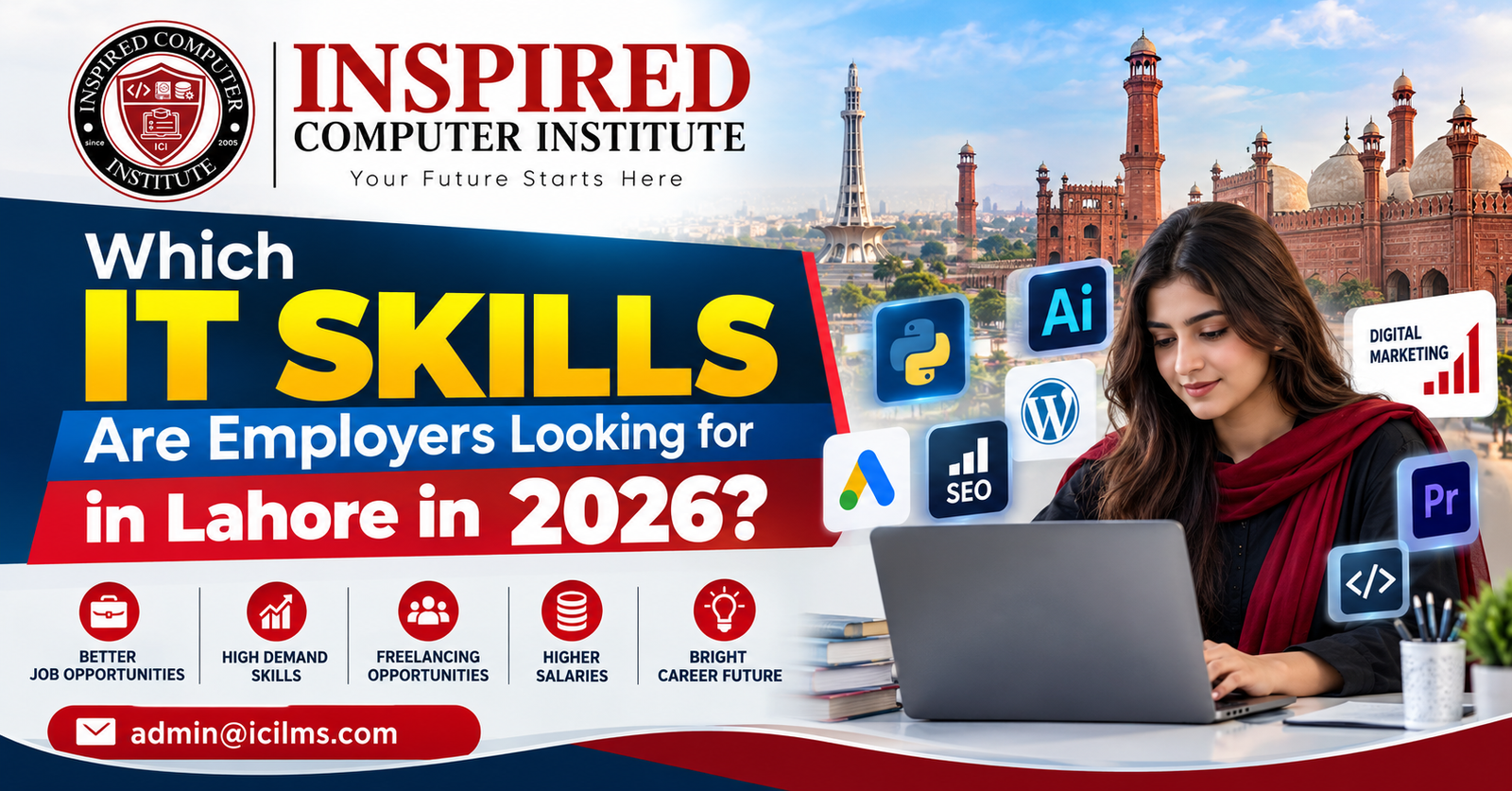
Which IT Skills Are Employers Looking for in Lahore in 2026?
Komal Shahzadi
- October 5, 2026
- Comment 0
Which IT Skills Are Employers Looking for in Lahore in 2026?
Lahore has spent years developing into one of Pakistan’s most important technology and software hubs, but the definition of an “IT professional” is changing remarkably fast. In 2026, knowing how to write a little code, build a basic WordPress website, or list a collection of software tools on your CV is rarely enough to distinguish you from hundreds of other applicants. Employers increasingly want people who can solve business problems with technology, adapt to AI-assisted workflows, communicate with clients and teammates, and turn technical knowledge into measurable results. That shift is particularly important for students, fresh graduates, freelancers, and professionals searching for IT jobs in Lahore in 2026.
The hottest skills span several interconnected fields. Artificial intelligence, machine learning, software development, cloud computing, DevOps, cybersecurity, data analytics, mobile development, UI/UX, QA automation, and digital marketing technology all matter, although demand varies considerably by company and role. A Lahore software house serving overseas clients, for example, may prioritize React, Node.js, AWS, Git, and strong English communication. A data-focused organization may instead look for Python, SQL, Power BI, machine learning, and data-engineering capabilities. Meanwhile, companies modernizing internal systems may need .NET, Java, ERP expertise, cloud infrastructure, security, and business-analysis skills.
There is another important change hiding underneath those job titles: AI is becoming a layer across IT work rather than merely a separate career category. Developers can use AI coding assistants, marketers can automate research and analysis, designers can accelerate prototyping, and cybersecurity professionals can apply AI-assisted monitoring. Employers therefore have a growing reason to ask not simply, “Do you know AI?” but “Can you use AI reliably within your actual profession?” If you are planning an IT career in Lahore, that distinction may shape which skills are worth learning next.
Lahore’s IT Job Market in 2026
Lahore’s technology employment market is broad because it is not built around one type of company. The city contains software houses, outsourcing businesses, startups, e-commerce companies, fintech operations, digital agencies, educational technology businesses, enterprise IT departments, and companies developing products for international customers. That variety creates opportunities at different levels, from internships and junior developer positions to specialized roles in cloud architecture, AI, security, data engineering, and technical management. It also means there is no single programming language or certificate that magically guarantees employment. The strongest candidates generally develop a skill stack rather than betting their entire careers on one isolated technology.
Pakistan’s broader technology sector also gives Lahore-based professionals an international dimension. The Pakistan Software Export Board and State Bank of Pakistan have documented the country’s growing IT and IT-enabled services export activity over recent years, while government initiatives continue to emphasize digital services and technology exports. For workers in Lahore, this matters because an employer may effectively be recruiting for the global market even when the employee sits in a local office. You might spend your morning working from Gulberg, Johar Town, or another Lahore technology cluster while building software for customers thousands of kilometres away. Consequently, skills valued internationally—Git workflows, cloud platforms, security practices, Agile development, documentation, and professional communication—can become just as important locally.
Job seekers should therefore avoid treating “demand” as a list of trendy keywords. Technologies rise and fall, but businesses repeatedly pay for people who can build applications, manage infrastructure, protect systems, analyze information, automate processes, and improve digital products. A developer who understands business requirements and deployment is often more useful than someone who has memorized syntax without ever completing a production-style project. The same principle applies to data analysts, designers, marketers, and security professionals. Lahore’s competitive advantage gives ambitious workers opportunities, but competition also means practical evidence of competence has become increasingly valuable.
Why Employers Are Becoming More Selective
Imagine two candidates applying for the same junior software position. The first has completed ten online courses and lists twenty technologies on a CV. The second knows fewer technologies but has built a functioning application, published the code on GitHub, written documentation, connected an API, deployed the project to the cloud, fixed real bugs, and can clearly explain every technical decision. Which person feels safer to hire? Increasingly, employers favor the second profile because demonstrated ability reduces hiring uncertainty.
AI has made this distinction even more significant. Generative tools can produce code snippets, documentation, SQL queries, test cases, designs, and marketing drafts in seconds. That does not eliminate technical jobs; it changes the baseline. Employers can reasonably expect professionals to work faster while still checking whether AI-generated output is correct, secure, maintainable, and suitable for the business. Someone who blindly copies generated code may introduce vulnerabilities or subtle bugs. Someone who understands fundamentals can use the same tool as an accelerator. Think of AI as a power tool: owning the drill is not the skill; knowing where, why, and how to drill without damaging the wall is.
Hiring managers are also increasingly interested in T-shaped professionals. Such people possess deep expertise in one area while understanding adjacent disciplines. A frontend developer might specialize in React but also understand APIs, databases, Git, accessibility, testing, and deployment. A data analyst might excel in Power BI while knowing SQL, Python, statistics, and stakeholder communication. This combination makes employees more flexible and improves collaboration across teams. For Lahore candidates competing for both domestic and international-facing roles, building that combination can be far more valuable than collecting unrelated technologies simply to make a CV look crowded.
Artificial Intelligence and Machine Learning Skills
Few technology categories attract as much attention in 2026 as artificial intelligence and machine learning. Yet AI employment is much broader than becoming a research scientist who invents new neural-network architectures. Companies need software engineers who integrate AI models into applications, data specialists who prepare reliable datasets, developers who build retrieval systems, analysts who automate workflows, and product professionals who understand where AI actually produces business value. This creates several entry points for Lahore’s technology workforce.
A strong AI foundation commonly begins with Python, followed by statistics, probability, linear algebra fundamentals, data manipulation, and machine-learning concepts. Libraries and frameworks such as NumPy, pandas, scikit-learn, PyTorch, and TensorFlow remain useful depending on the role. Candidates should understand concepts including supervised and unsupervised learning, classification, regression, clustering, feature engineering, model evaluation, overfitting, and validation. Jumping directly into flashy generative-AI applications without understanding data and evaluation can create a surprisingly fragile skill set.
Practical experience makes these concepts meaningful. Instead of merely completing an AI course, a candidate could build a customer-support classifier, recommendation prototype, forecasting model, document-search application, or multilingual information-retrieval system. The project should explain the problem, dataset, model or API choice, evaluation method, limitations, and deployment approach. That final part is often overlooked. Employers rarely benefit from a machine-learning notebook that works only on the candidate’s laptop; they need systems that can eventually function inside real products.
For Lahore professionals, AI can be particularly attractive because the skills transfer well across borders. However, candidates should resist exaggerated titles and focus on measurable competence. AI engineering, data engineering, MLOps, model evaluation, and application integration are practical areas where software fundamentals combine with newer AI capabilities.
Generative AI, LLMs, and AI Automation
Generative AI has created an additional skills category around large language models (LLMs) and intelligent automation. Businesses increasingly want applications that can search internal documents, summarize information, support customers, extract structured data, assist employees, or automate repetitive knowledge work. Building such applications involves considerably more than typing clever prompts into a chatbot. Employers may value developers who understand model APIs, structured outputs, tool calling, embeddings, vector search, retrieval-augmented generation, evaluation, privacy, guardrails, latency, and cost management.
Prompt engineering still has value, but it is strongest when combined with another discipline. A software engineer who understands prompting can create better AI applications. A marketer who understands it can accelerate content research while maintaining editorial judgment. A data analyst can use models to help classify or summarize information. Prompting by itself is increasingly difficult to treat as a durable career moat because interfaces and models keep improving. The more defensible skill is designing reliable workflows around AI.
Candidates should also learn to evaluate model output rather than assuming fluent language equals correct information. LLMs can hallucinate, mishandle ambiguous instructions, expose sensitive information when systems are badly designed, or produce inconsistent answers. A production-minded AI developer asks uncomfortable questions: What happens when retrieval fails? How do we measure answer quality? Which information can be sent to an external API? What is the cost per request? Can a malicious prompt manipulate the application? Those questions distinguish experimentation from engineering.
A compelling portfolio project could therefore combine an LLM with a real application: perhaps an internal-document assistant with citations, role-based access, evaluation tests, and a simple web interface. Such a project demonstrates AI knowledge alongside software engineering, security awareness, and product thinking—exactly the combination that can make an applicant more useful.
Software Development and Programming Skills
Traditional software development remains fundamental even during the AI boom. Businesses still need developers to build billing systems, dashboards, e-commerce platforms, APIs, customer portals, enterprise applications, automation tools, and mobile backends. AI may change how developers write code, but organizations still require people who understand architecture, debugging, databases, security, performance, testing, and the consequences of technical decisions.
Employers typically care less about how many programming languages you claim to know than whether you can genuinely develop software. Core concepts include data structures, algorithms, object-oriented or functional design where appropriate, database fundamentals, HTTP, APIs, authentication, version control, debugging, testing, and clean-code principles. Git and platforms such as GitHub or GitLab deserve special attention because modern development is collaborative. Knowing how to branch, review changes, resolve conflicts, and document work is part of professional programming rather than an optional extra.
Backend candidates should understand databases particularly well. SQL remains highly useful, and familiarity with PostgreSQL, MySQL, SQL Server, or comparable systems can open doors across many technology stacks. NoSQL databases such as MongoDB or Redis may be valuable when the application calls for them, but developers should understand why they are choosing a particular database instead of following trends. REST APIs remain common, while knowledge of GraphQL, event-driven architectures, queues, caching, and microservices can become useful as developers advance.
The key word is production. Can you take an idea from requirement to functioning software? Can you investigate an error rather than immediately asking an AI model to regenerate everything? Can another developer read your code? Can you explain your trade-offs? These capabilities continue to separate software engineers from people who merely recognize programming syntax.
Python, JavaScript, Java, and Modern Frameworks
For anyone deciding which programming language to learn in Lahore, Python and JavaScript/TypeScript are especially versatile starting points, although Java, C#, PHP, Dart, Kotlin, Swift, and other languages remain valuable in their respective ecosystems. Python crosses several boundaries: backend development, scripting, automation, data analysis, machine learning, and AI. JavaScript dominates browser-based development, while TypeScript has become increasingly useful for teams that want stronger type safety in larger applications.
Framework knowledge converts those languages into employable application-development skills. React remains prominent for frontend development, while Next.js adds full-stack and server-rendering capabilities around the React ecosystem. Node.js enables JavaScript and TypeScript developers to work on servers, with frameworks such as Express and NestJS serving different architectural preferences. Python developers may encounter Django, Flask, or FastAPI. Java developers frequently work with Spring and Spring Boot, while Microsoft-oriented businesses commonly use C# and .NET.
Do not confuse framework familiarity with engineering mastery. Anyone can follow a tutorial that produces a polished-looking interface. Employers discover the difference when authentication breaks, an API becomes slow, requirements change, or the application must be deployed. That is why candidates should build projects containing realistic features such as login flows, permissions, database migrations, validation, error handling, automated tests, third-party API integration, and deployment.
One thoughtfully engineered application can demonstrate more than a folder containing fifteen unfinished tutorials. If you are targeting Lahore software houses, examine actual job advertisements in your specialization and count recurring technologies. Build around the patterns you repeatedly see rather than chasing every new framework discussed on social media.
Web Development Skills
Web development in Lahore remains an accessible route into technology, but entry-level competition means basic HTML and CSS alone rarely create much differentiation. Frontend developers should understand semantic HTML, modern CSS, JavaScript or TypeScript, responsive layouts, accessibility, browser behavior, state management, API consumption, performance, and testing. React knowledge is frequently useful, while frameworks such as Next.js can expand a developer’s ability to build production-ready web applications.
Performance has become an increasingly important part of frontend engineering. A beautiful website that loads slowly on mobile networks can hurt user experience and conversions. Developers should therefore understand image optimization, code splitting, caching, lazy loading, rendering approaches, and metrics associated with web performance. Accessibility is equally valuable. Building interfaces that work with keyboards, assistive technologies, and appropriate semantic structure makes products usable by more people and demonstrates professional attention to quality.
Backend web skills involve a different but connected set of responsibilities: APIs, databases, authentication, authorization, server security, logging, caching, background processing, and integration with external services. The best web developers do not necessarily memorize every component; they understand how the components communicate. When a checkout fails, for example, they can trace the journey from browser request to API, database, payment provider, and response rather than staring at one layer in isolation.
CMS and e-commerce expertise also retain commercial relevance. WordPress, Shopify, and related ecosystems support enormous numbers of businesses. The differentiator is moving beyond simple template installation toward customization, performance, integrations, security, analytics, and conversion-focused implementation.
Full-Stack Development and API Integration
Full-stack development appeals strongly to startups and software-service businesses because one engineer can contribute across multiple parts of an application. A typical modern stack might combine React or Next.js on the frontend, Node.js or Python on the backend, PostgreSQL for persistent data, Redis for caching, GitHub for source control, and a cloud provider for deployment. The precise technologies matter less than understanding the entire request lifecycle.
API integration deserves special attention because modern applications are rarely islands. Software connects to payment gateways, authentication providers, CRMs, analytics platforms, messaging services, AI models, logistics systems, and countless third-party services. Developers should know HTTP methods, status codes, JSON, authentication mechanisms, rate limits, webhooks, retries, idempotency, error handling, and secure credential management. A developer who can reliably connect systems creates immediate business value.
Full-stack candidates should nevertheless avoid becoming “a little familiar with everything and excellent at nothing.” Pick an anchor. You might become particularly strong in frontend engineering while remaining competent with APIs and databases, or specialize in backend architecture while understanding enough frontend development to deliver complete features. Employers can then see both depth and range.
A portfolio application should demonstrate this integration. Rather than another static to-do list, build something with user accounts, permissions, a relational database, search, third-party APIs, automated tests, and cloud deployment. Add a clear README explaining architecture and setup. That project becomes a miniature demonstration of how you would operate inside an actual engineering team.
Cloud Computing and DevOps Skills
As companies move applications away from manually maintained servers toward scalable cloud infrastructure, cloud computing and DevOps skills become increasingly valuable. AWS, Microsoft Azure, and Google Cloud provide enormous ecosystems, and you do not need to master all three. Understanding one platform deeply while knowing general cloud principles is a more sensible strategy. Candidates should learn computing, storage, networking, databases, identity and access management, monitoring, backups, and cost fundamentals.
DevOps connects development with reliable delivery. Linux, Git, Docker, CI/CD pipelines, infrastructure configuration, monitoring, logging, and scripting form a useful foundation. Docker is particularly practical because containers help teams package applications and dependencies consistently. Kubernetes becomes relevant for organizations operating more complex containerized infrastructure, although beginners should not rush into Kubernetes without first understanding networking, Linux, containers, and deployment fundamentals.
Infrastructure as Code tools such as Terraform can also strengthen a cloud engineer’s profile. Instead of configuring every server manually, teams describe infrastructure through version-controlled definitions. This improves repeatability and auditing while reducing configuration drift. Combined with automated CI/CD pipelines, the result is a development environment where software can move from commit to testing and deployment with fewer manual steps.
For Lahore-based professionals, cloud skills pair exceptionally well with development, cybersecurity, and data engineering. A backend developer who can deploy and monitor an application is more independent. A security engineer who understands cloud identity policies can address modern attack surfaces. A data engineer familiar with cloud storage and managed processing services can build larger pipelines. Cloud knowledge acts less like a standalone island and more like a bridge connecting several valuable IT careers.
AWS, Azure, Docker, Kubernetes, and CI/CD
Learning cloud technologies becomes easier when you stop treating product names as exam vocabulary. Build something. Take a small application, containerize it with Docker, configure environment variables securely, deploy it to AWS or Azure, attach a managed database, set up logs, configure HTTPS, and create a CI/CD pipeline that automatically runs tests before deployment. Suddenly, abstract cloud terminology turns into a system you can explain during an interview.
AWS offers a huge collection of services, but beginners can focus on foundational concepts represented by services such as compute, object storage, managed databases, serverless functions, networking, identity, and monitoring. Azure provides comparable capabilities and can be particularly relevant in Microsoft-centered enterprise environments. What employers ultimately need is someone who understands availability, security, permissions, scaling, reliability, and costs rather than someone who has simply memorized a service catalog.
Kubernetes should usually come later. It is powerful for orchestrating containers across clusters, handling deployments, services, scaling, and configuration, but its complexity can overwhelm newcomers. Learn Docker thoroughly first. Understand ports, volumes, images, networks, environment configuration, and container lifecycle. Then concepts such as pods, deployments, services, ingress, secrets, and Helm become easier to understand.
Certifications can help establish structured knowledge, particularly for cloud roles, but a certificate should complement practical evidence. A recruiter seeing “AWS Certified” plus a deployed architecture documented on GitHub receives two signals: you studied the material and actually used it. That combination is substantially stronger.
Cybersecurity Skills
Every new application, cloud account, employee device, API, and database creates another potential security concern, which is why cybersecurity skills remain strategically important. Employers need professionals who can reduce risk, identify vulnerabilities, monitor systems, respond to incidents, and help development teams avoid creating security weaknesses in the first place. Security is not simply “ethical hacking”; it contains defensive, offensive, governance, cloud, application, identity, and incident-response disciplines.
Beginners should build strong networking and operating-system fundamentals. Learn TCP/IP, DNS, HTTP/HTTPS, firewalls, VPNs, Linux, Windows administration, permissions, authentication, and common attack patterns. Then study areas such as vulnerability management, SIEM platforms, endpoint security, identity and access management, penetration testing, security monitoring, and incident response. Familiarity with OWASP Top 10 concepts is especially valuable for people interested in application security.
Cloud security adds another growing layer. Misconfigured permissions, exposed storage, leaked secrets, insecure APIs, and excessive access can cause serious problems even when application code itself looks sound. Professionals who understand both cloud architecture and security can therefore occupy an attractive intersection. DevSecOps takes the same idea into software delivery by integrating scanning, secret management, dependency checks, and security controls into development pipelines.
Aspiring security professionals should practice legally in labs, capture-the-flag environments, and systems they are explicitly authorized to test. Documenting findings clearly is also essential. A brilliant technical discovery loses much of its value if the engineer cannot explain the risk, reproduce the problem, and recommend a practical fix.
Data Analytics and Data Engineering Skills
Businesses collect information constantly, but raw data is not automatically useful. Data analysts turn information into insights, while data engineers build systems that make trustworthy data available in the first place. Both career paths can be valuable in Lahore because companies across technology, retail, finance, logistics, telecom, e-commerce, and services need better decisions.
For analysts, SQL should be near the top of the learning list. Add Excel, Power BI or Tableau, basic statistics, data cleaning, visualization, and business communication. Python becomes useful for larger datasets, automation, and more advanced analysis. The important skill is not creating the fanciest dashboard; it is asking the right question. If sales dropped last month, can you identify which products, regions, channels, or customer segments caused the change and communicate what management should investigate?
Data engineering goes deeper into pipelines and infrastructure. Useful skills include SQL, Python, data modeling, ETL/ELT concepts, APIs, orchestration, warehouses, cloud storage, distributed processing, and data-quality monitoring. Depending on the organization, technologies may include Airflow, dbt, Spark, Kafka, Snowflake, BigQuery, Redshift, Databricks, or equivalent platforms. Again, underlying concepts matter more than collecting brand names.
AI increases rather than decreases the importance of reliable data. A sophisticated model fed incomplete, duplicated, biased, or outdated information can confidently produce poor results. Data professionals therefore sit underneath much of the AI economy. If you enjoy analytical thinking but do not necessarily want to become a traditional software developer, analytics or data engineering offers a compelling direction.
Mobile App Development Skills
Mobile development remains relevant because smartphones continue to serve as the primary digital interface for millions of consumers. Lahore companies building e-commerce, fintech, logistics, education, healthcare, food-delivery, and service applications need developers capable of creating reliable Android and iOS experiences. Candidates can pursue native development with Kotlin for Android or Swift for iOS, or cross-platform development using frameworks such as Flutter and React Native.
Flutter can be attractive for teams seeking a shared codebase across platforms, while React Native appeals to developers already comfortable with JavaScript or TypeScript and React-style development. Native development remains valuable when teams require deep platform integration, maximum control, or highly specialized performance. There is no universally “best” choice; the best technology depends on the product and the employers you are targeting.
Mobile developers should understand far more than screens and buttons. Real applications require API integration, authentication, local storage, state management, notifications, deep links, error handling, offline behavior, analytics, app security, performance optimization, and release processes. Developers must also think carefully about different screen sizes, unreliable networks, battery consumption, and platform-specific behavior.
A strong portfolio app should therefore feel like a product rather than a classroom exercise. Connect it to a real backend, implement secure authentication, handle network failures gracefully, add automated tests where practical, and demonstrate thoughtful UI decisions. Publish it if possible, or provide a polished demonstration with accessible source code and documentation.
UI/UX and Product Design Skills
Technology companies do not succeed merely because their software functions; people must understand and enjoy using it. That makes UI/UX design an important part of Lahore’s digital job ecosystem. Designers commonly work with tools such as Figma while applying principles of information architecture, typography, color, spacing, accessibility, responsive design, prototyping, usability testing, and design systems.
The strongest designers are problem solvers rather than screen decorators. Suppose users abandon an e-commerce checkout. Changing button colors without investigating the problem is decoration. Interviewing users, analyzing behavior, identifying confusing steps, simplifying the flow, prototyping alternatives, and testing them is UX work. Employers value designers who can explain that reasoning because it connects design decisions with customer and business outcomes.
Product thinking further improves employability. Designers should understand how developers implement interfaces, what technical constraints exist, and how product managers prioritize features. They do not need to become programmers, but familiarity with HTML/CSS concepts and component-based development can improve collaboration. Likewise, understanding analytics helps designers evaluate whether an interface change actually improves user behavior.
Your portfolio should tell stories rather than display isolated mockups. Explain the problem, constraints, research, alternatives, decisions, prototype, testing, and outcome. Hiring managers want to know how you think, not merely whether you can create attractive gradients. In an era when AI can generate visual concepts quickly, thoughtful product reasoning becomes even more important.
Software Quality Assurance and Automation Testing
Software testing is another field undergoing significant transformation. Manual QA remains necessary for exploratory testing, usability checks, and scenarios requiring human judgment, but test automation increasingly strengthens employability. QA professionals can benefit from Selenium, Cypress, Playwright, Appium, Postman, API testing, SQL, Git, and CI/CD knowledge, depending on whether they test web, mobile, backend, or enterprise systems.
A good tester thinks differently from a developer. Developers naturally focus on making a feature work; testers ask how it might fail. What happens with an empty field? A huge file? An expired token? A slow network? Two simultaneous requests? Incorrect permissions? This curiosity is enormously valuable because production users will eventually discover cases nobody anticipated.
Automation engineers translate repeatable checks into maintainable test suites. However, automation is not about writing thousands of brittle scripts. Teams need tests that provide fast, trustworthy feedback without failing randomly. Understanding test design, selectors, fixtures, mocking, API validation, reporting, and pipeline integration therefore matters as much as knowing the automation framework itself.
AI can assist with generating test ideas and boilerplate, but human judgment remains crucial for deciding what deserves testing and whether the software satisfies its intended purpose. A QA professional who combines testing fundamentals, coding ability, API knowledge, automation, and CI/CD awareness can become an important contributor to engineering quality.
Digital Marketing and SEO Technology Skills
IT-adjacent opportunities in Lahore extend beyond conventional programming. Technical SEO, analytics, marketing automation, conversion tracking, e-commerce technology, and performance marketing increasingly require people comfortable with both marketing and technical systems. Digital agencies and online businesses need professionals who can interpret data instead of simply publishing content or launching campaigns.
SEO professionals should understand search intent, keyword research, content strategy, internal linking, crawlability, indexing, structured data, website architecture, page performance, analytics, and reporting. Familiarity with Google Search Console, Google Analytics, crawling tools, keyword platforms, spreadsheets, and increasingly AI-assisted research workflows can improve productivity. Technical SEO specialists benefit from HTML, JavaScript rendering concepts, HTTP status codes, canonicalization, redirects, sitemaps, robots directives, and Core Web Vitals.
Marketing technology also involves attribution and tracking. Professionals may work with tag-management systems, advertising platforms, CRM tools, email automation, dashboards, and e-commerce analytics. Being able to explain whether a campaign produced profitable customers rather than merely clicks makes a marketer far more valuable.
AI is changing content workflows dramatically, but mass-generating generic material is not a durable strategy. Search visibility increasingly depends on producing genuinely useful pages that satisfy user needs, demonstrate subject understanding, and provide a strong experience. The winning skill is therefore not “AI content generation”; it is knowing how to combine research, editorial judgment, technical SEO, analytics, and automation into a measurable growth system.
Soft Skills Lahore IT Employers Expect
Technical ability may get your CV shortlisted, but communication, problem solving, teamwork, ownership, and adaptability frequently determine whether you succeed in the job. This becomes especially important for Lahore companies working with international customers. A technically talented employee who cannot explain progress, clarify requirements, document decisions, or communicate a delay can create costly confusion.
Professional English communication is particularly useful in outsourcing and remote work. You do not need an artificial accent or unnecessarily complicated vocabulary. You need clarity. Can you write an understandable email? Can you describe a bug without rambling? Can you ask a client a precise question when a requirement is ambiguous? Can you explain a technical constraint to someone who does not code? These abilities turn technical expertise into business value.
Problem-solving deserves equal emphasis. Employers do not expect employees to know everything, especially in technology where tools change constantly. They do expect them to investigate. Strong professionals reproduce problems, inspect logs, read documentation, search intelligently, test hypotheses, and ask focused questions. AI assistants can accelerate that process, but they should complement rather than replace reasoning.
Finally, learn to receive feedback. Software development is collaborative, and code reviews, design critiques, failed experiments, and changing requirements are normal. The professional who adapts without becoming defensive tends to improve quickly. Technology stacks may change every few years; the ability to learn, communicate, and solve problems travels with you throughout your career.
How to Build the IT Skills Employers Actually Want
The fastest route to employability is usually not taking course after course. Choose a target role first. Search current Lahore job listings for that role across major employment platforms and company career pages, then create a simple spreadsheet of recurring requirements. After reviewing dozens of relevant openings, patterns emerge. If React, TypeScript, Git, REST APIs, SQL, and AWS repeatedly appear in junior full-stack listings, you have a far more useful curriculum than a random “top technologies” video can provide.
Next, build a portfolio around realistic problems. A developer might create a SaaS-style application with authentication, permissions, payments, APIs, tests, and deployment. A data analyst could take a public dataset, clean it with SQL or Python, build a dashboard, and write an executive summary. A cybersecurity learner could document authorized lab exercises and remediation recommendations. A designer could publish complete UX case studies. The objective is evidence.
GitHub can be especially useful for technical candidates when repositories are clean and understandable. Include a README describing the problem, architecture, setup process, technologies, screenshots, known limitations, and future improvements. Avoid filling your profile with copied tutorial repositories. Three projects you deeply understand are more convincing than thirty projects you cannot explain.
Then practice interviews by explaining your decisions aloud. Why PostgreSQL rather than MongoDB? Why did you choose this API architecture? What would you change if traffic increased tenfold? What security risks did you consider? These questions reveal whether knowledge is superficial or operational.
Certifications can complement this strategy for areas such as AWS, Azure, networking, cybersecurity, and certain enterprise platforms. Treat them as supporting evidence, not substitutes for ability. The most resilient formula for IT careers in Lahore in 2026 is simple: solid fundamentals + a focused specialization + AI literacy + demonstrable projects + communication skills.
Conclusion
The IT skills employers are looking for in Lahore in 2026 reflect a technology market that is becoming both more sophisticated and more connected to international work. AI and machine learning, full-stack development, cloud computing, DevOps, cybersecurity, data analytics, mobile development, UI/UX, QA automation, and technical digital marketing all provide viable directions. The best choice depends on your strengths, interests, education, and the actual vacancies available when you apply.
One pattern connects nearly all of these careers: employers increasingly benefit from professionals who can use AI without becoming dependent on it. A programmer still needs programming fundamentals. A data analyst still needs analytical judgment. A designer still needs to understand users. A cybersecurity specialist still needs networking and security fundamentals. AI can act like an engine strapped to each profession, but somebody still needs to steer.
For students and fresh graduates in Lahore, this is good news because you do not have to learn everything. Pick a destination and construct a coherent skill stack around it. If software development interests you, combine a language with frameworks, databases, Git, APIs, testing, cloud deployment, and AI-assisted development. If data appeals to you, combine SQL, visualization, Python, statistics, and business communication. If cybersecurity catches your attention, start with networking and operating systems before moving toward security tooling and cloud security.
Most importantly, build things and document what you learn. The gap between “I completed a course” and “Here is a working system I designed, built, tested, deployed, and can explain” is enormous. In Lahore’s competitive IT market, crossing that gap may be one of the smartest career investments you can make.
20 FAQs About IT Skills and Jobs in Lahore in 2026
1. Which IT skill is most in demand in Lahore in 2026?
There is no single skill that dominates every employer, but software development, AI engineering, cloud/DevOps, cybersecurity, and data-related skills are among the strongest areas to investigate. Demand changes by industry and seniority, so candidates should validate their choice against current Lahore vacancies before committing to a learning path.
2. Is artificial intelligence a good career in Lahore?
Yes, particularly when AI knowledge is paired with Python, software engineering, data skills, APIs, or cloud deployment. Employers generally need people who can turn AI capabilities into useful applications rather than candidates who only know how to write prompts.
3. Is Python in demand in Lahore?
Python is highly versatile because it is used in AI, machine learning, backend development, automation, data analytics, and scripting. Its broad applicability makes it a sensible language for many beginners, although your eventual career path should determine what you learn alongside it.
4. Is JavaScript still worth learning in 2026?
Yes. JavaScript remains fundamental to web development, and TypeScript is particularly valuable for larger modern applications. Pairing JavaScript or TypeScript with React, Next.js, Node.js, APIs, databases, Git, and deployment knowledge can create a strong full-stack profile.
5. Which is better for jobs in Lahore: Python or JavaScript?
Neither is universally better. Choose Python for paths such as AI, data, automation, and Python backend development; choose JavaScript/TypeScript if web and full-stack development are your primary interests. Learning one deeply is initially better than learning both superficially.
6. Are cloud computing skills in demand in Lahore?
Cloud knowledge is increasingly useful because software companies need to deploy, secure, monitor, and scale applications. AWS and Azure are strong platforms to study, particularly alongside Linux, networking, Docker, Git, and CI/CD.
7. Should fresh graduates learn AWS or Azure?
Either can be worthwhile. Look at the employers you intend to target and determine which platform appears more frequently in their vacancies. The underlying concepts—networking, compute, storage, IAM, databases, security, and monitoring—transfer between platforms.
8. Is cybersecurity a good career in Lahore?
Cybersecurity can offer a strong long-term path, but beginners should build foundations in networking, Linux, Windows, web technologies, and security principles. Specialized knowledge becomes considerably easier once those fundamentals are solid.
9. Which cybersecurity skills should beginners learn?
Start with TCP/IP, DNS, HTTP, Linux, Windows fundamentals, authentication, permissions, basic scripting, and common web vulnerabilities. From there, explore SOC operations, SIEM, penetration testing, incident response, cloud security, or application security according to your interests.
10. Is data analytics a good career for non-programmers?
Yes. Data analytics can be approachable for people who do not want to begin with heavy software development. Excel, SQL, Power BI or Tableau, statistics, data visualization, and communication provide a useful foundation, with Python added as your analytical requirements become more advanced.
11. Is web development overcrowded in Lahore?
Entry-level web development can be competitive, especially among candidates with only basic HTML, CSS, and tutorial-level JavaScript. Stronger differentiation comes from TypeScript, modern frameworks, APIs, databases, testing, security, Git, deployment, accessibility, and genuine portfolio projects.
12. Is Flutter worth learning for Lahore IT jobs?
Flutter can be valuable for companies building cross-platform mobile applications. Before specializing, compare local vacancies for Flutter, React Native, native Android, and iOS development to understand which path best matches the companies you want to join.
13. Do IT employers in Lahore require a university degree?
Requirements vary considerably. Some organizations and graduate programs prefer or require relevant degrees, while other software houses and startups place greater weight on demonstrated skills and experience. A strong portfolio cannot guarantee that a company will waive formal requirements, but it can substantially strengthen skills-based applications.
14. Can I get an IT job without a computer science degree?
It is possible in many skills-based technology roles, although the difficulty depends on the employer and specialization. Self-taught candidates need especially strong evidence through projects, internships, freelance work, open-source contributions, certifications, or other demonstrable experience.
15. How important is English for IT jobs in Lahore?
English communication can be very important, particularly at companies serving overseas clients or working with distributed teams. Focus on clear speaking, professional writing, technical documentation, requirement clarification, and the ability to explain complex ideas simply.
16. Will AI replace software developers in Lahore?
AI is more likely to transform software-development workflows than make engineering knowledge irrelevant. Developers who can use AI tools while understanding architecture, debugging, security, testing, databases, and product requirements are better positioned than those who rely entirely on generated code.
17. Is prompt engineering enough to get an AI job?
Usually, prompt engineering alone is a narrow foundation. Combining it with Python, APIs, LLM application development, retrieval systems, evaluation, databases, software engineering, automation, or domain expertise creates a more durable professional profile.
18. Which IT skills are best for freelancing from Lahore?
Web development, mobile development, UI/UX, automation, AI integration, data analytics, WordPress/Shopify development, SEO, and cloud services can all support freelance work. Success also requires client communication, scoping, pricing, reliability, and portfolio quality.
19. How can fresh graduates stand out to Lahore IT employers?
Build two or three substantial projects, maintain a professional CV and GitHub profile, complete an internship where possible, develop strong communication skills, and tailor applications to each role. Being able to explain how you solved actual technical problems is more persuasive than listing dozens of technologies.
20. What should I learn first for an IT career in Lahore in 2026?
Choose a target career before choosing tools. For software development, begin with programming fundamentals and Git; for data analytics, start with Excel and SQL; for cybersecurity, begin with networking and operating systems; and for UI/UX, start with design principles and Figma. Build projects as soon as possible rather than waiting until you feel you have learned everything.