Currently Empty: ₨ 0
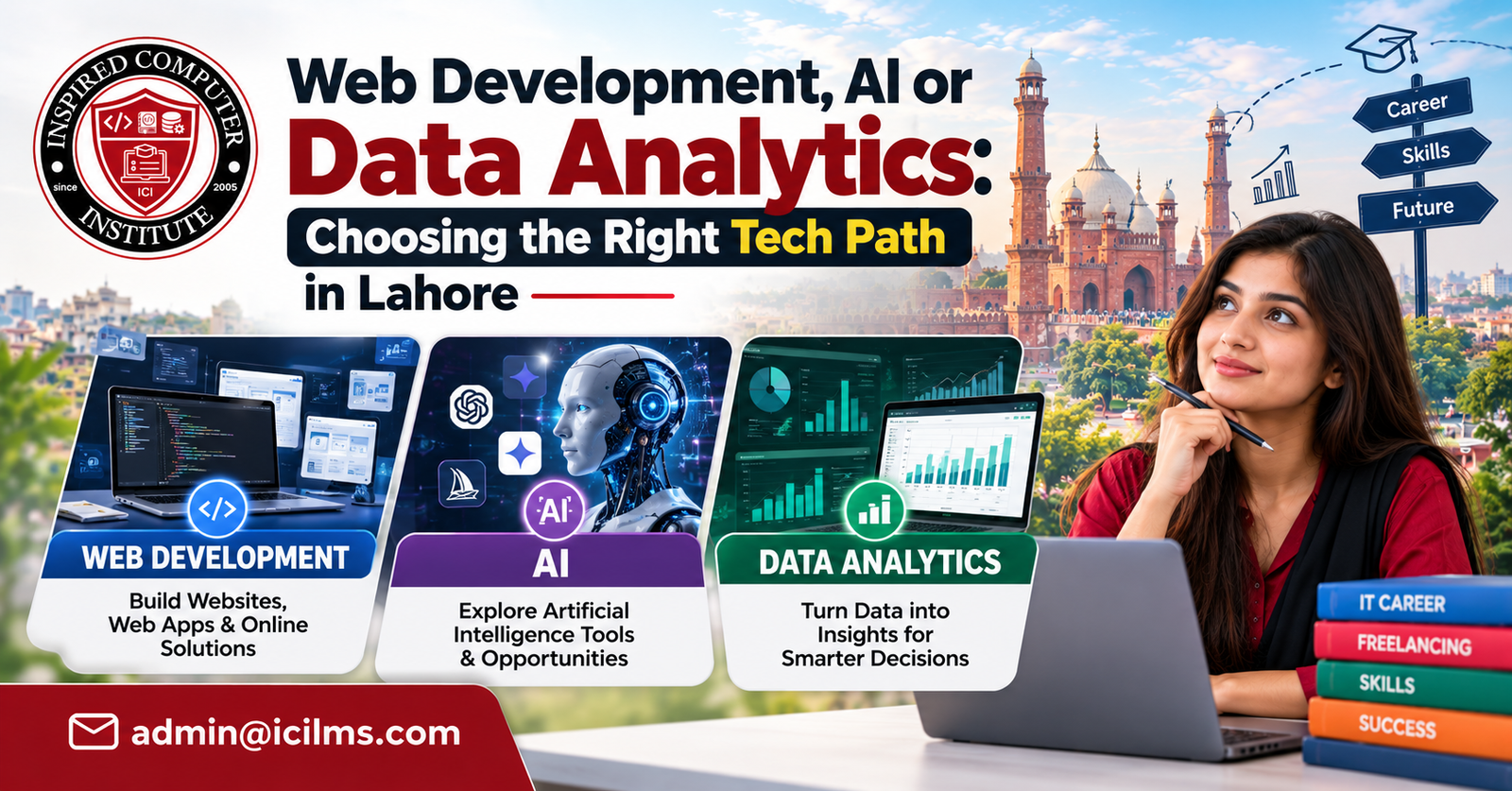
Web Development, AI or Data Analytics: Choosing the Right Tech Path in Lahore
Komal Shahzadi
- October 6, 2026
- Comment 0
Web Development, AI or Data Analytics: Choosing the Right Tech Path in Lahore
Choosing a technology career today can feel a little like standing at Lahore’s Liberty Roundabout with three roads in front of you and no navigation app. One sign says Web Development, another points toward Artificial Intelligence (AI), and the third promises a future in Data Analytics. All three roads can lead to successful careers, remote jobs, freelancing income, entrepreneurship and opportunities with international companies. The difficult part isn’t finding a promising field. It’s figuring out which promising field actually matches your abilities, interests, education and career goals.
That question has become especially relevant for students and young professionals in Lahore. Pakistan’s digital economy has expanded beyond the old idea that an IT career simply means becoming a software engineer. Software houses, startups, e-commerce companies, financial businesses, marketing agencies and international outsourcing firms now need people with very different technical abilities. At the same time, platforms serving remote workers have made geographical boundaries less important. Someone learning technical skills in Lahore can potentially build websites for a company in Dubai, analyze business data for a client in Europe or contribute to an AI application used thousands of kilometres away.
Yet hype can make career decisions unnecessarily confusing. AI sounds futuristic, web development appears practical, and data analytics seems attractive to people who enjoy working with numbers. Social media makes matters worse by presenting every new skill as a shortcut to a six-figure salary. Real careers don’t work that way. Your results depend on how deeply you learn a skill, how effectively you apply it and whether you can turn knowledge into projects that solve actual problems.
So, Web Development vs AI vs Data Analytics—which is better in Lahore? There isn’t one universal winner. Web development can provide a relatively accessible route into practical software work and freelancing. AI can offer enormous long-term potential but normally demands stronger programming, mathematics and problem-solving foundations. Data analytics sits somewhere between business and technology, making it particularly interesting for people who enjoy finding meaning in numbers without necessarily wanting to build full software applications.
This guide breaks down all three paths so you can choose based on reality rather than hype.
Why Lahore Is Becoming a Serious Tech Career Hub
Lahore has traditionally been associated with education, commerce, culture and entrepreneurship, but technology has become an increasingly visible part of the city’s professional landscape. Universities produce large numbers of computer science, software engineering, business and mathematics graduates, while software companies and digital agencies create opportunities for both experienced professionals and newcomers. Add coworking spaces, startup communities, training institutes and Pakistan’s substantial freelance workforce, and Lahore becomes a practical place to begin experimenting with a digital career.
One advantage of studying technology in Lahore is the variety of ways you can enter the market. You don’t necessarily have to wait until a large software company hires you. A web development student, for instance, can create websites for small businesses while applying for internships. A data analytics learner can build public dashboards and portfolio projects from open datasets. An aspiring AI engineer can experiment with machine-learning models, APIs and open-source tools before landing a formal AI position. That ability to learn, build and earn simultaneously makes technology different from many conventional professions.
Lahore’s commercial diversity also matters. Think about the number of educational institutions, retailers, restaurants, healthcare businesses, property companies, manufacturers, online stores and service businesses operating throughout the city. Every category is producing digital information and increasingly needs technology. A retailer may require an e-commerce website. A larger company may need dashboards that turn sales records into useful management information. A software startup may want AI-powered search, automation or customer support. Different problems create demand for different skills.
However, being in a growing market doesn’t mean every learner automatically succeeds. Entry-level technology fields are competitive, and basic skills are becoming easier to acquire. Knowing a few HTML tags or watching an introductory Python course isn’t enough to differentiate you. Employers and clients increasingly care about demonstrable competence: Can you build something? Can you analyze a messy dataset? Can you explain why your model behaves a certain way? Can you communicate with a non-technical client?
That’s why choosing the right field matters. The goal isn’t merely to enroll in whatever course has the most impressive advertisement. You want a path you can stay interested in long enough to become genuinely useful.
Understanding the Three Career Paths Before You Choose
Web development, artificial intelligence and data analytics overlap, but they solve different kinds of problems. Understanding those differences can prevent months of frustration. Imagine a Lahore-based online clothing business. A web developer might build and maintain its online store, checkout experience and customer account system. A data analyst might examine orders and discover which products sell best during particular months or which advertising channels generate profitable customers. An AI specialist might develop a recommendation system that predicts which products individual customers are most likely to purchase.
Notice something important: none of these professionals is automatically “better” than the others. They’re solving different parts of the same business problem.
Web development focuses heavily on creating applications and experiences that people access through browsers and internet-connected systems. It rewards builders. If seeing a functional product emerge from lines of code excites you, web development deserves serious consideration.
Artificial intelligence focuses on systems capable of performing tasks involving prediction, classification, language, perception, recommendation or increasingly sophisticated forms of automation. AI attracts people who enjoy programming, experimentation and deeper technical problem-solving. Modern AI also extends far beyond training giant models from scratch; many developers now build applications around existing models, APIs and AI infrastructure.
Data analytics, meanwhile, asks questions about what data means. Why did sales fall? Which customers are leaving? What happened after a marketing campaign? Which region is performing best? Analysts transform raw information into insights that managers and teams can act upon.
Your personality matters here. Some people enjoy building interfaces for hours but dislike statistics. Others find websites visually interesting but would rather investigate patterns in spreadsheets. Another group loves mathematics and experiments enough to tolerate an AI model failing ten times before the eleventh attempt works.
Choosing intelligently starts with recognizing these differences rather than chasing whichever technology happens to dominate this month’s headlines.
What Is Web Development?
Web development is the process of creating websites and web-based applications. It ranges from relatively straightforward company websites to sophisticated platforms involving payments, user accounts, databases, dashboards, messaging and other complex functionality. Because almost every industry needs some form of online presence, web development remains one of the most practical technology skills for people interested in employment, freelancing or building their own products.
Web development is usually divided into front-end, back-end and full-stack development. Front-end developers work on the parts users see and interact with. HTML provides structure, CSS controls presentation, and JavaScript adds behaviour and interactivity. Modern developers may then work with frameworks and libraries such as React, Next.js, Vue or similar technologies depending on the project. If you enjoy making interfaces responsive, attractive and easy to use, front-end work can be satisfying.
Back-end developers work behind the scenes. They handle databases, authentication, APIs, business logic and server-side processes. Languages and technologies vary widely and can include JavaScript or TypeScript with Node.js, Python, PHP, Java, C# and others. Databases such as PostgreSQL, MySQL and MongoDB may also become part of the toolkit. Full-stack developers combine substantial front-end and back-end knowledge.
For beginners in Lahore, web development has a particularly useful advantage: results become visible quickly. Write some HTML and CSS, refresh your browser and you can immediately see what changed. That fast feedback loop can make the learning process less abstract than fields where beginners spend weeks studying theory before producing something impressive.
It also lends itself naturally to portfolio building. Instead of telling an employer you know React, you can show them a deployed application. Instead of claiming you understand e-commerce development, you can demonstrate a functioning store project. In technology hiring, evidence frequently speaks louder than certificates.
What Is Artificial Intelligence?
Artificial intelligence is a broad area of computing concerned with building systems capable of performing tasks that traditionally require forms of human intelligence. Depending on the application, that might involve understanding language, recognizing images, generating content, making predictions, detecting anomalies or recommending products. Machine learning, deep learning, natural language processing and computer vision sit within or alongside the wider AI ecosystem.
The explosion of generative AI has made this field especially attractive. Large language models can generate and analyze text, assist with programming, summarize documents and support conversational applications. Businesses are consequently exploring AI-assisted customer service, document processing, internal knowledge systems, workflow automation and countless other use cases.
But aspiring students should distinguish between using AI tools and developing AI systems. Knowing how to ask a chatbot useful questions can improve productivity, but that alone doesn’t make someone an AI engineer. Technical AI careers often require Python programming, data handling, statistics, probability, machine-learning concepts and familiarity with libraries or frameworks used to develop models and AI-powered applications.
There’s also a growing middle ground. You don’t always need to become a machine-learning researcher. Software developers can create valuable products by integrating existing AI models through APIs, implementing retrieval systems, designing evaluation pipelines and building reliable interfaces around AI capabilities. That makes AI increasingly relevant even to conventional developers.
If you’re considering AI training in Lahore, ask yourself whether you enjoy experimentation. AI development rarely feels like writing a simple instruction and receiving a perfectly predictable output. You test approaches, measure performance, investigate errors and improve systems iteratively. For the right personality, that uncertainty is fascinating rather than frustrating.
What Is Data Analytics?
Data analytics is the practice of collecting, cleaning, examining and interpreting data so that organizations can make better decisions. While AI often tries to build systems that predict or automate, analytics frequently starts with a more grounded question: What is happening in this business, and why?
Suppose a Lahore-based e-commerce company has thousands of monthly orders. Management may know overall revenue, but that’s only the surface. Which categories have the highest margins? Are returning customers spending more than new customers? Which city generates the most refunds? Did a recent campaign increase genuine sales or simply give discounts to people who would have purchased anyway? A good data analyst turns these questions into measurable investigations.
Common tools include Microsoft Excel, SQL, Power BI, Tableau and Python. Excel remains useful because businesses everywhere rely on spreadsheets. SQL is essential when information lives in databases. Visualization tools such as Power BI allow analysts to transform rows of numbers into interactive dashboards. Python becomes valuable for larger datasets, automation and more sophisticated analysis.
Data analytics also requires something that beginners sometimes overlook: communication. Finding an interesting pattern is only half the job. You need to explain what it means to managers, marketers, finance teams or clients who may have little interest in technical details. The strongest analyst isn’t necessarily the person who produces the most complicated calculation. Often, it’s the person who converts complicated information into a clear business decision.
That characteristic makes analytics attractive to graduates from business, economics, finance, engineering and mathematics—not only computer science. If you naturally look at numbers and wonder what story they tell, this path may fit you surprisingly well.
Web Development vs AI vs Data Analytics: Quick Comparison
Choosing among these fields becomes easier when you compare them against the same criteria rather than treating each as an isolated career. The table below provides a practical overview, but remember that categories overlap and individual roles can vary significantly.
| Factor | Web Development | Artificial Intelligence | Data Analytics |
|---|---|---|---|
| Beginner difficulty | Low to medium | Medium to high | Low to medium |
| Programming requirement | High | High | Low to medium |
| Mathematics requirement | Low to medium | Medium to high | Medium |
| Visual creativity | High for front-end | Usually low | Medium |
| Business understanding | Useful | Useful | Very important |
| Freelancing accessibility | High | Growing but specialized | Medium |
| Portfolio building | Very easy | Moderate | Easy |
| Typical starting tools | HTML, CSS, JavaScript | Python, SQL, ML libraries, AI APIs | Excel, SQL, Power BI, Python |
| Best suited for | Builders and problem-solvers | Technical experimenters | Analytical thinkers |
| Learning curve | Relatively gradual | Steeper | Relatively gradual |
If your priority is getting into practical projects quickly, web development has a strong argument in its favour. You can start with a simple page and gradually move toward complete applications. The market also contains many smaller jobs, which can help freelancers gain experience.
AI generally requires more patience. You can certainly build basic AI applications quickly using modern APIs, but developing strong foundational expertise takes longer. Statistics, programming, data structures, machine learning and evaluation aren’t subjects most people master in a few weekends.
Data analytics can offer a smoother starting point, particularly for people already comfortable with Excel or business concepts. You might begin with spreadsheets, progress to SQL and dashboards, and then learn Python. This creates a natural staircase rather than forcing you to jump immediately into advanced software engineering.
Don’t interpret “easier” as “better,” though. A field that feels challenging because it clashes with your interests may never become a strong career. A difficult field you genuinely enjoy can become easier simply because you’re willing to practice longer.
Choosing Web Development in Lahore
Web development makes sense if you enjoy building tangible things. There’s a particular satisfaction in starting with an empty editor and eventually seeing a working application running in a browser. That feedback can keep beginners motivated through the inevitable debugging sessions where one missing character seems determined to ruin an entire evening.
For Lahore-based students, another attraction is the diversity of potential customers and employers. Digital agencies need developers to build client websites. Software houses build applications for local and international businesses. Startups need developers who can move quickly from idea to prototype. Smaller businesses may hire freelancers for websites, landing pages, online stores or maintenance. Remote opportunities widen that market considerably.
Web development is also useful for entrepreneurship. Imagine that you identify a problem faced by tuition academies, restaurants or property businesses. If you can develop web applications, you don’t necessarily need to hire a technical co-founder before testing your idea. You can build a prototype yourself and see whether customers care.
However, basic web development has become competitive. Simply knowing HTML, CSS and elementary JavaScript may no longer separate you from thousands of beginners. Your goal should therefore be professional competence rather than course completion. Learn responsive design, version control with Git, APIs, databases, authentication, deployment and debugging. Understand performance and accessibility. Learn enough about user experience to avoid creating interfaces that technically work but frustrate actual users.
The difference between someone who “knows web development” and someone employers want to hire often comes down to the quality of completed projects. Build applications that look as though somebody could genuinely use them.
Skills You Need to Become a Web Developer
A sensible web-development journey begins with fundamentals. Learn HTML well enough to structure pages semantically rather than treating every element as a generic container. Study CSS so you understand layouts, responsive design, Flexbox and Grid. Then invest serious effort in JavaScript, because modern web applications depend heavily on it.
After JavaScript fundamentals, a front-end framework such as React can make sense. Don’t rush into frameworks before understanding the language underneath them. Memorizing React patterns without knowing JavaScript is like learning to drive one specific car without understanding steering, braking or road signs. Everything seems fine until something unexpected happens.
Developers interested in full-stack work can then learn server-side development. Node.js is attractive because JavaScript developers can use a related language across both front and back ends, while Python, PHP, Java and other ecosystems remain perfectly valid depending on the opportunities you’re targeting. Learn relational databases and SQL even if you also experiment with NoSQL databases.
Git and GitHub should become normal parts of your workflow. Employers often want evidence that you understand version control and collaborative development. Deployment is equally important. A portfolio project sitting permanently on your laptop doesn’t demonstrate the complete development cycle as effectively as an application someone can actually open.
Then comes the skill no tutorial can fully teach: debugging. Professional development involves reading errors, inspecting network requests, searching documentation and breaking large problems into smaller ones. If you develop the habit of solving problems independently instead of copying every solution blindly, you’ll build a foundation that remains useful even as frameworks change.
Web Development Jobs, Freelancing and Earning Opportunities
Web development remains attractive because it supports several income paths. You can seek a junior developer position, internship, agency role, remote employment or freelance work. Eventually, you can build products, start an agency or specialize in higher-value areas such as performance optimization, e-commerce development or complex web applications.
Freelancing deserves realistic expectations. Platforms can expose Pakistani developers to global customers, but simply creating a profile doesn’t produce clients. New freelancers compete against developers from around the world, many with years of reviews. Your portfolio, proposal-writing ability, communication and specialization therefore matter almost as much as technical knowledge.
Local freelancing can be overlooked. Lahore contains countless businesses with outdated websites, poor mobile experiences or no effective digital presence. A beginner who can communicate professionally may find opportunities through personal networks, LinkedIn, business communities and direct outreach. Instead of saying, “I make websites,” show a business how a faster website, clearer booking process or better online store could solve a commercial problem.
Employment offers different advantages. Working inside a good software team exposes you to code reviews, testing, architecture and collaboration—things solo tutorials rarely reproduce accurately. Even developers who ultimately want to freelance can benefit enormously from professional team experience.
Income varies too much by skill, employer, experience and client market to promise a reliable figure. Be suspicious of institutes advertising guaranteed enormous salaries after a short course. Web development rewards capability, not certificates alone. Someone who can design, build, deploy and maintain useful applications will generally have stronger opportunities than somebody who has collected ten certificates without finishing one serious project.
Choosing Artificial Intelligence in Lahore
AI is an excellent path for people fascinated by automation, intelligent systems, language models, machine learning and prediction. It can also be the wrong choice for someone selecting it purely because the words “artificial intelligence” sound more advanced than “web development.” Prestige is a poor substitute for genuine interest.
The field contains several possible career directions. Machine-learning engineers build systems that train or serve predictive models. Data scientists use statistics, programming and domain knowledge to investigate complex datasets and create predictive solutions. AI engineers may build applications around foundation models and other AI services. Computer-vision specialists work with images and video, while NLP specialists focus on language.
Generative AI has expanded the landscape. Developers can now create assistants, search systems, document-processing applications and automation tools without training massive foundation models themselves. Yet this accessibility introduces another challenge: shallow knowledge becomes obsolete quickly. If your entire expertise depends on knowing one tool’s interface, you’re vulnerable whenever that product changes.
Strong foundations provide insurance. Learn programming properly. Understand data. Study basic statistics and machine-learning principles. Learn how to evaluate outputs rather than assuming an AI system is correct because its answer sounds confident.
Lahore can be a useful place to develop these capabilities through universities, software companies, communities and online learning, but geography matters less in AI than curiosity and sustained practice. Research papers, open-source repositories, datasets and sophisticated development tools are accessible online. The person who experiments consistently can progress far beyond someone waiting for a classroom instructor to provide every answer.
Skills You Need for an AI Career
Python is one of the most useful languages for an AI learner because of its enormous ecosystem for data manipulation, machine learning and scientific computing. Become comfortable with functions, classes, data structures, environments and debugging before jumping into complex neural networks. SQL is also valuable because real AI projects need data, and that data often lives in databases.
Mathematics matters, although beginners sometimes receive contradictory advice about how much they need. You don’t need to become a mathematician before writing your first machine-learning program. Still, concepts from linear algebra, probability, statistics and calculus help you understand why models behave as they do. Without that foundation, it’s easy to become someone who can execute library commands but struggles when results go wrong.
Learn data preparation because glamorous models are only one part of practical AI work. Real-world information can contain missing values, inconsistent labels, duplicates and biases. Understanding preprocessing and exploratory analysis makes you far more effective.
Then study core machine-learning concepts: regression, classification, clustering, overfitting, training and validation, feature engineering and evaluation metrics. Deep learning can follow once those foundations are comfortable.
For modern generative-AI development, learn about model APIs, embeddings, retrieval-augmented generation, structured outputs, tool use, evaluation and responsible deployment. Security and privacy deserve attention too. A clever demo that leaks sensitive customer information isn’t a successful product.
Most importantly, build projects where performance can be evaluated. A résumé saying “AI enthusiast” carries limited weight. A working application with a clear problem, documented methodology, evaluation process and thoughtful explanation tells a much stronger story.
AI Jobs, Freelancing and Long-Term Opportunities
AI’s long-term potential is substantial because the technology can affect almost every information-heavy industry. Businesses are exploring automation in customer support, software development, marketing, finance, healthcare administration, education and internal operations. That creates opportunities not only for researchers but also for engineers capable of integrating AI reliably into existing products.
Entry-level opportunities, however, can be more demanding than web development. A small business might hire a beginner to create a basic website, but it’s less likely to trust an inexperienced freelancer with a business-critical predictive system. AI projects can require deeper technical knowledge and stronger evidence of competence.
That means students should consider combining AI with another practical skill. Web development plus AI, for example, is powerful because you can create complete AI-powered products instead of isolated notebooks. Data analytics plus machine learning is another natural combination because analytical work builds familiarity with datasets and business questions.
Freelance opportunities increasingly include chatbot development, workflow automation, document analysis, AI integration and customized knowledge assistants. But avoid becoming dependent on buzzwords. Clients don’t ultimately pay for “AI.” They pay because support becomes faster, employees save time, customers find information more easily or repetitive work disappears.
Long-term success will likely belong to professionals who understand both the technology and the business problem. Tools will change. Today’s fashionable framework may become tomorrow’s forgotten repository. Problem-solving ability, programming fundamentals, evaluation skills and domain knowledge are much harder to replace.
If you genuinely enjoy technical experimentation and are willing to keep learning continuously, AI can be an exceptional career direction. If you merely want the quickest path to earning your first freelance payment, another route may be more practical initially.
Choosing Data Analytics in Lahore
Data analytics sits at a useful intersection between technology and business. You need enough technical ability to manipulate information, but you also need enough commercial awareness to understand why the analysis matters. This combination makes the field attractive to students who don’t necessarily dream about becoming software engineers.
Consider a retail company with branches around Lahore. Its database might contain millions of individual transaction records. Those records are useless to senior management if nobody can transform them into answers. Which branch is growing fastest? Which products frequently sell together? When does demand peak? Where is inventory sitting too long? An analyst can turn those questions into dashboards and recommendations.
The learning journey can also feel approachable. Someone can begin with Excel, learn formulas, pivot tables and data cleaning, then progress to SQL. Power BI or Tableau introduces visualization and dashboarding. Python can later automate repetitive tasks or handle more sophisticated analysis.
But don’t confuse approachable with easy. Professional analytics requires careful thinking. A chart can be technically correct and still be misleading. Correlation can be mistaken for causation. Missing data can distort conclusions. Poorly selected metrics can make an unsuccessful campaign look successful.
This is why domain knowledge matters. An analyst working in e-commerce should understand concepts such as conversion rates, customer acquisition and retention. Someone working in finance needs different knowledge. The more deeply you understand the organization you’re analyzing, the more useful your technical skills become.
For Lahore graduates from business, economics, accounting, mathematics and engineering backgrounds, data analytics can therefore provide a bridge into technology without requiring an immediate transformation into a full-time software developer.
Skills You Need to Become a Data Analyst
Start with Excel, but learn it beyond basic data entry. Functions, pivot tables, lookup techniques, charts and data-cleaning workflows are practical skills that appear frequently in real organizations. Then move into SQL, which should become one of the strongest tools in your analytical toolkit.
SQL allows you to retrieve and transform information stored in relational databases. Learn filtering, grouping, joins, subqueries and eventually window functions. Don’t simply memorize syntax. Practice translating business questions into queries. “Which five customers spent the most last quarter?” is more meaningful training than completing twenty disconnected syntax exercises.
Next, learn a business-intelligence platform such as Power BI. Focus not only on making dashboards attractive but also on choosing useful metrics and designing visualizations that communicate quickly. Executives rarely want to spend fifteen minutes deciphering a chart.
Python can come next, particularly pandas for data manipulation and libraries used for visualization and statistical analysis. Not every junior analyst role requires advanced Python, but it expands what you can automate and investigate.
Statistics deserves a place in your roadmap. Learn averages, distributions, variability, sampling, confidence intervals, hypothesis testing and basic regression. These concepts protect you from making confident claims based on weak evidence.
Finally, practice storytelling. Imagine presenting your findings to a manager who has five minutes before another meeting. Can you explain what happened, why it matters and what action you recommend? Analytics without communication is unfinished work.
Data Analytics Jobs and Career Opportunities
Data skills can be useful across banking, retail, telecommunications, e-commerce, logistics, marketing, healthcare, manufacturing and software. Job titles vary: data analyst, business intelligence analyst, reporting analyst, product analyst, marketing analyst and operations analyst can all involve overlapping capabilities.
This diversity creates an advantage. You don’t necessarily have to wait for a company with “technology” in its name. Traditional businesses increasingly generate substantial amounts of digital information and need employees capable of interpreting it.
Freelancing exists too, although it can work differently from web development. A website is easy for a client to define as a standalone deliverable. Analytics projects often require access to internal data and ongoing business context, which can make trust more important. Freelancers may work on spreadsheet automation, dashboard development, reporting systems, data cleaning and specific analytical projects.
A portfolio can solve part of the credibility problem. Use publicly available datasets to demonstrate SQL analysis, Power BI dashboards and Python notebooks. But don’t just upload files. Explain the business question, your process, key findings and recommendations. Employers want to see how you think.
Data analytics can also serve as a launchpad into adjacent careers. Some analysts move toward data science and machine learning. Others progress into business intelligence, product management, analytics engineering or strategic business roles.
If you enjoy asking “why?” when you see a number, that’s a good sign. Analysts spend much of their professional lives discovering that the first answer is rarely the complete answer.
Which Tech Path Is Easiest for Beginners?
For many beginners, web development and data analytics provide gentler entry points than advanced AI, although individual experience depends heavily on background. A computer science student comfortable with Python and mathematics may find machine learning natural. A business graduate who has lived inside Excel for four years may find analytics dramatically easier.
Web development gives beginners rapid visual feedback. You can create a simple webpage on your first day and gradually improve it. That sense of progress is motivational. The difficulty increases when you move toward JavaScript-heavy applications, databases, authentication and production deployment, but the learning curve can be climbed incrementally.
Data analytics offers a similarly gradual progression. You can begin with familiar spreadsheet concepts and work toward SQL, dashboards, statistics and Python. People who enjoy business questions but dislike building user interfaces may find this route more intuitive.
AI usually has more prerequisites. Programming, statistics and data handling can all become important before you understand machine learning deeply. Modern AI APIs make it possible to build impressive prototypes surprisingly quickly, but building a demo isn’t the same as mastering the field.
A useful experiment is to spend a few days on each discipline. Build a small webpage. Analyze a public dataset in Excel or Power BI. Write a simple Python program and experiment with a basic machine-learning or AI application. Pay attention to which frustration you’re willing to tolerate.
That’s the hidden career test. Every field becomes frustrating eventually. Choose the kind of problems you don’t mind struggling with. If debugging CSS feels strangely satisfying, web development may suit you. If finding a pattern in messy numbers feels like detective work, consider analytics. If experimenting with intelligent systems keeps you curious after repeated failures, AI may be your road.
Which Field Offers the Best Freelancing Opportunities in Lahore?
For someone starting from zero and specifically targeting freelancing, web development often provides the clearest entry route. Websites, landing pages, WordPress customization, e-commerce stores and application development can be packaged into understandable services. Clients know what they’re buying, and the finished product is easy to demonstrate.
That doesn’t mean web-development freelancing is effortless. Competition is intense, particularly for generic services. “I will build a website” places you against thousands of people offering essentially the same thing. Specialization can improve your position. You might focus on websites for healthcare clinics, high-converting landing pages, Shopify development or performance optimization.
AI freelancing is developing rapidly, particularly around automation and integration. Businesses may want AI assistants, document-processing workflows or customer-support automation. These projects can command significant value when they solve genuine problems, but they often require more technical depth and client trust.
Data analytics freelancing works well when you can offer concrete deliverables: Power BI dashboards, Excel automation, SQL reporting, data cleaning or recurring business reports. Instead of selling “data analytics,” sell an outcome a business owner can visualize.
Location itself is less important once you’re working remotely, but Lahore can still help through networking and local business relationships. Your first client doesn’t have to live in California. It might be a business a few kilometres away that desperately needs a better website or sales dashboard.
Whichever field you choose, remember that freelancers run miniature businesses. Technical competence gets you through the door; communication, reliability, scope management and professionalism keep clients coming back.
How to Choose the Right Tech Course or Training Institute in Lahore
The number of technology courses available can make selection difficult. Attractive advertisements promise job-ready skills, freelancing income and expertise in a matter of weeks. Instead of judging an institute by marketing claims, examine the curriculum, instructors, practical projects and graduate outcomes.
Start with the syllabus. A web-development course should teach genuine fundamentals rather than rushing directly into fashionable frameworks. An AI program should cover programming, data and core machine-learning concepts instead of presenting a collection of AI tools as complete expertise. A data-analytics course should include meaningful practice with spreadsheets, SQL and visualization rather than spending most classroom time on theory.
Investigate instructors. Do they have credible practical experience? Can you see projects they’ve built, companies they’ve worked with or technical material they’ve published? Teaching skill and industry experience aren’t identical, but evidence of genuine competence matters.
Ask about projects. A strong course should leave you with work you can demonstrate. If six months of training produces nothing except a certificate, you’ve missed one of the most important benefits of structured learning.
Also understand what institutes cannot do. No academy can guarantee that you’ll become employable simply by attending classes. You’ll still need independent practice. Think of an instructor as a gym trainer. The trainer can show you the correct movements and design a routine, but nobody else can perform the repetitions for you.
Compare paid training with high-quality online resources as well. Paying for structure, mentoring and accountability can be worthwhile, but expensive doesn’t automatically mean better. Choose the environment that makes you consistently practice.
A Practical Roadmap for Starting Your Tech Career
Once you’ve selected a path, stop comparing yourself with every other technology professional on the internet. Constantly switching between web development, cybersecurity, AI, cloud computing and data science can create the illusion of learning while preventing mastery. Give one direction enough time to produce evidence.
During the first stage, build fundamentals. Web developers can focus on HTML, CSS and JavaScript. Data analysts can learn Excel and SQL. AI learners can concentrate on Python, mathematics and data manipulation. Avoid collecting twenty technologies before you can use three confidently.
The next stage should revolve around projects. Build something slightly beyond your comfort zone. A web developer might create an appointment-booking application. A data analyst might investigate an e-commerce dataset and build an executive dashboard. An AI learner could create a document-question-answering application and evaluate its responses.
Then make your work visible. Use GitHub where appropriate, create a portfolio and improve your LinkedIn profile. Explain projects in plain language. Recruiters and clients shouldn’t need to reverse-engineer your code to understand what you accomplished.
After that, seek real-world experience aggressively. Apply for internships and junior roles. Approach small businesses. Contribute to open-source projects where feasible. Offer to solve a legitimate problem for an organization rather than endlessly building tutorial clones.
Most importantly, measure progress by what you can independently do, not how many hours of video you’ve watched. Tutorials are maps; projects are the journey. You haven’t learned to navigate Lahore merely because you’ve stared at Google Maps for three months. Eventually, you have to get on the road.
Conclusion: Web Development, AI or Data Analytics?
So, Web Development, AI or Data Analytics—which tech path should you choose in Lahore? Choose web development if you enjoy building applications, want a relatively accessible route into coding and value strong freelancing possibilities. Choose AI if you’re excited by intelligent systems, enjoy technical experimentation and are prepared for a steeper learning curve involving programming, mathematics and data. Choose data analytics if you enjoy numbers, patterns and business problems and want a career combining technical tools with decision-making.
There is no requirement to remain inside one box forever. Technology careers evolve. A web developer can learn AI and build intelligent applications. A data analyst can progress toward machine learning. An AI engineer benefits enormously from strong software-development and data skills. Your first choice is a starting point, not a lifetime contract.
If you’re completely undecided, practical experimentation beats another month of career videos. Spend enough time in each field to complete one tiny project. Notice which project makes you curious enough to keep improving it after the tutorial ends. Curiosity is often a better compass than hype.
Lahore can provide education, professional networks, employers and local clients, while remote work can extend your potential market far beyond Pakistan. But neither geography nor the name of your course determines your outcome. Skill depth, projects, communication, consistency and problem-solving ability matter much more.
Pick one road. Learn the fundamentals properly. Build things that work. Show people what you can do. Then keep improving. A technology career is rarely built through one dramatic decision; it’s built through hundreds of ordinary practice sessions that eventually compound into expertise.
Frequently Asked Questions
1. Which is better in Lahore: web development, AI or data analytics?
There is no universally better choice. Web development is particularly suitable for people who enjoy coding and building applications, data analytics fits people who enjoy business questions and numbers, while AI is attractive to learners interested in machine learning, automation and intelligent systems. Your educational background and interests should influence the decision more than trends.
2. Is web development a good career in Lahore?
Yes. Web developers can pursue opportunities with software houses, digital agencies, startups, product companies, local businesses and remote employers. Freelancing is another possible route. Competition at the beginner level means a strong portfolio and practical skills are increasingly important.
3. Is AI a good career choice in Pakistan?
AI can be a promising long-term field as businesses increasingly explore automation, generative AI, machine learning and intelligent software. It generally requires deeper programming and analytical skills than many beginner-friendly technology roles, so students should develop strong fundamentals instead of learning only individual AI tools.
4. Is data analytics in demand in Lahore?
Organizations across retail, finance, e-commerce, marketing, software, manufacturing and other industries increasingly rely on data for decisions. Skills such as Excel, SQL, Power BI, Python and business communication can therefore support a variety of analytical roles.
5. Which field is easiest for a beginner?
Web development and data analytics usually offer relatively accessible starting points. Web development provides immediate visual feedback, while analytics can begin with familiar tools such as Excel. AI can be accessible at a basic level but usually becomes more demanding when you pursue professional machine-learning expertise.
6. Can I learn web development without a computer science degree?
Yes. A degree can help with theoretical foundations and certain hiring processes, but practical web-development skills can be learned independently. Employers and freelance clients often place significant value on portfolios, problem-solving ability and demonstrable project experience.
7. Can I become a data analyst without coding?
You can begin analytics with Excel and visualization tools, but learning SQL is strongly recommended, and Python can significantly expand your capabilities. Avoid treating “no coding required” as a permanent career strategy if you want broader analytical opportunities.
8. Does AI require advanced mathematics?
Professional machine learning benefits from statistics, probability, linear algebra and some calculus. Beginners don’t need to master every mathematical concept before experimenting, but mathematical foundations become increasingly valuable as projects become more sophisticated.
9. Which field is best for freelancing in Lahore?
Web development generally provides one of the clearest freelancing routes because websites and web applications are easy to package as defined services. AI automation and data-dashboard projects can also provide freelance opportunities, particularly after you develop specialized expertise.
10. How long does it take to learn web development?
You can understand basic HTML and CSS relatively quickly, but professional competence takes sustained practice. Rather than targeting an arbitrary number of months, aim to reach the point where you can independently design, build, debug and deploy several complete projects.
11. How long does it take to become a data analyst?
The timeline depends on your background and study intensity. Someone already comfortable with spreadsheets and business concepts may progress faster. A practical foundation should include Excel, SQL, dashboard development, statistics and several portfolio projects.
12. How long does learning AI take?
Basic AI applications can be built surprisingly quickly using modern services, but professional AI and machine-learning expertise can require years of continued learning. Python, statistics, machine-learning fundamentals, data preparation and model evaluation all deserve serious attention.
13. Should I learn Python for AI?
Yes. Python is widely used across machine learning, data science and AI development because of its mature ecosystem. Learning Python properly instead of memorizing isolated snippets will make later AI concepts considerably easier to understand.
14. Should I learn Python for data analytics?
Python is highly useful, although beginners can start with Excel and SQL. As datasets and workflows become more complicated, Python can help with cleaning, analysis, visualization and automation.
15. Is JavaScript still worth learning for web development?
Yes. JavaScript remains fundamental to modern browser-based development and is also widely used on servers through technologies such as Node.js. Learning JavaScript fundamentals creates a strong base for frameworks and full-stack development.
16. Can I learn AI and web development together?
Yes, and the combination can be powerful because many AI products need web interfaces and back-end systems. Beginners should still avoid overwhelming themselves. Building solid foundations in one area before adding the second usually produces better results than studying everything simultaneously.
17. Is a certificate enough to get a tech job in Lahore?
Usually not by itself. Certificates can demonstrate that you’ve completed training, but employers often want practical evidence of ability. Projects, internships, GitHub work, problem-solving skills and clear communication can make your profile substantially stronger.
18. What projects should beginners build for their portfolios?
Web developers can create business websites, dashboards, e-commerce prototypes or booking systems. Data analysts can build SQL analyses and interactive business dashboards using realistic datasets. AI learners can develop prediction projects, document-analysis systems or AI-powered applications while clearly documenting how performance was evaluated.
19. Which field has the best future: AI, data analytics or web development?
All three are likely to remain relevant because they address different needs. Businesses still require software interfaces, organizations still need to understand their data, and AI is creating new opportunities for automation. The safer strategy is to develop strong fundamentals and continuously adapt as tools evolve.
20. What should I choose if I’m still confused?
Run a small personal experiment instead of choosing from descriptions alone. Spend a few days creating a basic website, analyzing a dataset and building a simple Python or AI project. Pay attention to which activity keeps you interested when problems appear. Then choose that path, commit to it for a meaningful period and build increasingly challenging projects before reconsidering your direction.