Currently Empty: ₨ 0
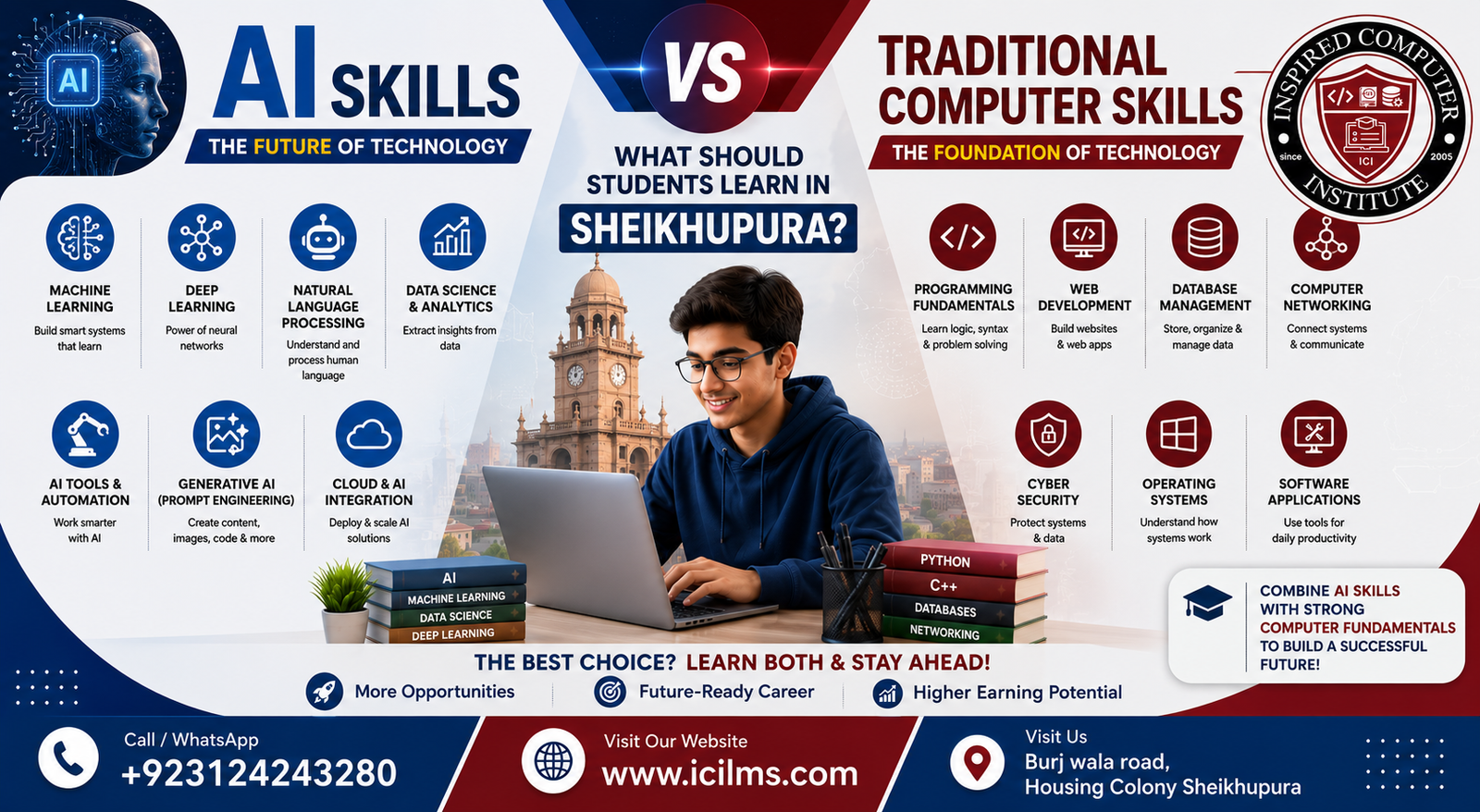
AI Skills vs Traditional Computer Skills What Should Students Learn in Sheikhupura
Komal Shahzadi
- June 16, 2026
- Comment 0
AI Skills vs Traditional Computer Skills What Should Students Learn in Sheikhupura
The digital world is changing faster than ever before. Just a few years ago, students mainly focused on learning basic computer operations, Microsoft Office, internet browsing, and software applications. Today, the rise of Artificial Intelligence (AI) has transformed how people learn, work, communicate, and solve problems. From AI-powered writing assistants and image generators to smart chatbots and data analysis tools, technology is becoming increasingly intelligent and accessible.
For students in Sheikhupura, this shift presents both opportunities and challenges. Many learners wonder whether they should focus on traditional computer education or invest their time in learning AI tools. The reality is that choosing one over the other may not be the smartest strategy. Traditional computer skills provide the foundation needed to understand technology, while AI skills help students work more efficiently and stay competitive in a rapidly evolving job market.
Educational institutions that recognize this balance are helping students prepare for the future more effectively. One such example is Inspired Computer Institute, which aims to equip learners with both practical computer knowledge and modern AI competencies. By combining these two areas, students can develop a versatile skill set that remains valuable across different industries and career paths.
Understanding the Changing Digital Landscape
Technology has become deeply integrated into nearly every aspect of daily life. Whether students are completing assignments, applying for jobs, communicating with teachers, or starting online businesses, digital skills are now essential rather than optional. The increasing use of automation and AI has accelerated this transformation, making it important for learners to understand both traditional computing concepts and emerging technologies.
Organizations around the world are adopting AI to improve productivity and decision-making. At the same time, they continue to rely on employees who possess strong computer fundamentals. Businesses still need professionals who can create documents, manage spreadsheets, troubleshoot technical issues, organize data, and understand software systems. AI may simplify many tasks, but it cannot completely replace human understanding and technical competence.
For students in Sheikhupura, adapting to this changing landscape means embracing a broader approach to learning. Instead of viewing AI and traditional computer education as competing options, they should see them as complementary skills. Those who understand how computers work and also know how to use AI effectively will be better positioned for academic success and future employment.
How Technology Has Evolved in Recent Years
The evolution of technology has been remarkable. Traditional computer education once focused heavily on hardware basics, operating systems, typing skills, office productivity software, and internet literacy. These skills remain relevant today, but the emergence of AI has introduced entirely new possibilities.
Modern AI tools can generate text, create presentations, analyze data, write code, summarize information, and automate repetitive tasks. Students can complete research faster, improve their writing, and explore creative projects with AI assistance. This evolution has not eliminated the need for foundational computer knowledge. Instead, it has increased the importance of understanding technology at a deeper level.
Those who possess only AI skills may struggle when technical issues arise or when tasks require manual control and critical analysis. Conversely, students with only traditional computer skills may miss opportunities to improve efficiency and productivity through AI. The most successful learners are those who combine both skill sets.
What Are Traditional Computer Skills?
Traditional computer skills refer to the foundational knowledge required to operate computers and use common software applications effectively. These skills form the backbone of digital literacy and remain highly valuable in educational institutions, businesses, and government organizations.
Students who learn traditional computing gain confidence in using technology for a variety of purposes. They understand how operating systems function, how files are organized, how software applications work, and how digital communication tools are used. This knowledge creates a strong foundation for advanced learning and professional development.
Despite the excitement surrounding AI, employers continue to seek candidates with strong computer fundamentals. Tasks such as document creation, spreadsheet management, presentation design, email communication, and data organization remain essential in most workplaces. Traditional computer education ensures students are prepared for these responsibilities.
Core Areas of Traditional Computer Education
Traditional computer education typically covers several important areas that contribute to overall digital competence.
| Skill Area | Description |
|---|---|
| Microsoft Office | Word processing, spreadsheets, presentations |
| Internet Skills | Browsing, research, online communication |
| Operating Systems | Windows management and navigation |
| Typing Skills | Efficient keyboard usage |
| Data Management | File organization and storage |
| Basic Troubleshooting | Solving common computer issues |
These competencies provide students with practical skills they can apply immediately in academic and professional environments.
Why Traditional Computer Skills Still Matter
Many people mistakenly believe AI will make traditional computer skills obsolete. The opposite is true. AI tools often require users to understand basic computing concepts before they can be used effectively. A student who cannot organize files, manage software, or work with digital documents may struggle to maximize the benefits of AI technology.
Traditional computer skills also promote independent problem-solving. When systems fail or unexpected issues occur, foundational knowledge helps users diagnose and resolve problems. Employers value this capability because it reduces dependency and increases workplace efficiency.
Another important consideration is credibility and accuracy. AI-generated content often requires editing, verification, and formatting. Students with strong computer skills are better equipped to review outputs, identify errors, and present information professionally.
What Are AI Skills?
AI skills involve understanding and using artificial intelligence tools to improve productivity, creativity, research, communication, and decision-making. These skills have become increasingly valuable as AI applications continue to expand across industries.
Learning AI does not necessarily mean becoming a machine learning engineer or data scientist. For many students, AI literacy involves knowing how to interact with AI systems, create effective prompts, evaluate responses, and use AI responsibly. These abilities can significantly enhance learning outcomes and workplace performance.
AI tools are now accessible to students at virtually every educational level. From generating study notes to assisting with coding projects, AI provides powerful support when used correctly. Students who develop AI skills can complete tasks more efficiently and gain exposure to technologies shaping the future workforce.
Popular AI Tools Students Are Using Today
Students increasingly rely on a variety of AI-powered platforms to support their educational activities. Some common examples include AI writing assistants, chatbot-based learning tools, presentation generators, image creation platforms, and coding assistants.
These tools help students brainstorm ideas, summarize complex information, improve writing quality, and automate repetitive tasks. They also encourage experimentation and innovation by allowing learners to explore concepts quickly and interactively.
The growing availability of AI tools means students who understand how to use them effectively may gain a significant advantage in both academic and professional settings.
The Growing Importance of AI Literacy
AI literacy is becoming as important as digital literacy. As organizations integrate AI into their operations, employees must understand how these systems work and how to use them responsibly. According to various global workforce studies, AI-related competencies are among the fastest-growing skill categories in modern employment markets.
Students who develop AI literacy learn how to evaluate information critically, recognize potential biases, and use AI outputs responsibly. These skills help them avoid overreliance on automation while maximizing its benefits.
Educational institutions that incorporate AI training are helping students stay relevant in an increasingly technology-driven economy. Learning AI today can create opportunities across fields such as business, marketing, education, healthcare, design, and software development.
AI Skills vs Traditional Computer Skills
The debate between AI skills and traditional computer skills often creates unnecessary confusion. Rather than competing with each other, these skill sets serve different but equally important purposes. Understanding their distinctions can help students make informed educational decisions.
Key Differences Between the Two
| Traditional Computer Skills | AI Skills |
|---|---|
| Focus on operating technology | Focus on leveraging intelligent tools |
| Emphasize software proficiency | Emphasize automation and productivity |
| Build foundational knowledge | Enhance efficiency and creativity |
| Essential for digital literacy | Essential for future workforce readiness |
| Require manual execution | Utilize AI-assisted processes |
Both categories contribute to a comprehensive digital education.
Advantages of Traditional Computer Skills
Traditional computer skills provide stability and versatility. They establish the technical foundation necessary for understanding software systems, managing digital information, and performing workplace tasks effectively. These competencies remain relevant across virtually every profession.
Students who master traditional computing also develop confidence when working independently. They can troubleshoot issues, adapt to new software environments, and understand technology beyond surface-level interactions.
Advantages of AI Skills
AI skills enable students to accomplish more in less time. They enhance productivity, support creativity, and help learners access information efficiently. AI can simplify complex tasks and provide valuable assistance during research, writing, coding, and project development.
These skills also increase career readiness. As businesses continue integrating AI into their workflows, employees who understand AI tools may have stronger employment prospects and greater opportunities for advancement.
Limitations of Relying Only on AI
While AI offers numerous benefits, relying exclusively on it can create significant challenges. AI systems occasionally generate inaccurate information, misunderstand instructions, or produce biased outputs. Students must possess sufficient knowledge to evaluate and verify AI-generated content.
Without traditional computer skills, users may become dependent on automation and struggle when technology does not perform as expected. Effective use of AI requires human judgment, critical thinking, and technical understanding.
Why Students in Sheikhupura Should Learn Both
Students in Sheikhupura face the same technological changes affecting learners worldwide. To remain competitive in higher education and future careers, they need a balanced skill set that includes both traditional computer knowledge and AI literacy.
The combination of these competencies creates stronger digital citizens who can adapt to evolving technologies while maintaining practical workplace capabilities. Learning both areas also increases flexibility, allowing students to pursue diverse career paths.
Building Future-Ready Career Opportunities
Employers increasingly seek candidates who can use technology effectively and adapt to innovation. Traditional computer skills demonstrate technical competence, while AI skills showcase adaptability and forward-thinking capabilities.
Students who possess both are better prepared for careers in administration, marketing, education, software development, entrepreneurship, finance, and numerous other fields. This combination improves employability and supports long-term professional growth.
Improving Academic Performance and Productivity
AI tools can help students organize research, generate study materials, and streamline learning processes. Traditional computer skills enable them to present information professionally, manage digital resources, and complete assignments efficiently.
Together, these abilities create a powerful academic advantage. Students can focus more on understanding concepts and less on repetitive tasks, leading to improved productivity and learning outcomes.
Developing Problem-Solving and Critical Thinking Skills
One of the greatest benefits of learning both AI and traditional computing is the development of strong problem-solving abilities. Traditional computer education teaches logical thinking and technical troubleshooting. AI training encourages experimentation, analysis, and strategic decision-making.
When combined, these skills help students evaluate information critically, solve complex challenges, and adapt to changing circumstances. Such capabilities are highly valued in both educational and professional environments.
Inspired Computer Institute’s Training Approach
Recognizing the importance of balanced digital education, Inspired Computer Institute focuses on helping students develop both traditional computer competencies and modern AI skills. This integrated approach reflects the realities of today’s technology-driven world and prepares learners for future opportunities.
Combining AI Education with Practical Computer Training
Inspired Computer Institute emphasizes a learning model that blends foundational computer education with exposure to emerging AI technologies. Students gain practical experience using office applications, internet tools, and computer systems while also exploring AI-powered platforms and productivity solutions.
This balanced methodology ensures learners understand both the mechanics of technology and the innovative tools transforming industries. Rather than replacing traditional education, AI training complements and strengthens existing computer knowledge.
Industry-Relevant Learning Environment
The institute aims to provide training aligned with current market demands. By incorporating practical exercises, real-world projects, and modern software tools, students gain experience that extends beyond theoretical knowledge.
Such an environment helps learners build confidence, improve technical proficiency, and prepare for workplace expectations. Exposure to both conventional and AI-driven technologies creates a more comprehensive educational experience.
Benefits for Students and Job Seekers
Students and job seekers who participate in this integrated training approach may benefit in several ways:
- Stronger digital literacy
- Enhanced productivity and efficiency
- Greater career flexibility
- Improved problem-solving capabilities
- Better preparation for future technologies
- Increased confidence in professional environments
These advantages can contribute significantly to academic success and long-term career development.
Conclusion
The question is no longer whether students should learn AI skills or traditional computer skills. The real question is how effectively they can combine both. Traditional computer education provides the foundation for digital competence, while AI skills unlock new levels of productivity, creativity, and innovation. Each supports the other, creating a powerful combination that prepares students for modern education and employment.
For students in Sheikhupura, embracing both areas of learning is one of the smartest investments they can make in their future. Institutions such as Inspired Computer Institute recognize this reality by integrating practical computer training with AI education, helping learners develop the balanced skill set required in today’s rapidly evolving digital world.
FAQs
1. What is the difference between AI skills and traditional computer skills?
Traditional computer skills focus on operating software and hardware systems, while AI skills involve using intelligent tools to automate tasks, generate content, analyze data, and improve productivity.
2. Are traditional computer skills still important in the age of AI?
Yes. Traditional computer skills remain essential because they provide the foundation needed to understand, manage, and effectively use digital technologies, including AI tools.
3. Which AI tools should students learn first?
Students can start with AI chatbots, writing assistants, presentation generators, research tools, and coding assistants to improve productivity and learning efficiency.
4. Why should students in Sheikhupura learn AI?
AI skills can enhance academic performance, improve productivity, and increase career opportunities in an increasingly technology-driven job market.
5. How does Inspired Computer Institute help students prepare for the future?
Inspired Computer Institute combines practical computer education with AI-focused training, helping students develop both foundational digital skills and modern technological competencies.
6. Can AI replace traditional computer education completely?
No. AI can assist with many tasks, but it cannot replace the foundational knowledge gained through traditional computer education. Students still need to understand software, file management, internet safety, data handling, and troubleshooting to use technology effectively and independently.
7. What career opportunities benefit from both AI and computer skills?
Many careers now require a combination of these skills, including digital marketing, graphic design, content creation, software development, data entry, administration, customer support, e-commerce management, accounting, and business operations. Professionals who understand both areas often have a competitive advantage in the job market.
8. Is AI difficult for beginners to learn?
Not at all. Many modern AI tools are designed with user-friendly interfaces that make them accessible to beginners. Students can start by learning how to write effective prompts, generate content, conduct research, and automate simple tasks before moving on to more advanced applications.
9. How can AI help students with their studies?
AI can assist students by summarizing lengthy articles, explaining complex concepts, generating practice questions, improving writing quality, organizing study notes, and helping with research. When used responsibly, AI can make learning more efficient and engaging.
10. What traditional computer skills should every student master?
Every student should learn:
- Microsoft Word, Excel, and PowerPoint
- Internet research techniques
- Email communication
- File and folder management
- Basic computer troubleshooting
- Cybersecurity and online safety practices
These skills remain essential in education and professional environments.
11. Why is critical thinking important when using AI?
AI tools can occasionally provide inaccurate, outdated, or misleading information. Critical thinking helps students evaluate AI-generated content, verify facts, identify errors, and make informed decisions instead of accepting every response at face value.
12. How does learning AI improve employability?
Employers increasingly value candidates who can use AI tools to improve productivity, automate repetitive tasks, analyze information, and enhance workflow efficiency. AI literacy demonstrates adaptability and readiness for modern workplace technologies.
13. What industries are adopting AI the fastest?
AI is rapidly transforming industries such as:
- Education
- Healthcare
- Finance
- Marketing
- Retail and E-commerce
- Manufacturing
- Information Technology
- Customer Service
Students who learn AI today can benefit from opportunities across these growing sectors.
14. Should school and college students start learning AI now?
Yes. Early exposure to AI helps students develop digital confidence and understand technologies that are shaping the future. Learning AI alongside traditional computer skills allows students to build a strong foundation before entering higher education or the workforce.
15. What makes Inspired Computer Institute’s approach beneficial for students?
Inspired Computer Institute focuses on a balanced learning model that combines practical computer education with modern AI training. This approach helps students gain essential technical skills while also learning how to use emerging technologies effectively, preparing them for academic success and future career opportunities.
16. How can students use AI responsibly?
Students should use AI as a learning assistant rather than a replacement for independent thinking. Responsible use includes verifying information, avoiding plagiarism, protecting personal data, and using AI to enhance understanding rather than bypass learning.
17. Will AI skills become more important in the future?
Industry trends indicate that AI-related skills will continue to grow in importance. As businesses integrate AI into daily operations, professionals who understand both AI tools and traditional computing concepts will likely have stronger career prospects.
18. Can learning AI help students start online businesses?
Yes. AI can help students create content, design marketing materials, conduct market research, manage customer interactions, and improve productivity. Combined with computer skills, AI can support entrepreneurship and digital business growth.
19. What is the best way to learn both AI and computer skills?
The most effective approach is structured training that covers computer fundamentals first and then introduces AI applications. Practical projects, hands-on exercises, and real-world examples help students understand how both skill sets work together.
20. Why is Sheikhupura’s student community increasingly interested in AI education?
Students in Sheikhupura are recognizing that digital transformation is creating new educational and career opportunities. AI education, combined with traditional computer training, helps them stay competitive, improve productivity, and prepare for the demands of the modern workforce.