Currently Empty: ₨ 0
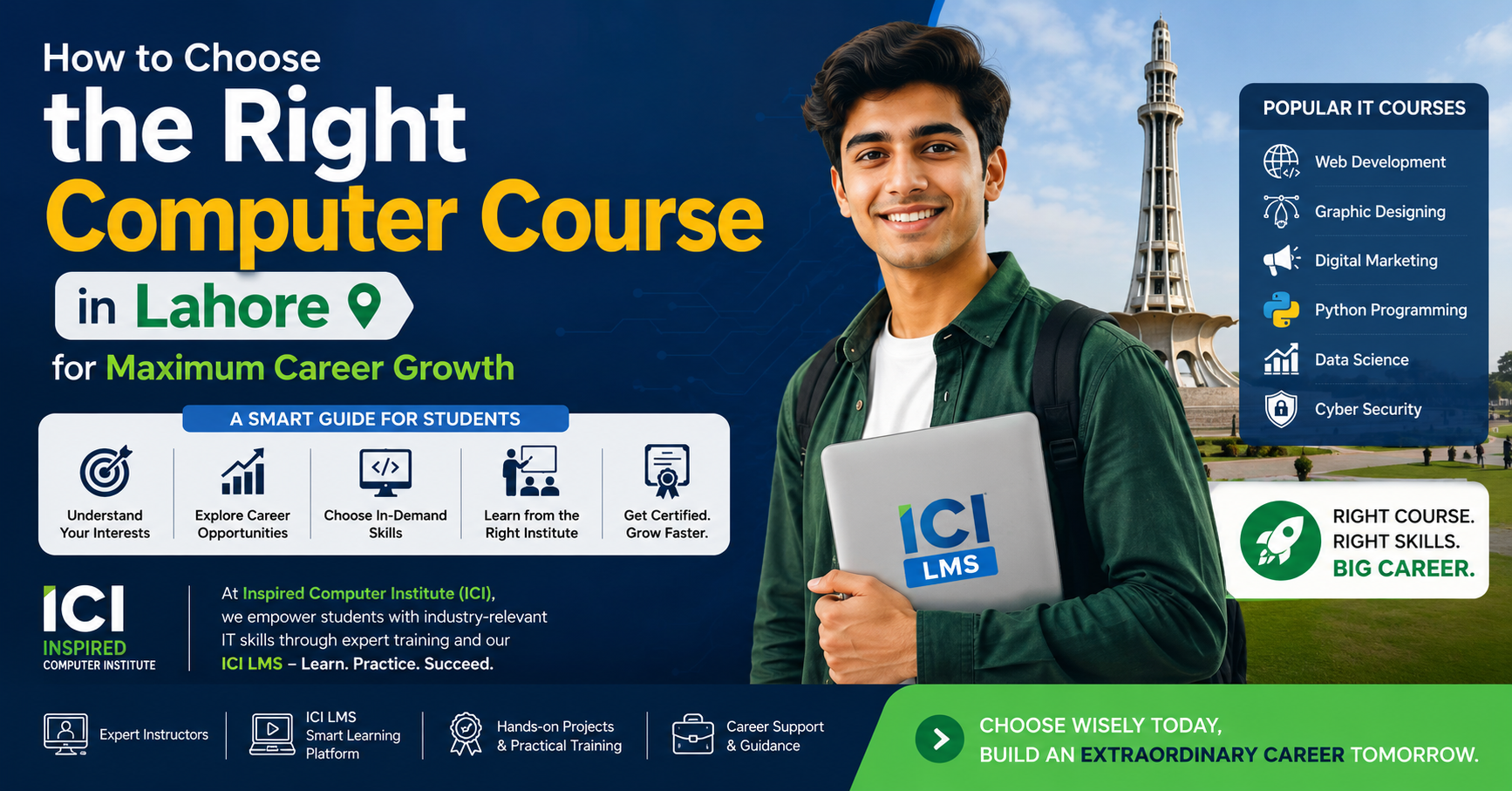
How to Choose the Right Computer Course in Lahore for Maximum Career Growth
Komal Shahzadi
- June 1, 2026
- Comment 0
How to Choose the Right Computer Course in Lahore for Maximum Career Growth
Introduction to IT Education in Lahore
Lahore has emerged as one of Pakistan’s leading educational and technology hubs, attracting thousands of students who want to build successful careers in the digital economy. Over the last decade, the city has experienced significant growth in software houses, digital marketing agencies, e-commerce businesses, startups, and multinational technology companies. This rapid expansion has increased the demand for skilled IT professionals across a wide range of specializations. As a result, computer education is no longer viewed as an optional skill; it has become a valuable asset that can open doors to local and international career opportunities.
The availability of computer courses in Lahore has also increased dramatically. Students can now choose from hundreds of training programs covering web development, graphic design, software engineering, digital marketing, cybersecurity, networking, data analytics, artificial intelligence, and many other fields. While having numerous options is beneficial, it also creates confusion for students who are unsure about which course will provide the best return on their investment of time and money.
Many students enroll in courses simply because their friends recommend them or because they hear that a particular skill is trending. This approach often leads to disappointment because not every technology field is suitable for every individual. Career growth depends on selecting a course that matches your interests, strengths, long-term goals, and current market demand. A carefully chosen course can become the foundation of a rewarding professional journey, while a poor choice can result in wasted resources and limited career progression.
Understanding how to evaluate different courses, institutions, and career paths is therefore essential. By taking a strategic approach to your education, you can maximize your chances of building a successful career in Pakistan’s growing technology sector and even compete in the global digital marketplace.
Why Choosing the Right Computer Course Is a Career-Defining Decision
Selecting a computer course may seem like a simple educational decision, but in reality, it is one of the most important career choices a student can make. The technology industry is vast, and each specialization offers unique opportunities, challenges, earning potential, and growth prospects. The course you choose today can influence the type of work you perform, the industries you enter, and the income opportunities available to you in the future.
A common misconception among students is that any IT course will automatically lead to success. While technology skills are undoubtedly valuable, success often depends on choosing the right specialization and developing expertise in that area. For example, someone who enjoys creativity and visual storytelling may excel in graphic design but struggle with programming. Similarly, an individual who enjoys logical thinking and problem-solving may find software development highly rewarding but may not enjoy marketing-related work.
The right course should help students develop practical skills that employers and clients actively seek. Modern organizations prioritize professionals who can solve real business problems rather than individuals who possess only theoretical knowledge. This is why selecting a course with strong practical components is often more beneficial than choosing one focused solely on academic concepts.
Technology is constantly evolving. New tools, frameworks, and methodologies emerge every year. Choosing a course that teaches adaptable and future-focused skills can significantly improve long-term employability. Students who make informed educational decisions are better positioned to secure high-paying jobs, build successful freelance careers, or launch their own technology-based businesses.
The Rapid Growth of the IT Industry in Pakistan
Pakistan’s IT sector has become one of the country’s fastest-growing industries. Government initiatives, increased internet penetration, expanding startup ecosystems, and growing international demand for digital services have all contributed to this growth. The country’s software exports have continued to increase, creating substantial opportunities for skilled professionals.
Technology companies are actively seeking individuals with expertise in software development, cloud computing, digital marketing, cybersecurity, web development, and data management. This demand extends beyond major technology firms. Businesses in healthcare, banking, education, retail, manufacturing, and telecommunications also require skilled IT professionals.
The rise of remote work has further expanded opportunities. Pakistani professionals can now work with international companies without leaving the country. This global accessibility means that students who develop in-demand digital skills can compete in worldwide job markets and potentially earn significantly higher incomes than those available through traditional employment paths.
The Impact of Skill-Based Education on Career Success
Modern employers increasingly value practical skills over formal qualifications alone. A degree remains important in many situations, but employers often prioritize candidates who can demonstrate real-world abilities. This shift has increased the importance of specialized computer courses that focus on hands-on training and portfolio development.
Skill-based education helps students bridge the gap between academic knowledge and workplace expectations. Instead of memorizing theories, learners gain experience solving practical problems, working with industry-standard tools, and completing projects similar to those encountered in professional environments.
Students who graduate with strong portfolios, project experience, and practical expertise often find it easier to secure employment or freelance clients. This is one of the primary reasons why choosing the right course can have a lasting impact on career success.
Understanding Your Career Goals Before Selecting a Course
Before enrolling in any computer course, it is essential to clearly define your career objectives. Many students focus exclusively on course popularity without considering whether the field aligns with their personal interests and long-term ambitions. This can lead to frustration, reduced motivation, and difficulty maintaining consistent progress.
Career planning does not require a detailed roadmap for the next twenty years. However, having a general sense of direction helps narrow your options and increases the likelihood of choosing a course that supports your aspirations. Consider the type of work environment you prefer. Do you want to work independently as a freelancer? Are you interested in joining a large corporation? Do you dream of launching your own startup?
Your answers to these questions can significantly influence which course is most appropriate. Different technology fields support different career paths. Understanding your goals allows you to make more strategic educational decisions and avoid unnecessary detours.
Assessing Your Interests and Natural Strengths
Every successful career begins with self-awareness. Students should evaluate their interests, personality traits, and natural abilities before committing to a specialization. Technology offers opportunities for creative thinkers, analytical problem-solvers, communicators, strategists, and entrepreneurs.
For example, creative individuals often enjoy graphic design, user interface design, animation, and multimedia production. Analytical thinkers may prefer software development, cybersecurity, or data analysis. Individuals who enjoy communication and strategy often thrive in digital marketing and SEO.
Recognizing your strengths helps identify courses where you are most likely to succeed and remain motivated over the long term.
Aligning Personal Goals with Market Demand
Passion alone is not enough; market demand also matters. The most effective career decisions occur when personal interests intersect with industry needs. Researching job trends, salary ranges, and employment opportunities can help determine which fields offer the strongest prospects.
Technology sectors such as web development, cybersecurity, artificial intelligence, cloud computing, and digital marketing continue to experience strong growth. By combining personal interests with high-demand skills, students can maximize both job satisfaction and career opportunities.
The Most In-Demand Computer Courses in Lahore
The technology industry offers a wide variety of specializations, each with its own career opportunities, earning potential, and learning requirements. One of the biggest mistakes students make is assuming that all computer courses provide similar outcomes. In reality, each field serves different industries and requires different skill sets. Understanding the most in-demand computer courses in Lahore can help students make informed decisions based on their interests and career goals.
As Lahore continues to grow as a center for technology, software development, digital entrepreneurship, and online business, employers are actively seeking professionals with practical technical expertise. Companies are not only hiring for traditional IT roles but also for positions that support digital transformation, customer engagement, cybersecurity, and business automation. This means students now have more career options than ever before.
When evaluating courses, it is important to look beyond short-term trends. Some technologies become popular for a brief period and then lose relevance. Students should prioritize courses that teach foundational skills while also incorporating current industry practices. The ideal course provides a balance between practical application and long-term career value.
Another important consideration is flexibility. Many modern IT skills can be used in multiple career paths. A web developer can work in a company, freelance for international clients, or start a web development agency. A digital marketer can work for brands, run campaigns for businesses, or launch their own online ventures. This flexibility makes technology education one of the most versatile investments a student can make.
Let’s explore some of the most valuable and career-focused computer courses available in Lahore today.
Web Development
Web development remains one of the most sought-after skills in the global technology industry. Every business, whether small or large, needs an online presence. Websites are often the first point of interaction between a company and its customers, making skilled web developers essential in nearly every industry.
A quality web development course teaches students how websites are designed, built, and maintained. Learners typically begin with foundational technologies such as HTML, CSS, and JavaScript before progressing to advanced frameworks and programming languages. Modern web development also includes responsive design, database integration, content management systems, and web application development.
One reason web development is such an attractive career option is its accessibility. Students can begin learning with relatively minimal resources and start building projects quickly. Over time, they can create portfolios showcasing their abilities to employers and clients. Many successful freelancers started by developing simple websites before advancing to complex web applications.
The earning potential in web development is also substantial. Businesses across the world regularly hire developers for website creation, maintenance, e-commerce development, and custom web solutions. Remote work opportunities are abundant, allowing professionals to serve international clients while working from Lahore. For students looking for a skill that combines creativity, technical expertise, and strong career prospects, web development remains one of the most reliable choices.
Graphic Design and Multimedia
Graphic design is ideal for individuals who enjoy creativity, visual communication, and artistic expression. In today’s digital environment, businesses rely heavily on visual content to attract customers, build brand recognition, and communicate effectively. This demand has created a thriving market for skilled graphic designers.
A comprehensive graphic design course teaches students how to use industry-standard tools such as Adobe Photoshop, Illustrator, InDesign, and other creative software. Beyond technical skills, students learn design principles, typography, branding, color theory, layout creation, and visual storytelling techniques.
Graphic designers play an important role in marketing campaigns, social media content creation, website design, product packaging, advertising materials, and multimedia production. Their work influences how customers perceive brands and interact with digital experiences.
The field has expanded significantly due to the rise of social media platforms and online businesses. Every company now requires graphics for advertisements, websites, presentations, and promotional campaigns. This has created opportunities for full-time employment as well as freelancing.
Creative professionals often appreciate the flexibility that graphic design offers. Designers can work independently, collaborate with agencies, or even build personal brands around their creative services. For students with artistic talent and a passion for visual communication, graphic design provides a rewarding and sustainable career path.
Digital Marketing and SEO
Digital marketing has transformed the way businesses attract customers and generate revenue. As more consumers spend time online, companies increasingly invest in digital strategies to improve visibility, build relationships, and drive sales. This shift has created strong demand for skilled digital marketing professionals.
A digital marketing course typically covers search engine optimization (SEO), social media marketing, content marketing, email marketing, paid advertising, analytics, and conversion optimization. Students learn how businesses use digital channels to reach target audiences and achieve marketing objectives.
SEO is particularly valuable because it focuses on increasing website visibility in search engine results. Companies often compete aggressively for online rankings because higher visibility leads to more traffic, leads, and revenue. Professionals with SEO expertise are highly sought after by businesses of all sizes.
Digital marketing is also one of the most freelance-friendly career options. Many professionals manage campaigns for multiple clients simultaneously, creating flexible income opportunities. Others work within agencies, startups, e-commerce businesses, or multinational corporations.
The dynamic nature of digital marketing makes it an exciting field. New platforms, tools, and strategies emerge regularly, creating continuous learning opportunities. Students who enjoy creativity, communication, data analysis, and strategic thinking often find digital marketing both engaging and financially rewarding.
Software Development and Programming
Software development is one of the most respected and lucrative professions within the technology industry. Software developers build applications, systems, and tools that power modern businesses, websites, smartphones, and digital services.
Programming courses typically introduce students to languages such as Python, Java, JavaScript, C#, or PHP. Learners develop problem-solving skills while creating software solutions for real-world challenges. As their expertise grows, they can specialize in areas such as mobile app development, enterprise software, cloud computing, artificial intelligence, or machine learning.
The demand for software developers continues to increase globally. Organizations rely on software to improve efficiency, automate processes, manage data, and enhance customer experiences. This reliance creates consistent employment opportunities across numerous industries.
One of the major advantages of software development is career scalability. Entry-level developers can gradually advance into senior engineering roles, technical leadership positions, software architecture, or entrepreneurship. The field rewards continuous learning and innovation, making it particularly appealing to individuals who enjoy solving complex problems.
Although programming requires dedication and persistence, the long-term rewards are often significant. High earning potential, global demand, remote work opportunities, and intellectual challenges make software development one of the strongest career paths available today.
Cybersecurity and Networking
As businesses become increasingly dependent on digital infrastructure, protecting sensitive information has become a top priority. Cyberattacks, data breaches, and online threats continue to grow in sophistication, creating urgent demand for cybersecurity professionals.
Cybersecurity courses teach students how to identify vulnerabilities, protect systems, monitor networks, and respond to security incidents. Networking courses focus on designing, maintaining, and troubleshooting communication systems that connect devices and organizations.
These fields are essential because every modern business relies on secure and reliable digital infrastructure. Banks, healthcare providers, government agencies, educational institutions, and multinational corporations all require cybersecurity expertise.
Professionals in cybersecurity often enjoy strong job security because organizations cannot afford to neglect digital protection. The field also offers numerous specialization options, including ethical hacking, penetration testing, security analysis, compliance management, and cloud security.
Networking specialists similarly play a crucial role in maintaining business operations. They ensure that systems remain connected, efficient, and secure. Students who enjoy technology, investigation, and problem-solving may find cybersecurity and networking particularly rewarding.
Career Opportunities After Completing an IT Course
Completing a computer course is only the beginning of a professional journey. The true value of IT education lies in the opportunities it creates afterward. One of the reasons technology education remains so attractive is the diversity of career paths available to graduates.
Unlike many traditional professions, IT skills can be applied in multiple environments. A student may choose employment, freelancing, consulting, entrepreneurship, or even a combination of these options. This flexibility allows individuals to shape careers according to their personal goals and lifestyles.
Technology professionals are also less restricted by geographic boundaries. Thanks to remote work and online collaboration tools, skilled individuals can provide services to clients and employers around the world. This global accessibility significantly expands career possibilities and earning potential.
Understanding the various opportunities available after completing an IT course can help students make more strategic educational decisions and set realistic expectations for their future careers.
Career Opportunities After Completing an IT Course
The technology sector is unique because it offers multiple pathways to professional success. Unlike some industries where career progression follows a fixed structure, IT professionals can customize their journeys according to their skills, interests, and ambitions. Whether someone prefers the independence of freelancing, the stability of corporate employment, or the excitement of entrepreneurship, technology skills provide the flexibility to pursue different goals.
Another major advantage is that IT careers often reward competence more than seniority. A highly skilled individual with a strong portfolio can sometimes achieve significant success even without years of experience. Employers and clients are increasingly interested in results, practical expertise, and the ability to solve problems efficiently.
Technology careers also tend to evolve continuously. As professionals gain experience, they can move into specialized roles, leadership positions, consulting opportunities, or business ownership. This creates long-term growth potential that extends far beyond entry-level employment.
For students in Lahore, the expanding digital economy means opportunities are available both locally and internationally. The following career paths represent some of the most common and rewarding directions available after completing an IT course.
Freelancing Careers
Freelancing has revolutionized the employment landscape for technology professionals. Instead of working exclusively for one employer, freelancers offer their skills directly to clients, often serving businesses from multiple countries simultaneously. This model has become especially popular in Pakistan, where thousands of professionals earn income through platforms such as Upwork, Fiverr, Freelancer, and PeoplePerHour.
Students who complete courses in web development, graphic design, SEO, digital marketing, content creation, software development, or video editing often find freelancing particularly accessible. They can start by taking smaller projects, building client relationships, and gradually increasing their rates as their expertise grows.
One of the greatest benefits of freelancing is flexibility. Professionals can choose their projects, set their schedules, and determine how much work they want to accept. This independence appeals to many individuals who prefer autonomy over traditional employment structures.
Freelancing also creates opportunities for international income. A developer in Lahore can work with clients in the United States, Canada, Australia, the United Kingdom, or Europe without leaving home. This global access can significantly increase earning potential compared to local-only opportunities.
Success in freelancing requires more than technical skills. Communication, professionalism, time management, and client relationship management are equally important. Students who develop both technical expertise and business skills often achieve the greatest long-term success in the freelance marketplace.
Corporate Employment Opportunities
While freelancing offers independence, many students prefer the stability and structured growth opportunities associated with corporate employment. Technology professionals are in demand across virtually every industry, making corporate careers an attractive option for graduates of computer courses.
Organizations rely on technology for operations, communication, customer service, data management, security, and innovation. As a result, companies regularly hire web developers, software engineers, IT support specialists, network administrators, cybersecurity analysts, graphic designers, digital marketers, and data professionals.
Corporate employment provides several advantages. Employees often receive fixed salaries, professional development opportunities, health benefits, mentorship, and exposure to large-scale projects. Working within established organizations can also accelerate learning by allowing professionals to collaborate with experienced colleagues and multidisciplinary teams.
Another significant benefit is career progression. Many companies offer clearly defined advancement paths that enable employees to move from junior positions to senior roles, management positions, and executive leadership opportunities. These structured career ladders provide long-term stability and growth.
For students who value teamwork, mentorship, and organizational support, corporate employment can be an excellent way to develop expertise while building a strong professional network.
Entrepreneurship and Business Development
Technology skills provide a powerful foundation for entrepreneurship. Many successful startups and digital businesses begin with individuals who possess technical expertise and a vision for solving problems. Unlike traditional businesses that may require substantial startup capital, technology ventures can often be launched with relatively modest resources.
Students who learn web development can create websites and software products. Digital marketers can establish agencies that help businesses grow online. Graphic designers can launch branding studios. Software developers can build applications and subscription-based platforms that generate recurring revenue.
Entrepreneurship offers significant rewards but also involves greater risk. Business owners must manage finances, marketing, customer acquisition, operations, and long-term planning. However, those who successfully build businesses often enjoy greater independence and unlimited growth potential.
The startup ecosystem in Pakistan continues to expand, creating new opportunities for technology-driven innovation. Entrepreneurs who combine technical expertise with strong business strategies can develop solutions that serve local and international markets.
For ambitious students who enjoy innovation, leadership, and problem-solving, entrepreneurship represents one of the most exciting career paths available after completing an IT course.
Essential Factors to Consider When Choosing a Computer Institute
Selecting the right course is important, but choosing the right institute is equally critical. Even the most promising subject can become ineffective if it is taught through outdated methods or lacks practical application. Students should carefully evaluate training providers before making a final decision.
A quality institute does more than deliver information. It creates an environment where students can develop confidence, build practical skills, receive mentorship, and prepare for real-world challenges. The educational experience should bridge the gap between learning and employment.
With numerous computer institutes operating in Lahore, students should compare programs based on measurable factors rather than marketing claims alone. The following considerations can help identify institutions that provide genuine value.
Updated Curriculum
Technology changes rapidly. Tools and techniques that were relevant five years ago may no longer meet industry requirements today. For this reason, an updated curriculum is one of the most important indicators of a quality computer institute.
Students should review course outlines carefully and ensure that the material reflects current technologies, best practices, and employer expectations. Modern training programs should incorporate contemporary tools, frameworks, and workflows that professionals actually use in the workplace.
An updated curriculum also demonstrates that the institute actively monitors industry trends and adapts its programs accordingly. This commitment to relevance helps students develop skills that remain valuable after graduation.
Qualified Trainers
Instructors play a significant role in the learning process. Experienced trainers bring practical insights that go beyond textbooks and theoretical explanations. They can share real-world examples, discuss industry challenges, and provide guidance based on professional experience.
Students should look for institutes where instructors have hands-on expertise in their respective fields. Trainers who actively work in the industry often possess deeper knowledge of current practices and emerging trends.
Strong instructors also know how to simplify complex topics, making technical concepts easier to understand. Their mentorship can significantly accelerate student development and improve learning outcomes.
Practical Learning Environment
Technology skills cannot be mastered through theory alone. Practical experience is essential because it allows students to apply concepts, solve problems, and gain confidence in their abilities.
A quality institute should emphasize project-based learning, assignments, case studies, and real-world simulations. Students should have opportunities to create websites, design graphics, develop applications, execute marketing campaigns, or configure networks depending on their chosen field.
Practical training also helps students build portfolios that demonstrate their capabilities to employers and clients. A strong portfolio often carries more weight than certificates alone when seeking professional opportunities.
Certifications and Job Placement Support
Certifications can enhance credibility and strengthen professional profiles. While practical skills remain the most important factor, recognized certifications can provide additional evidence of competence.
Students should also consider whether an institute offers career support services. Resume development, interview preparation, internship opportunities, networking events, and job placement assistance can significantly improve employment prospects.
Institutes that maintain relationships with employers often provide valuable connections that help graduates transition from education to professional careers more effectively.
Why Inspired Computer Institute (ICI LMS) Is a Smart Choice
In a competitive educational environment, students need training providers that focus on practical outcomes rather than simply delivering lectures. Inspired Computer Institute (ICI LMS) has positioned itself as an institution dedicated to helping learners acquire relevant skills that align with modern industry demands.
The institute recognizes that today’s students require more than theoretical knowledge. Employers seek professionals who can contribute immediately, adapt quickly, and demonstrate practical competence. This understanding influences the structure and delivery of its programs.
By emphasizing industry relevance, flexible learning, and skill development, Inspired Computer Institute aims to prepare students for success in today’s technology-driven economy.
Why Inspired Computer Institute (ICI LMS) Is a Smart Choice
Choosing the right institute can significantly influence a student’s learning experience and future career prospects. While many institutions offer computer courses, the quality of training, practical exposure, and student support can vary greatly. Students who want maximum career growth should look for institutes that focus on real-world skills, industry relevance, and continuous learning opportunities. This is where Inspired Computer Institute (ICI LMS) stands out as a strong option for aspiring IT professionals in Lahore.
Technology employers today are less interested in memorized theory and more focused on practical capabilities. They want candidates who can build websites, create marketing campaigns, design graphics, write code, troubleshoot systems, and solve business problems. Inspired Computer Institute understands this shift and structures its training programs to help students develop job-ready skills rather than simply complete a course.
The institute’s approach is designed to support learners from different backgrounds. Whether someone is a student, a fresh graduate, a job seeker, a freelancer, or a working professional looking to upgrade their skills, the training environment aims to accommodate different learning needs. This flexibility is increasingly important in today’s fast-moving digital world, where individuals often need to balance education with work, family, and other commitments.
Another notable advantage is the focus on career-oriented learning. Instead of concentrating solely on academic knowledge, students are encouraged to gain practical experience, build portfolios, and understand how technology is applied in real business environments. This approach helps bridge the gap between learning and employment, increasing the likelihood of successful career outcomes after course completion.
Industry-Focused Training Programs
One of the biggest challenges facing students today is ensuring that the skills they learn remain relevant in a rapidly changing job market. Many educational programs struggle to keep pace with technological advancements, leaving graduates with outdated knowledge. Inspired Computer Institute addresses this challenge by emphasizing industry-focused training that aligns with current market requirements.
Industry-focused education means teaching students the tools, platforms, and methodologies that employers actively use. Whether the subject is web development, graphic design, digital marketing, software development, or another IT discipline, the goal is to provide practical skills that can be applied immediately in professional environments.
Students benefit from exposure to real-world scenarios and project-based learning experiences. Instead of merely studying concepts, they learn how to implement solutions, complete assignments, and develop work that reflects industry expectations. This practical approach enhances both confidence and competence.
Employers increasingly evaluate candidates based on their ability to demonstrate skills rather than simply present certificates. Students who complete hands-on projects often have stronger portfolios and greater confidence during interviews. By focusing on practical application, industry-focused training helps prepare learners for the realities of modern technology careers.
The emphasis on market-relevant skills also benefits aspiring freelancers. Clients typically care about results rather than academic credentials alone. Students who can demonstrate completed projects and proven abilities are often better positioned to secure freelance contracts and build long-term client relationships.
Flexible Learning Through ICI LMS
Modern education is evolving beyond traditional classroom boundaries. Students increasingly expect learning experiences that fit their schedules and lifestyles. This is particularly important for working professionals, university students, and individuals who may not always be able to attend physical classes consistently.
The ICI LMS (Learning Management System) supports this flexibility by providing a digital learning environment that allows students to access educational resources more conveniently. Through online learning tools, course materials, assignments, and educational content can be organized in a way that supports structured and efficient learning.
Flexibility offers several advantages. Students can review lessons multiple times, revisit challenging concepts, and learn at a pace that matches their individual needs. This personalized learning experience often improves understanding and retention compared to one-size-fits-all educational approaches.
For working professionals, flexible learning can make skill development more accessible. Instead of choosing between employment and education, individuals can often balance both responsibilities more effectively. This accessibility helps more people pursue career advancement without disrupting their existing commitments.
The integration of digital learning tools also reflects broader industry trends. As remote work and online collaboration become increasingly common, students benefit from becoming comfortable with digital platforms and self-directed learning environments. These experiences can contribute positively to future workplace readiness.
Common Mistakes Students Should Avoid
Choosing a computer course is an important investment, but many students make avoidable mistakes during the decision-making process. These mistakes can lead to wasted time, unnecessary expenses, and frustration. Understanding common pitfalls can help students make smarter choices and achieve better outcomes.
One of the most common mistakes is following trends without understanding personal interests. Students often hear that a particular skill is in demand and immediately enroll without considering whether they actually enjoy the subject. While market demand is important, long-term success typically requires genuine interest and motivation.
Another mistake is focusing solely on course fees. While affordability matters, the cheapest option is not always the best value. A slightly higher investment in quality education may provide significantly better training, practical experience, and career support. Students should evaluate overall value rather than price alone.
Many learners also underestimate the importance of practical experience. Technology is a hands-on field. Simply attending lectures is rarely enough to develop professional-level skills. Students should prioritize programs that emphasize projects, assignments, and portfolio development.
Some students expect immediate success after completing a course. While education provides a foundation, career growth requires continuous learning, practice, networking, and persistence. Technology professionals must regularly update their knowledge to remain competitive.
Another common error is ignoring future career goals. Students sometimes select courses without considering where those skills might lead professionally. A clear understanding of career objectives can make course selection far more strategic and effective.
Avoiding these mistakes can significantly improve the educational experience and increase the likelihood of achieving meaningful career growth.
Future Trends in IT Careers
Technology continues to evolve at an extraordinary pace, creating new opportunities and transforming existing professions. Students who understand future trends can make more informed decisions about which skills to develop and which career paths to pursue.
One of the most significant trends is the increasing adoption of artificial intelligence (AI) and machine learning. Organizations are using AI to automate tasks, improve decision-making, and enhance customer experiences. Professionals who understand AI technologies are likely to be in strong demand in the coming years.
Cloud computing is another rapidly growing field. Businesses increasingly rely on cloud-based infrastructure to improve flexibility, scalability, and efficiency. Skills related to cloud platforms and cloud security are becoming increasingly valuable.
Cybersecurity will remain a priority as digital threats continue to evolve. As organizations collect and manage more data, protecting sensitive information becomes even more important. Cybersecurity specialists are expected to remain among the most sought-after professionals in the technology sector.
Data analytics is also gaining importance. Companies generate enormous amounts of information every day and need professionals who can interpret data and transform it into actionable insights. Data-driven decision-making is becoming a key competitive advantage across industries.
Digital marketing continues to evolve alongside consumer behavior. Emerging technologies, social media platforms, and search engine algorithms create ongoing demand for professionals who can adapt marketing strategies to changing environments.
Remote work and global collaboration are likely to remain significant trends as well. Technology professionals increasingly have opportunities to work with international clients and organizations regardless of physical location. This globalization expands career possibilities and allows skilled individuals to access broader markets.
Students who focus on continuous learning and adaptability will be best positioned to thrive in this evolving landscape. Technology careers reward curiosity, innovation, and the willingness to embrace change.
Conclusion
Choosing the right computer course in Lahore is one of the most important decisions a student can make when planning for long-term career success. The technology industry offers countless opportunities, but achieving meaningful growth requires more than simply enrolling in a popular program. Students must carefully evaluate their interests, strengths, career objectives, and market demand before making a commitment.
Fields such as web development, graphic design, digital marketing, software development, and cybersecurity continue to offer strong employment prospects both locally and internationally. These skills can support multiple career paths, including freelancing, corporate employment, consulting, and entrepreneurship. The flexibility and global reach of technology careers make them particularly attractive in today’s digital economy.
Equally important is the choice of institute. High-quality training programs should provide updated curricula, experienced instructors, practical learning opportunities, and career support services. Institutions that focus on real-world application help students transition more effectively from education to professional environments.
Inspired Computer Institute (ICI LMS) offers a learning environment that emphasizes industry relevance, practical skill development, and flexible education. Through career-focused training and modern learning systems, students can build competencies that align with current market expectations and future industry trends.
The technology sector rewards those who invest in continuous learning and strategic skill development. By selecting the right course, choosing a reputable institute, and remaining committed to personal growth, students can position themselves for rewarding careers in one of the world’s most dynamic and opportunity-rich industries.