Currently Empty: ₨ 0
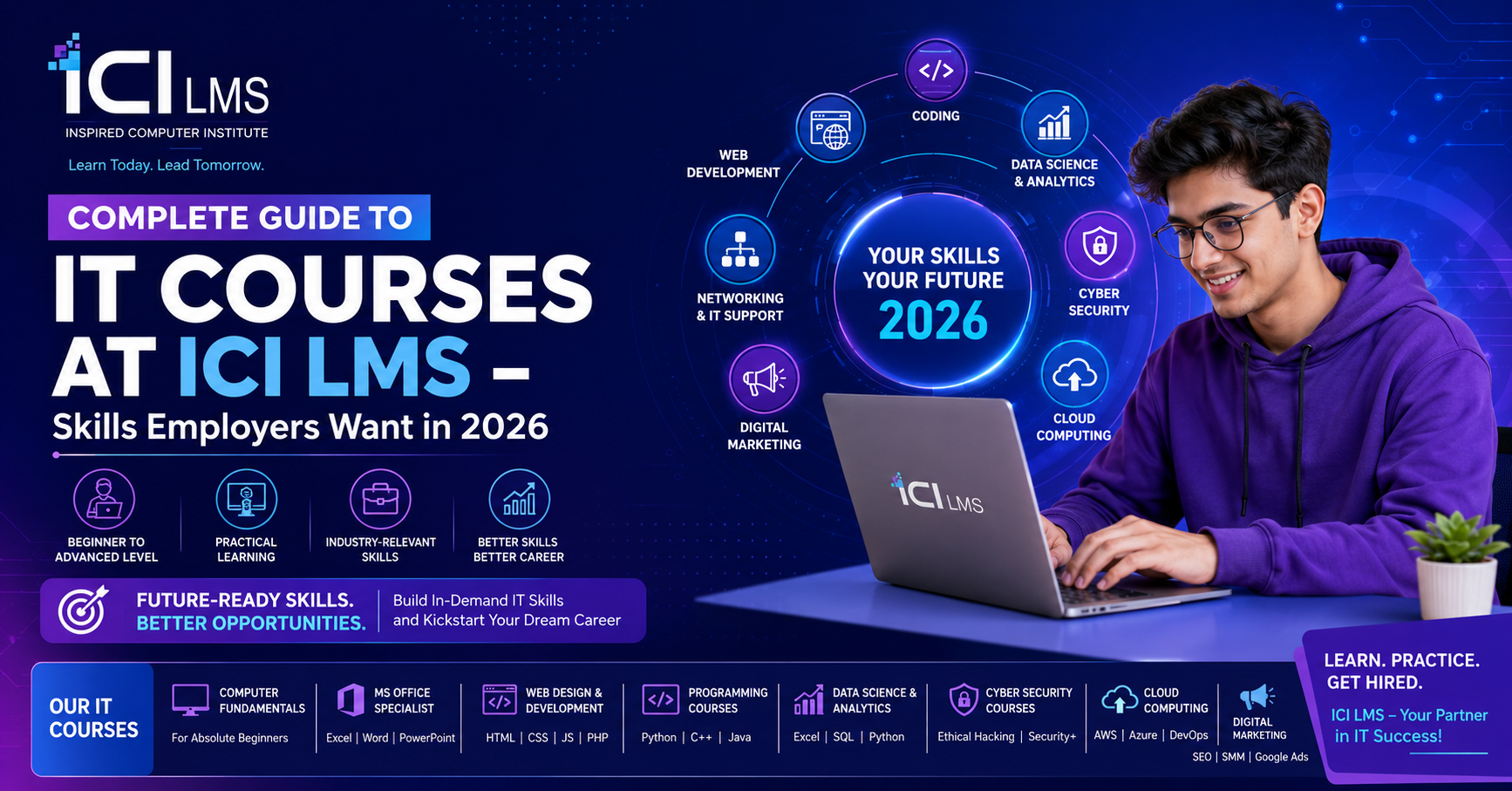
Complete Guide to IT Courses at ICI LMS – Skills Employers Want in 2026
Komal Shahzadi
- June 2, 2026
- Comment 0
Complete Guide to IT Courses at ICI LMS – Skills Employers Want in 2026
Introduction to Inspired Computer Institute (ICI LMS)
Technology continues to reshape every industry, from healthcare and finance to retail and manufacturing. As businesses accelerate their digital transformation efforts, the demand for professionals with practical and job-ready IT skills has reached unprecedented levels. Inspired Computer Institute (ICI LMS) aims to bridge the gap between academic learning and industry requirements by offering a wide range of information technology courses designed for learners at different skill levels. Whether someone is taking their first steps into computing or looking to upgrade existing technical expertise, ICI LMS provides structured learning pathways that align with current market demands.
The institute focuses on delivering practical knowledge that students can immediately apply in real-world scenarios. Rather than relying solely on theoretical instruction, many courses emphasize hands-on projects, assignments, and problem-solving exercises. This approach helps learners build confidence while developing technical competencies that employers actively seek. In today’s competitive job market, possessing relevant digital skills can significantly improve employment prospects, increase earning potential, and open doors to remote work opportunities.
Another major advantage of studying through a modern learning management system is flexibility. Learners can often access educational resources according to their schedules, making it easier for students, working professionals, and entrepreneurs to continue developing their expertise. As organizations increasingly prioritize digital literacy, cloud computing, cybersecurity awareness, data analysis, and software development skills, institutions such as ICI LMS play a critical role in preparing the workforce for future challenges. Understanding the available course options can help prospective students choose a learning path that matches both their interests and career aspirations.
Why IT Skills Matter More Than Ever in 2026
The technology landscape in 2026 is expected to be more dynamic than ever. Artificial intelligence, automation, cloud platforms, cybersecurity threats, and data-driven decision-making are influencing how companies operate across virtually every sector. Employers are searching for individuals who can adapt quickly to evolving technologies while contributing meaningful solutions to business challenges. This growing demand has transformed IT education from a specialized field into a valuable asset for nearly everyone.
Organizations now depend on digital systems for communication, customer engagement, operations management, and business analytics. As a result, even non-technical roles increasingly require a basic understanding of technology tools and digital workflows. Professionals with IT competencies often enjoy greater career mobility because their skills can be transferred across industries and geographical locations. Remote and hybrid work environments have further increased the need for employees who are comfortable using digital platforms and collaborating online.
Industry reports consistently indicate strong growth in areas such as cybersecurity, software development, cloud computing, and data analytics. Employers are not only looking for academic qualifications but also practical skills that can be demonstrated through projects and certifications. Learning through specialized IT courses enables students to build portfolios that showcase their abilities to recruiters and hiring managers. By investing in technology education today, learners position themselves for long-term career growth while remaining competitive in an increasingly digital economy.
Overview of IT Courses Offered by ICI LMS
ICI LMS typically offers a diverse selection of technology-focused programs designed to meet the needs of students with varying levels of experience. The course catalog often spans foundational computer literacy programs, professional software training, web development, programming, networking, cybersecurity, digital marketing, and emerging technology disciplines. This comprehensive approach allows learners to build skills progressively while exploring different career paths within the technology sector.
One of the key strengths of a broad IT curriculum is that it accommodates multiple learning objectives. Some students may seek immediate employment after completing a short-term certification program, while others may pursue advanced technical skills to support long-term professional development. By providing structured training across multiple disciplines, ICI LMS enables learners to identify areas that align with their interests and strengths.
Modern employers often value candidates who possess a combination of technical expertise and practical problem-solving abilities. For this reason, effective IT education focuses not only on software and systems but also on critical thinking, project management, communication, and adaptability. Through a blend of theoretical knowledge and practical application, students gain exposure to real-world scenarios that prepare them for workplace challenges. Whether the goal is securing an entry-level position or transitioning into a specialized technology role, the variety of courses available through ICI LMS supports diverse career ambitions.
Learning Pathways for Beginners, Intermediate Learners, and Professionals
Not every student begins their learning journey with the same level of experience. Some may have never used advanced computer applications, while others already possess technical backgrounds and seek specialized certifications. Effective IT education recognizes these differences by providing tiered learning pathways that support gradual skill development.
Beginners typically start with foundational computer courses that introduce operating systems, internet usage, file management, typing skills, and productivity applications. These courses establish a strong digital foundation that serves as a stepping stone toward more advanced learning opportunities. Intermediate learners often progress into web development, programming, graphic design, digital marketing, or networking programs where they begin applying technical concepts to real projects.
Experienced professionals may pursue advanced topics such as cybersecurity, cloud computing, software engineering, database management, and data analytics. These specialized areas often require deeper technical knowledge and focus on industry-standard tools and methodologies. By following a structured learning pathway, students can avoid feeling overwhelmed while steadily expanding their expertise. This progressive approach ensures that learners develop confidence and competence at every stage of their educational journey.
Basic Computer Skills Course
The Basic Computer Skills Course serves as the foundation for many other technology programs offered through ICI LMS. For individuals who are new to computers or returning to education after an extended period, this course provides essential knowledge needed to navigate today’s digital environment effectively. Mastering fundamental computer operations is often the first step toward broader technological literacy and future career development.
Students typically learn how computer systems function, how to manage files and folders, use operating systems efficiently, and perform everyday digital tasks. Practical exercises help learners become comfortable using keyboards, navigating software interfaces, accessing online resources, and communicating through digital platforms. These seemingly simple skills form the basis of productivity in virtually every modern workplace.
The importance of digital literacy cannot be overstated. Many employers expect candidates to possess at least basic computer competencies regardless of their specific job functions. Administrative assistants, customer service representatives, sales professionals, educators, and healthcare workers all rely on technology to complete daily responsibilities. By building confidence with computers, learners create a solid platform for pursuing more advanced technical training and career opportunities.
Core Topics Covered
The curriculum within a basic computer skills program generally includes a broad range of foundational topics. Students are introduced to computer hardware components, software applications, operating systems, internet navigation, email communication, and digital security practices. Understanding these concepts helps learners develop a practical understanding of technology and its role in everyday life.
Hands-on activities often play a significant role in reinforcing learning outcomes. Rather than memorizing theoretical concepts, students actively practice tasks such as creating documents, organizing files, browsing the internet safely, and using communication tools. This experiential approach encourages confidence and competence while reducing anxiety associated with unfamiliar technology.
Basic cybersecurity awareness is also becoming an increasingly important component of introductory computing education. Learners gain exposure to password management, phishing prevention, safe browsing practices, and data protection principles. These skills are valuable not only in professional environments but also in personal digital interactions. By mastering these core topics, students establish a strong foundation that supports future learning across multiple technology disciplines.
Career Opportunities After Learning Basic Computing
While basic computer skills alone may not qualify someone for highly specialized technical positions, they significantly enhance employability across numerous industries. Employers often consider digital literacy a minimum requirement for many administrative, operational, and customer-facing roles. Individuals who develop these competencies can pursue opportunities in office administration, retail operations, customer support, data entry, and clerical services.
Digital proficiency also increases workplace productivity and adaptability. Employees who can efficiently use software applications, communicate electronically, and manage information digitally contribute more effectively to organizational objectives. These capabilities often lead to greater career advancement opportunities over time.
For many learners, basic computing serves as a launching pad toward advanced training programs. Once foundational skills are established, students can confidently explore web development, programming, networking, graphic design, digital marketing, and cybersecurity courses. This progression expands career possibilities while enabling continuous professional growth in a technology-driven economy.