Currently Empty: ₨ 0
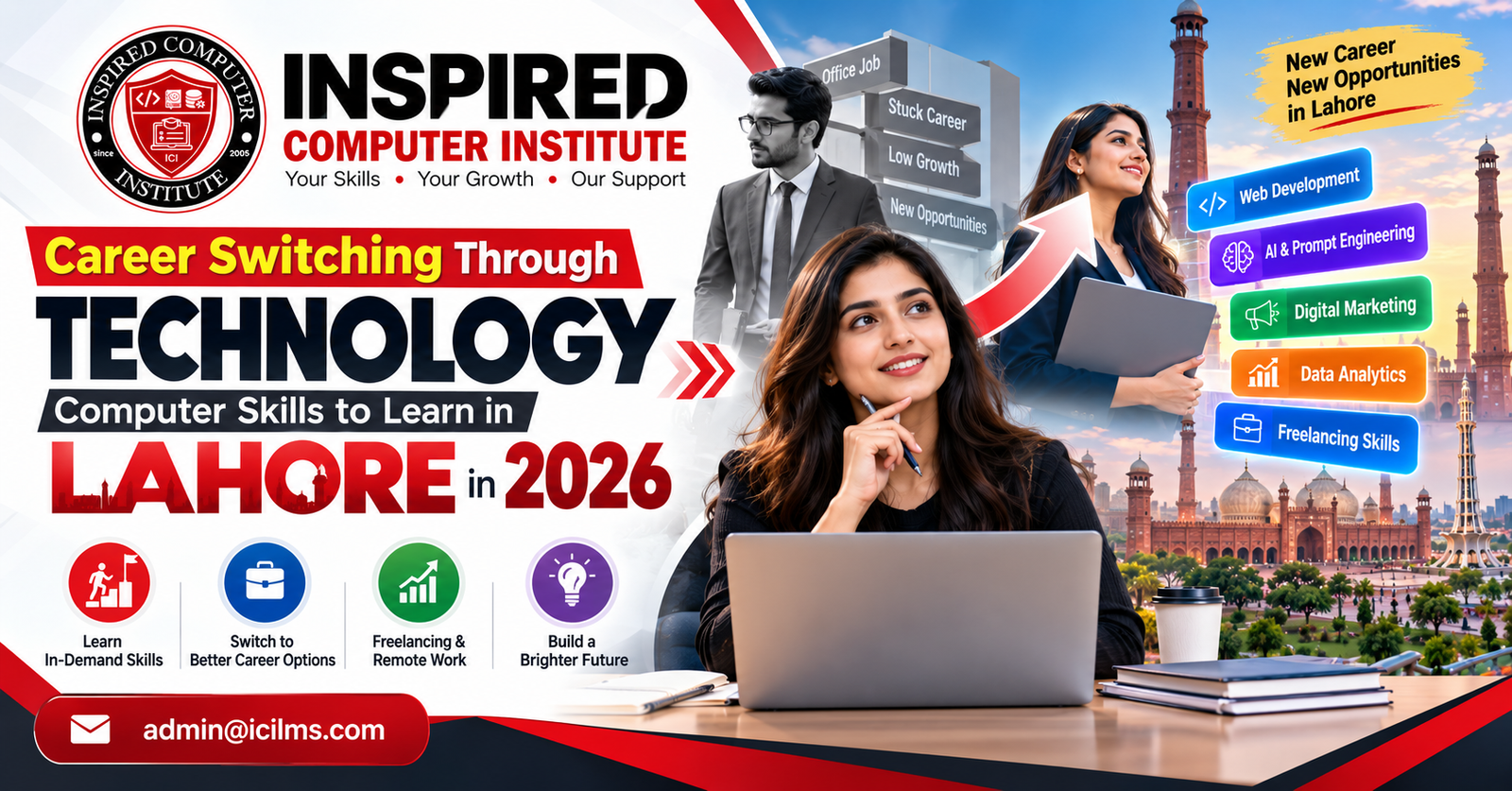
Career Switching Through Technology: Computer Skills to Learn in Lahore in 2026
Komal Shahzadi
- October 7, 2026
- Comment 0
Career Switching Through Technology: Computer Skills to Learn in Lahore in 2026
Changing careers used to feel like demolishing a house and starting again from the foundation. In 2026, technology has changed that equation. For professionals in Lahore, a career switch increasingly looks less like throwing away years of experience and more like adding a new digital layer to skills they already possess. An accountant can move toward data analytics, a teacher can enter instructional technology or digital marketing, a salesperson can learn CRM automation, and an engineer can transition toward software, cloud computing, cybersecurity, or artificial intelligence. That flexibility is one reason searches around computer skills to learn in Lahore in 2026 matter to students and working professionals alike.
Lahore is particularly interesting because it combines universities, software companies, digital agencies, startups, training institutes, e-commerce businesses, exporters, and a substantial population interested in freelancing and remote work. Someone learning technology in Lahore is therefore not restricted to applying for a conventional software-company job. The same skill might be sold to a business in Gulberg, used at a startup in Johar Town, offered independently through an online marketplace, or applied remotely for a company thousands of kilometers away. Geography still matters, but it no longer defines the walls of your career.
The difficult question is not whether you should learn “computers.” That phrase is far too broad in 2026. The real question is which technology skill matches your existing abilities, financial goals, available learning time, and preferred type of work. Coding is valuable, but it is not the only doorway. Data analytics, UI/UX, SEO, artificial intelligence, cybersecurity, cloud technology, e-commerce, automation, and digital marketing can all provide realistic career-switching routes.
This guide explores the computer skills worth considering in Lahore in 2026, what each career actually involves, and how to move from watching tutorials to becoming employable.
Why Technology Is Becoming a Practical Career-Switching Route in Lahore
Technology offers career switchers something traditional professions frequently cannot: relatively low barriers to experimentation. Imagine wanting to become a civil engineer without an engineering qualification. You cannot simply spend three months experimenting and start designing bridges. With many digital careers, however, you can learn foundational skills, complete personal projects, build a portfolio, and discover whether the field suits you before making a dramatic professional decision. That makes technology especially attractive to Lahore professionals who already have jobs, family commitments, degrees in unrelated disciplines, or limited time for another multi-year academic program.
Another advantage is that digital skills travel remarkably well between industries. SQL does not belong exclusively to software companies. Retailers, banks, logistics businesses, healthcare organizations, manufacturers, marketing teams, telecom companies, and e-commerce businesses all generate data. Digital marketing has a similar reach because virtually every organization needs customers. Cybersecurity becomes more important as organizations digitize their operations, while cloud services support companies ranging from tiny startups to multinational enterprises.
This does not mean technology provides effortless money. The days when simply completing a basic course could differentiate someone are fading quickly. Artificial intelligence has also automated portions of entry-level digital work, raising expectations for new professionals. Employers increasingly care about whether you can solve a real problem rather than whether you have watched 100 hours of tutorials.
For Lahore career switchers, that distinction matters. Your objective should not be collecting certificates like trophies. Your objective should be developing a marketable combination of technical ability, communication, problem-solving, portfolio evidence, and industry knowledge. Someone who understands accounting and Power BI, for example, can be more valuable for financial analytics than a beginner who knows Power BI buttons but understands nothing about financial statements.
Lahore’s Growing Digital and Technology Employment Ecosystem
Lahore has long been one of Pakistan’s important educational, commercial, entrepreneurial, and software-development centers. That gives a career switcher access to something equally valuable as online courses: an ecosystem. Software houses, digital agencies, technology companies, universities, incubators, e-commerce operations, corporate offices, coworking environments, and professional communities create opportunities to meet people already working in the field. For beginners, those connections can shorten the distance between learning a skill and understanding how that skill is actually used commercially.
Consider the difference between learning web development entirely in isolation and meeting developers who build websites professionally. A tutorial might teach you React components. A working developer can tell you why projects fail, what clients repeatedly request, which skills employers test during interviews, and why knowing Git may matter almost as much as writing another flashy interface. That practical intelligence is enormously useful during a career transition.
Lahore also provides opportunities outside pure technology businesses. A restaurant chain needs analytics. A clothing brand needs e-commerce expertise. A real-estate company needs digital marketing. A manufacturing operation may need dashboards and automation. A healthcare organization needs secure information systems. Once you begin thinking this way, the city’s employment market becomes much broader than a list of software houses.
Career switchers should therefore avoid searching only for job titles containing “software.” Search by problems you can solve. If you can create dashboards, automate repetitive spreadsheets, improve search visibility, design usable interfaces, secure systems, manage cloud infrastructure, or build digital products, your potential market includes conventional companies undergoing digital transformation as well as technology businesses themselves.
Remote Work and Freelancing Are Changing Career Boundaries
Remote work has fundamentally altered what “finding a job in Lahore” can mean. Your physical location may be Lahore while your client, manager, team, or customer is elsewhere in Pakistan—or outside the country entirely. For people switching careers, this creates a larger potential market, although it also introduces international competition. You are no longer competing only against another beginner sitting across town; you may be competing against skilled professionals across several continents.
That competition makes communication and specialization increasingly important. Suppose two freelancers can technically build a WordPress website. One says, “I make websites.” The other specializes in conversion-focused websites for dental clinics, understands local SEO, can improve page speed, communicates clearly in English, and provides structured weekly updates. The second person is selling a business outcome rather than a technical commodity.
Freelancing should therefore be treated as a business model rather than a computer skill. You still need an underlying service—development, design, SEO, analytics, automation, content, advertising, or another capability—but you also need proposal writing, client communication, pricing, project management, expectation setting, and reputation management.
For professionals in Lahore, remote employment can offer another route. Strong English communication, asynchronous collaboration, documentation, Git, project-management platforms, video meetings, and professional reliability become part of your technical career package. Learn to work digitally, not merely to perform one digital task.
How to Choose the Right Computer Skill for a Career Change
Choosing a technology skill because it is trending on social media is like buying shoes because somebody else runs quickly in them. The important question is whether they fit you. Before enrolling in a course, examine four factors: aptitude, interest, market demand, and transferable experience. The best career-switching opportunity usually sits somewhere in the overlap.
If you enjoy numbers, patterns, spreadsheets, and business questions, data analytics might suit you better than graphic design. If you naturally notice why apps are confusing and enjoy visual problem-solving, UI/UX could be worth exploring. People who love logical construction may prefer programming. Someone fascinated by systems, networks, investigation, and risk might gravitate toward cybersecurity. Strong communicators with an interest in psychology and business may find digital marketing more natural.
Time matters too. Becoming genuinely competent in software engineering generally requires a deeper technical runway than learning foundational SEO or entry-level data visualization. That does not make one career “better.” It means you need to match the learning investment to your circumstances.
Before spending heavily on training, run small experiments. Complete a free introductory course. Build one tiny project. Analyze a public dataset. Design a sample app screen. Create a basic website. Perform an SEO audit. If the work makes you curious enough to continue when it becomes frustrating, you have learned something important about yourself.
Match Your Existing Experience With a Technology Career
One of the biggest mistakes career switchers make is assuming their previous experience has become useless. In reality, domain expertise can become your competitive advantage. Technology plus industry knowledge is often stronger than technology alone.
An accountant learning Excel automation, SQL, and Power BI can move toward financial analytics. A supply-chain professional can use analytics for inventory forecasting and logistics reporting. A teacher can combine instructional knowledge with learning management systems, content production, educational technology, or AI-assisted learning workflows. A salesperson who understands CRM platforms, analytics, automation, and digital lead generation can become a revenue-operations specialist. An architect might add 3D tools, digital visualization, automation, or product design.
This approach also makes your professional story easier to explain during interviews. Instead of saying, “I spent seven years in banking but now I want to forget everything and become a technology person,” you can explain how banking exposed you to inefficient processes and how analytics or automation allows you to solve those problems more effectively.
Create an inventory of what you already know. Include industry knowledge, communication skills, software familiarity, management experience, customer understanding, financial knowledge, writing ability, and analytical thinking. Then look for a technology skill that multiplies those assets. A career switch should ideally be a bridge, not a cliff.
Web Development: A Versatile Skill for Career Switchers
Web development remains one of the most recognizable technology careers because the web continues to sit at the center of modern business. Companies need websites, dashboards, portals, e-commerce stores, internal tools, SaaS products, and web applications. The field is competitive, but people who can build reliable products and solve commercial problems can still create valuable careers.
Beginners normally encounter HTML, CSS, and JavaScript first. HTML provides structure, CSS controls presentation, and JavaScript adds behavior. Once these foundations make sense, developers can explore frameworks and libraries such as React and move deeper into server-side development, databases, APIs, authentication, deployment, testing, and version control.
AI coding assistants have changed development dramatically, but they have not eliminated the need to understand software. If anything, they have made fundamentals more important. AI can produce plausible code that contains security problems, incorrect assumptions, unnecessary complexity, or subtle bugs. A developer who blindly pastes generated code is like a driver following navigation instructions into a closed road.
For a career switcher in Lahore, portfolio quality matters. Rather than building five nearly identical tutorial projects, solve recognizable problems. Create an appointment system, inventory dashboard, local business website, expense tracker, e-commerce feature, or booking application. Document what you built, why you made particular decisions, and what you learned.
Front-End, Back-End, and Full-Stack Development Skills
Web development becomes easier to navigate once you understand its major directions. Front-end development focuses primarily on what users see and interact with. HTML, CSS, JavaScript, responsive design, accessibility, APIs, Git, and a modern framework form a useful foundation. Developers who enjoy visual feedback and user interaction often find front-end work satisfying.
Back-end development deals more heavily with application logic, databases, authentication, APIs, performance, and server-side systems. Depending on the ecosystem, you might learn Node.js, Python, Java, PHP, C#, or another language. SQL and database fundamentals become especially valuable here.
A full-stack developer works across both sides. The title sounds attractive to beginners because it appears to promise maximum employability, but do not confuse breadth with mastery. Trying to learn HTML, CSS, JavaScript, React, Node, Python, PHP, five databases, three clouds, and mobile development simultaneously is a reliable way to become mediocre at everything.
Start narrow. Learn programming fundamentals, Git, debugging, HTTP, APIs, and databases alongside your chosen stack. Build projects that actually work from beginning to deployment. Once you can independently understand and troubleshoot one stack, expanding becomes dramatically easier.
Artificial Intelligence and Generative AI Skills
Artificial intelligence is one of the most important areas for career switchers in 2026, but “learning AI” needs clarification. You do not necessarily need to become a machine-learning researcher. Businesses increasingly need people who can use generative AI, automation, APIs, data, and existing AI platforms to improve everyday workflows.
A useful starting point is AI literacy: understand what large language models can and cannot reliably do, how hallucinations occur, why context matters, how to evaluate output, and where privacy concerns appear. Then move from casual prompting toward structured workflows. Learn how to provide context, constraints, examples, reference information, and evaluation criteria.
More technical learners can study Python, statistics, machine learning fundamentals, model APIs, embeddings, vector search, retrieval-augmented generation, evaluation, and AI application development. Business-oriented learners can focus on workflow automation, AI-assisted research, customer support systems, marketing operations, documentation, sales workflows, and knowledge management.
The strongest opportunity may not be becoming an “AI expert” overnight. It may be becoming an accountant who understands AI automation, a marketer who can build AI-supported content workflows, or a developer who can integrate intelligent features into applications. AI works particularly well as a multiplier for existing expertise.
AI Automation, Prompting, and Practical Business Applications
Prompting by itself is unlikely to be a durable career moat. AI automation, however, can be much more valuable because it connects models to actual business processes. Think beyond asking a chatbot to write an email. Imagine a workflow that receives customer information, categorizes the request, retrieves relevant documentation, generates a draft response, requests human approval, records the interaction, and updates a CRM.
That is where tools such as APIs, webhooks, databases, spreadsheets, workflow automation platforms, and basic programming become useful. Python and JavaScript can significantly expand what you are able to build, while no-code and low-code automation tools provide an accessible starting point for non-developers.
Career switchers should also learn AI evaluation and verification. Businesses cannot safely automate important decisions simply because generated text sounds confident. Understanding human review, data privacy, access controls, failure handling, prompt injection risks, and output validation makes you more useful than someone who knows only clever prompts.
Choose a business process you understand and automate a small part of it. If you work in HR, prototype candidate-information summarization with appropriate privacy safeguards. If you work in sales, experiment with lead research and CRM updates. Practical AI skills become convincing when attached to measurable problems.
Data Analytics and Business Intelligence
Data analytics is one of the strongest technology bridges for people coming from business, finance, operations, sales, supply chain, economics, or administration. Companies generate enormous quantities of information but often struggle to convert it into decisions. A capable analyst acts like an interpreter between raw numbers and business action.
You can begin with spreadsheets before progressing to SQL, Power BI, Tableau, Python, and statistics. The goal is not merely producing colorful charts. You need to ask sensible questions. Why did sales decline? Which products have the strongest margins? Where are customers dropping out of a funnel? Which branch is underperforming? What changed compared with last quarter?
This is why domain knowledge is powerful. A person who understands retail can notice suspicious inventory patterns that a technically competent beginner might overlook. Someone with financial experience knows the difference between revenue and profit and understands why cash flow deserves attention.
Build portfolio projects around realistic questions rather than arbitrary datasets. Present the business problem, cleaning process, analysis, dashboard, findings, and recommendations. Employers need evidence that you can think with data, not simply change chart colors.
Excel, SQL, Power BI, and Python for Data Careers
For many Lahore professionals, Microsoft Excel remains an excellent starting point. Learn formulas, lookup functions, pivot tables, data cleaning, Power Query, structured tables, charts, and efficient spreadsheet design. Advanced Excel knowledge can improve your existing job before you ever change careers.
Next comes SQL, the language used to query relational databases. Learn SELECT statements, filtering, aggregation, joins, subqueries, common table expressions, and window functions. SQL appears repeatedly in analyst job descriptions because organizational data frequently lives in databases rather than tidy spreadsheet files.
Power BI can then turn information into interactive reports and dashboards. Learn data modeling and DAX instead of focusing exclusively on visual appearance. Finally, Python can expand your ability to clean, analyze, automate, and model data using tools such as pandas.
Do not wait until you “finish” all four technologies before building something. Create a sales analysis in Excel, reproduce parts of it using SQL, visualize results in Power BI, and later automate cleaning with Python. Connecting tools around one coherent project produces deeper learning than completing unrelated tutorials.
Digital Marketing and SEO Skills
Digital marketing can be an excellent career-switching field for people who combine creativity with analytical thinking. Businesses need attention, leads, customers, and measurable growth. Skills such as SEO, paid advertising, analytics, email marketing, conversion optimization, social media strategy, and content marketing help connect technology to revenue.
SEO deserves particular attention because search behavior now extends beyond traditional blue links. People discover businesses through search engines, maps, social platforms, marketplaces, and AI-powered answer experiences. Modern SEO therefore requires useful content, sound technical foundations, credible information, strong user experience, structured data where appropriate, and an understanding of search intent.
AI has made generic content easier to produce, which raises the value of originality, expertise, firsthand evidence, and strategy. Publishing dozens of interchangeable articles is not the same as building search visibility. Learn keyword research, competitor analysis, technical auditing, internal linking, on-page optimization, analytics, Search Console, conversion tracking, and content planning.
For a portfolio, audit real websites and show specific recommendations. Better yet, build your own small website and attempt to grow it. Actual results—even modest ones—teach lessons that courses cannot reproduce.
UI/UX Design and Digital Product Design
UI/UX design can suit career switchers who enjoy psychology, visual communication, research, organization, and problem-solving. UI, or user interface design, concerns the visual and interactive layer of a digital product. UX, or user experience, addresses the broader journey: whether the product is understandable, efficient, accessible, and aligned with user needs.
Figma is widely useful, but knowing Figma alone does not make someone a product designer. Learn typography, spacing, hierarchy, color, responsive layouts, components, design systems, accessibility, user flows, wireframes, prototypes, usability testing, and research principles.
Your portfolio should explain decisions rather than merely display beautiful screens. What problem existed? Who was the user? What did research suggest? Why did you change the flow? What trade-offs did you make? A polished mockup without reasoning can resemble a beautiful car with no engine.
Career switchers from psychology, architecture, graphic design, customer service, marketing, and product-oriented roles may find that their previous experience transfers surprisingly well into UX.
Cybersecurity and Networking Skills
As organizations digitize operations, security becomes increasingly important. Cybersecurity can offer a strong career path, but newcomers should understand that ethical security work requires more than downloading penetration-testing tools. Solid foundations in networking, operating systems, identity, permissions, protocols, cloud environments, and security principles come first.
Begin with how computers communicate. Learn IP addressing, DNS, HTTP/HTTPS, ports, firewalls, VPNs, routers, and basic network troubleshooting. Develop comfort with Windows and Linux. Then study authentication, encryption concepts, vulnerability management, logging, endpoint security, incident response, and common attack techniques from a defensive perspective.
Cybersecurity contains numerous career paths: security operations, governance and compliance, cloud security, application security, penetration testing, incident response, identity management, and security engineering. Not all of them require the same personality or coding ability.
A systems administrator may transition naturally toward infrastructure security, while someone with audit experience might find governance, risk, and compliance more accessible. Again, your old career can become part of the bridge.
Cloud Computing and DevOps
Cloud computing underpins a huge portion of modern digital infrastructure. Platforms such as Amazon Web Services, Microsoft Azure, and Google Cloud allow organizations to deploy applications, databases, storage, networks, and computing resources without operating every physical server themselves.
Career switchers should resist memorizing hundreds of cloud services. Start with fundamentals: Linux, networking, Git, command-line usage, servers, DNS, databases, security, virtualization, and basic scripting. Then choose one major cloud platform and understand core services for compute, storage, networking, identity, monitoring, and databases.
DevOps expands this into the processes used to build, test, deploy, and operate software reliably. Technologies such as Docker, CI/CD systems, infrastructure as code, monitoring tools, and eventually Kubernetes may enter your roadmap.
Cloud certifications can support a career transition, but certification without practical ability is fragile. Build and deploy something. Configure permissions. Break a test environment and repair it. Troubleshooting is where theoretical knowledge becomes professional competence.
Mobile App Development
Smartphones remain central to banking, transportation, commerce, education, entertainment, communication, and daily services, making mobile application development another possible route. Career switchers can explore native Android or iOS development or cross-platform technologies such as Flutter and React Native.
Mobile development requires more than making screens appear. You need programming fundamentals, state management, APIs, authentication, storage, navigation, responsive interfaces, error handling, testing, performance, and deployment knowledge. Understanding basic UI/UX principles also makes you a better mobile developer.
For beginners, one polished application is more persuasive than ten incomplete clones. Build something that solves a recognizable problem—a budgeting application, student planner, service-booking prototype, inventory tool, habit tracker, or local commerce concept. Connect it to a backend or external API where appropriate.
Treat each project like a small product. Write documentation, maintain your source code properly, collect feedback, and explain your technical decisions. This transforms a practice exercise into evidence of employability.
E-Commerce and Freelancing Skills
E-commerce sits at an interesting intersection between technology and business. You may learn platforms such as Shopify or WooCommerce, but successful e-commerce work also touches product research, store configuration, analytics, conversion optimization, payment systems, SEO, advertising, email marketing, customer experience, and operations.
This can suit career switchers who do not want to become traditional programmers. A technically confident e-commerce specialist can help businesses set up stores, improve product pages, troubleshoot integrations, measure conversion funnels, configure analytics, and automate repetitive processes.
Freelancing can provide a route to monetizing these capabilities, but do not expect a profile on a marketplace to magically create income. Build a clear offer. Instead of advertising twenty unrelated services, choose a specific problem and customer. “I improve Shopify product pages and analytics for fashion stores” is more understandable than “I do IT, SEO, design, development, data entry, and marketing.”
Learn professional communication, proposals, discovery calls, contracts, project scoping, revisions, deadlines, and client retention. These “soft” abilities frequently determine whether technical knowledge becomes sustainable income.
Building a Career-Switching Roadmap in Lahore
A successful transition needs structure. During the first month, explore your target field and learn its fundamentals. Do not spend this stage purchasing five courses. Select one structured learning resource and practice consistently. During months two and three, build increasingly independent projects. By this point, you should be spending less time watching instructors and more time solving problems yourself.
Next, create a portfolio that demonstrates two or three strong projects. Publish code on GitHub where relevant, create case studies for design or marketing work, and build dashboards for analytics projects. Explain the problem, process, decisions, outcome, and lessons. Your portfolio should answer an employer’s silent question: “Can this person actually do anything?”
Then begin market exposure before you feel perfectly ready. Attend technology events, connect professionally with Lahore-based practitioners, seek internships or junior opportunities, contribute to communities, approach small businesses where appropriate, and explore remote roles and freelance projects. Feedback from the market tells you what to improve.
A useful 2026 principle is learn → build → publish → get feedback → improve → apply. Do not stay trapped in “learn” for a year. Technology changes too quickly for anyone to feel completely finished.
Conclusion: Turning Computer Skills Into a New Career in 2026
Career switching through technology in Lahore is not about chasing whichever skill receives the most attention this month. It is about identifying a valuable problem you can learn to solve and proving that you can solve it consistently. Web development, AI automation, data analytics, digital marketing, UI/UX, cybersecurity, cloud computing, mobile development, and e-commerce all offer potential pathways, but none provides guaranteed success simply because you complete a course.
The smartest transition often combines your past with your future. If you already understand finance, add analytics. If you understand sales, add CRM automation and digital marketing. If you have infrastructure experience, explore cloud and cybersecurity. If you understand customers, consider UX or product design. Your previous career is raw material, not baggage.
Give yourself enough time to develop depth. Build projects without copying tutorials line for line. Learn to communicate your thinking. Use AI as an accelerator while maintaining the ability to verify its output. Most importantly, expose your work to real people and real problems.
The person who succeeds in Lahore’s 2026 technology market may not be the person who knows the greatest number of tools. It will often be the person who can learn continuously, solve useful problems, communicate professionally, and demonstrate credible results. Technology supplies the tools; your ability to turn them into outcomes builds the career.
20 Frequently Asked Questions About Computer Skills and Career Switching in Lahore
1. Which computer skill is best to learn in Lahore in 2026?
There is no universally best skill. Web development, data analytics, AI automation, cybersecurity, cloud computing, UI/UX, SEO, and digital marketing can all be valuable. Choose according to your existing experience, interests, learning time, and intended job market.
2. Which computer skill can a complete beginner learn?
Beginners can start with Excel and data analysis, HTML/CSS, WordPress, digital marketing, SEO, UI/UX, or basic Python. The ideal choice depends on whether you prefer analytical, creative, technical, or business-oriented work.
3. Is coding still worth learning in 2026 because of AI?
Yes, but the nature of coding is changing. AI can generate code quickly, while developers still need to understand architecture, debugging, security, requirements, testing, and whether generated code is correct. Developers who combine programming fundamentals with effective AI use can be particularly productive.
4. Can I switch to an IT career without a computer science degree?
Many technology roles are accessible without a computer science degree, particularly when candidates can demonstrate practical ability. A strong portfolio, foundational knowledge, communication skills, relevant certifications where useful, and real projects can help demonstrate competence.
5. How long does a technology career switch take?
It depends heavily on the field and your starting point. Several months of consistent study may create entry-level capability in some disciplines, while software engineering, cybersecurity, advanced data science, and cloud engineering can require substantially longer development.
6. Is data analytics a good career for non-programmers?
Yes. Data analytics can be particularly accessible to professionals already comfortable with numbers, business operations, Excel, finance, or reporting. You can begin with Excel, SQL, and Power BI before introducing Python.
7. What should I learn first for data analytics?
Start with spreadsheet proficiency and basic statistics, then learn SQL and a business-intelligence platform such as Power BI. Python can follow once you need greater automation, data processing, or analytical flexibility.
8. Is web development overcrowded in 2026?
Entry-level web development is competitive, particularly for people offering only basic website-building skills. Strong fundamentals, specialization, business understanding, AI-assisted productivity, and a credible project portfolio can help candidates differentiate themselves.
9. Should I learn Python in 2026?
Python remains useful for automation, analytics, artificial intelligence, backend development, scripting, and cybersecurity-related tasks. Learn it when it supports your chosen career rather than learning a programming language without a practical objective.
10. Can I build a career only by learning prompt engineering?
Depending entirely on prompting is risky because AI interfaces and capabilities change rapidly. Combine prompting with automation, domain expertise, data skills, programming, marketing, research, or another commercially valuable capability.
11. Which AI skills should career switchers learn?
Learn AI literacy, effective model interaction, verification, privacy awareness, workflow design, automation, and responsible use. Technical learners can progress toward Python, APIs, machine learning, retrieval systems, evaluations, and AI application development.
12. Is cybersecurity suitable for beginners?
Yes, but cybersecurity beginners should build foundational knowledge before rushing into offensive-security tools. Networking, Linux, Windows, protocols, permissions, identity, basic scripting, and security concepts provide a stronger foundation.
13. Which cloud platform should I learn first?
AWS, Microsoft Azure, and Google Cloud are all major platforms. Rather than attempting all of them simultaneously, learn cloud fundamentals and develop practical competence on one platform before broadening your knowledge.
14. Is UI/UX design possible without coding?
Yes. Many UI/UX positions do not require professional-level coding. Understanding how digital products are implemented can still improve collaboration with developers and help designers create technically realistic experiences.
15. Can digital marketing become a full-time career?
Yes. SEO, paid media, analytics, content strategy, email marketing, conversion optimization, and marketing automation can support specialized career paths. Professionals who connect marketing activity to measurable business outcomes generally create stronger value.
16. Can someone over 30 or 40 switch to technology?
Age alone does not prevent a technology career transition. Experienced professionals may possess domain knowledge, communication skills, management ability, customer understanding, and professional discipline that younger beginners have not yet developed. The challenge is demonstrating current technical capability.
17. Should I join a computer institute in Lahore or learn online?
Either approach can work. A good institute may provide structure, mentorship, peers, and accountability, while online learning provides flexibility and access to global resources. Evaluate training based on instructor quality, curriculum, projects, graduate outcomes, and practical depth rather than advertising claims.
18. How important is English for remote technology jobs?
English communication can be highly valuable for international remote work because professionals frequently need to understand requirements, write documentation, participate in meetings, explain decisions, and communicate asynchronously. Perfect accents are unnecessary; clarity and professionalism matter far more.
19. How can I get my first technology job without experience?
Replace the experience gap with evidence. Build projects, publish case studies, contribute to suitable open-source work, complete internships, solve problems for small organizations, participate in communities, and maintain a professional online presence. Demonstrated ability makes conversations with employers much easier.
20. What is the biggest mistake people make while switching careers through technology?
Tutorial addiction is one of the biggest problems. People can spend months collecting courses without independently building anything. A stronger approach is to learn the fundamentals, create projects, encounter problems, research solutions, publish your work, seek feedback, and gradually tackle more difficult challenges