Currently Empty: ₨ 0
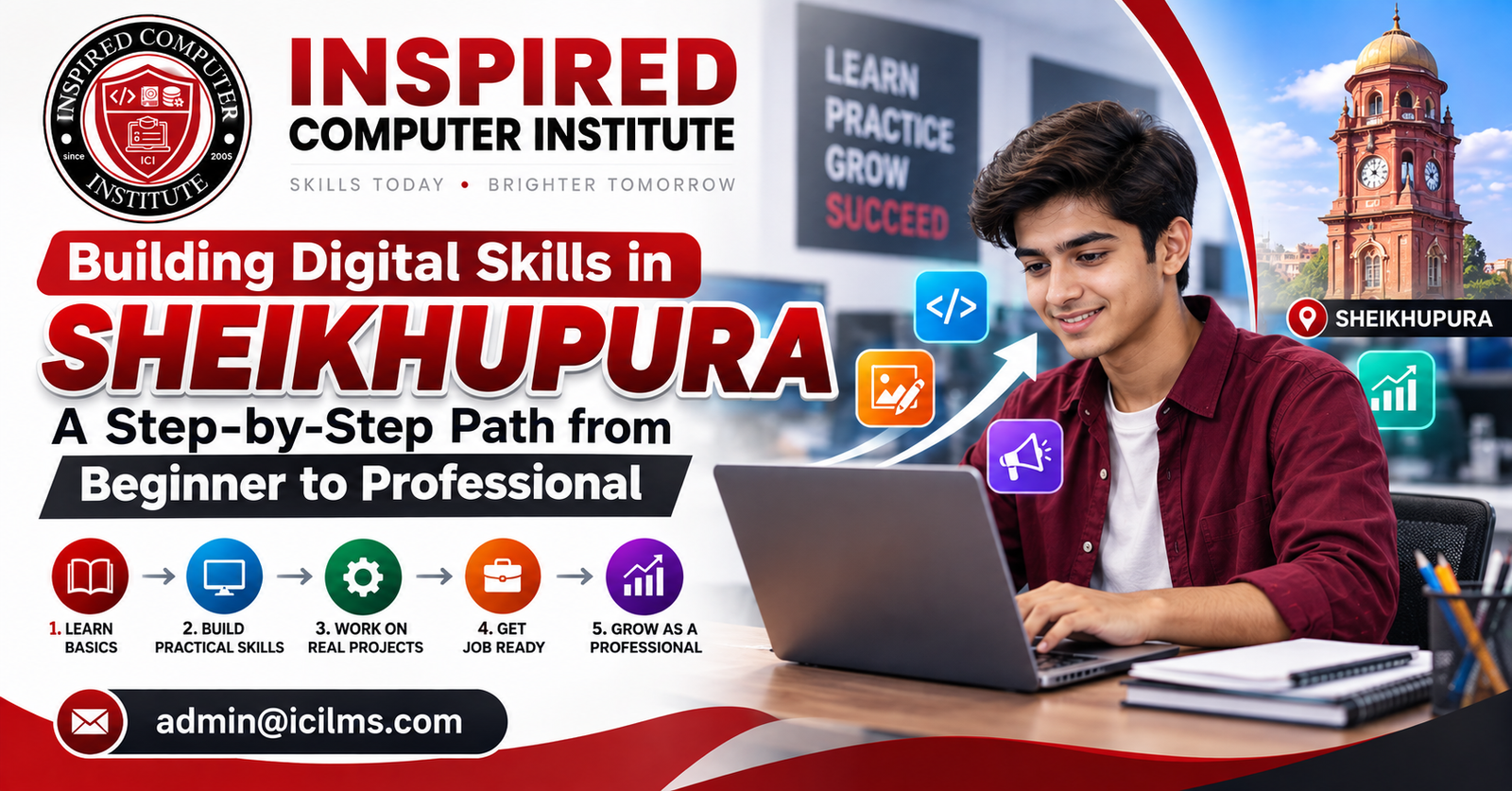
Building Digital Skills in Sheikhupura: A Step-by-Step Path from Beginner to Professional
Komal Shahzadi
- October 3, 2026
- Comment 0
Building Digital Skills in Sheikhupura: A Step-by-Step Path from Beginner to Professional
The idea of building a professional career no longer begins and ends with finding an office, factory, shop, or government job. For students, graduates, job seekers, entrepreneurs, and working professionals in Sheikhupura, the internet has opened another door: the opportunity to learn valuable skills and use them in local businesses, Pakistani companies, remote jobs, freelance marketplaces, or even an independent digital business. The important part is understanding that this transformation does not happen overnight. You don’t wake up one morning, watch three YouTube videos about graphic design or web development, and become a highly paid professional by evening. Digital skill development is a journey, and like any worthwhile journey, it becomes much easier when you know which road to follow.
Sheikhupura has an interesting advantage in this changing environment. Its proximity to Lahore, combined with its own commercial, industrial, educational, retail, and entrepreneurial activity, means learners do not necessarily have to choose between local and online opportunities. A person might develop social media content for a local clothing store today, work remotely for a Lahore-based company tomorrow, and eventually provide the same service to an international client. Digital skills can act like a bridge connecting all three markets. Instead of thinking only in terms of “getting an online job,” learners can think much more broadly about using technology to solve real business problems.
The challenge is knowing where to begin. Search for “best digital skills” online and you’ll immediately encounter dozens of choices: SEO, digital marketing, web development, graphic design, video editing, content writing, data analytics, e-commerce, artificial intelligence, UI/UX design, social media marketing, WordPress, programming, and freelancing. A beginner can easily become overwhelmed. The smarter approach is not trying to learn everything. It is developing foundational digital literacy, selecting one marketable specialization, practicing it deeply, building evidence of your ability, and gradually entering the professional market.
This guide provides exactly that roadmap. Whether you’re a student with limited experience, a graduate struggling to choose a direction, a shop owner hoping to digitize a business, or someone interested in freelancing from Sheikhupura, the following steps can help you progress from complete beginner to capable digital professional.
Why Digital Skills Matter for People in Sheikhupura
Digital skills are increasingly useful because technology has become part of almost every industry rather than remaining a separate industry of its own. Think about an ordinary business in Sheikhupura. A restaurant may need Facebook and Instagram marketing. A school may need a website and digital records. A real-estate business may need video content, online advertisements, Google visibility, and lead management. A clothing retailer may want an e-commerce store. A manufacturer may require spreadsheets, digital documentation, product catalogs, online communication, or business software. Each situation creates problems that someone with the appropriate digital skills can solve.
This is an important mindset shift for beginners. Learning graphic design isn’t simply about learning Photoshop, Illustrator, Canva, or another program. You’re learning how to communicate ideas visually. Learning SEO isn’t about memorizing where keywords should appear on a page. You’re learning how websites can improve their visibility when people search for relevant information, services, or products. Web development isn’t merely writing code; it’s creating useful digital experiences. Once you begin thinking about skills as solutions rather than software, career decisions become much clearer.
Digital competency can also complement traditional careers. An accountant who understands advanced spreadsheets, data visualization, cloud tools, and automation can potentially become more productive than someone relying entirely on manual processes. A teacher who knows presentation design, online learning tools, video production, and AI-assisted workflows can expand the ways lessons are delivered. A business owner who understands digital advertising and e-commerce can communicate with customers beyond the immediate neighborhood. Digital transformation doesn’t necessarily replace existing knowledge—it can multiply its usefulness.
For people in Sheikhupura, therefore, digital learning should not be viewed exclusively as a route into freelancing. Freelancing is one possibility among several. Employment, entrepreneurship, remote work, consulting, business digitization, and hybrid careers can all benefit from the same underlying capabilities. The goal should be to become someone who can confidently use technology to produce valuable results.
The Shift from Traditional Employment to Digital Opportunities
Traditional employment generally connects income to geography. You travel to a workplace, perform responsibilities during specified hours, and receive compensation from an employer. Digital work changes some of those boundaries because many outputs—software, designs, articles, marketing campaigns, reports, videos, websites, spreadsheets, presentations, and consulting—can be produced and delivered electronically. This doesn’t mean physical workplaces are disappearing. Instead, another layer of opportunity has developed alongside them.
Consider a graphic designer living in Sheikhupura. The designer’s potential customers aren’t necessarily limited to businesses within the city. A portfolio can be viewed from Islamabad, Karachi, Dubai, London, Toronto, or practically anywhere internet access allows. A developer can collaborate with a team without sharing the same building. An SEO specialist can optimize a website belonging to a company thousands of kilometers away. Your location remains part of your life, but it doesn’t always have to define the boundaries of your professional market.
This opportunity comes with competition. If you can offer a service globally, professionals elsewhere can compete for the same assignments. That’s why merely knowing the basics of a digital skill is rarely enough. Professional success requires technical ability combined with communication, reliability, problem solving, portfolio development, and continuous learning. Someone who knows how to operate design software but repeatedly misses deadlines will struggle. Someone with moderate technical ability who communicates clearly, understands client requirements, improves consistently, and delivers reliably can build much stronger professional relationships.
The shift toward digital work should therefore encourage preparation rather than unrealistic expectations. Online income isn’t a magic shortcut around learning. In many cases, it requires greater self-discipline because nobody is standing beside you telling you what to study next. Your long-term advantage comes from becoming genuinely useful.
How Digital Skills Can Expand Local and Global Career Options
One of the most practical advantages of developing digital skills in Sheikhupura is that the same knowledge can potentially serve several markets. Beginners sometimes imagine they must immediately compete for international freelance projects. That can make the first step unnecessarily intimidating. Your earliest opportunities may be much closer.
Suppose you’re learning social media marketing. You could create a sample campaign for a fictional restaurant, then approach an appropriate local business after developing enough competence. If you’re learning WordPress, you could create demonstration websites for a school, clinic, retailer, or professional service. An aspiring video editor can produce short-form videos from royalty-free footage. A graphic designer can develop a complete fictional brand identity. These projects create experience before international competition becomes relevant.
Local experience can then become evidence when pursuing broader opportunities. Instead of telling a potential client, “I know social media marketing,” you can explain what you actually did: planned content, created graphics, analyzed engagement, improved posting consistency, or helped generate inquiries. Proof is more persuasive than promises.
The same principle applies to employment. Companies generally hire people to achieve outcomes rather than accumulate certificates. A certificate can demonstrate that you completed training, but a portfolio demonstrates what you can actually produce. The strongest path therefore connects learning with practical output from the beginning.
Step 1 — Start With Basic Computer and Internet Skills
Jumping directly into advanced digital marketing, coding, or data analytics without solid computer fundamentals is like trying to build the second floor of a house before completing the ground floor. You might make temporary progress, but gaps eventually create frustration. Beginners should first become comfortable with everyday digital tools.
Start with operating-system fundamentals: creating folders, organizing files, installing trusted applications, handling downloads, understanding file extensions, compressing files, taking screenshots, and using keyboard shortcuts. Learn basic document creation and formatting. Become comfortable with spreadsheets and presentations. Practice transferring files between devices and storing important documents safely.
Typing deserves attention as well. If every email takes fifteen minutes because typing feels uncomfortable, nearly every digital career becomes slower. Accuracy matters more than speed initially, but regular practice gradually develops both. English communication can also be valuable in international digital work, particularly for understanding documentation and communicating with clients. You don’t need unnecessarily complicated vocabulary. Clear, simple professional communication usually works better than impressive-sounding language.
Most importantly, develop curiosity. When an unfamiliar software feature appears, explore it. When something stops working, search for the cause before immediately giving up. Digital professionals constantly encounter unfamiliar tools and changing interfaces. The ability to learn independently becomes a skill in itself.
Essential Computer Skills Every Beginner Should Learn
A strong beginner should know how to use a browser efficiently, work with multiple tabs, bookmark useful resources, download and upload files, convert common formats, organize documents, use cloud storage, participate in video meetings, and work with basic productivity software. These abilities may appear ordinary, but they form the infrastructure beneath more specialized careers.
Microsoft Word or Google Docs can teach document formatting and collaborative editing. Excel or Google Sheets introduces formulas, tables, sorting, filtering, and structured data. PowerPoint or Google Slides develops presentation skills. Cloud platforms teach file sharing and collaboration. Zoom, Google Meet, Microsoft Teams, Slack, or similar communication environments introduce remote-working habits.
Don’t just watch tutorials about these programs. Create something. Make a monthly household budget in a spreadsheet. Prepare a professional CV. Build a five-slide presentation about a topic you understand. Organize a cloud folder with subfolders and sharing permissions. Practical repetition converts abstract knowledge into usable ability.
Beginners should also learn basic troubleshooting: checking internet connections, updating software, understanding browser permissions, restarting applications, recognizing storage problems, and searching error messages effectively. You don’t need to become an IT technician. You simply want enough confidence that every minor technical problem doesn’t become a roadblock.
Internet Research, Email, Cloud Storage, and Online Safety
Knowing how to search Google is not necessarily the same as knowing how to research effectively online. Digital professionals must learn to evaluate information, compare sources, refine search queries, and distinguish credible documentation from low-quality advice. This has become even more important as AI-generated material increases the amount of information available online.
Email professionalism matters too. Use clear subject lines, appropriate greetings, concise explanations, and sensible attachments. Keep professional files organized. Learn how cloud permissions work before sharing sensitive information. Understand the difference between giving someone viewing, commenting, and editing access.
Cybersecurity should become a habit from the beginning. Use strong, unique passwords and a password manager where appropriate. Enable multi-factor authentication on important accounts. Be cautious with unexpected attachments, login links, fake job offers, payment requests, and messages asking for account credentials. Freelancers can be particularly attractive targets for scams because they routinely communicate with strangers online.
Artificial intelligence adds another layer. Tools powered by AI can accelerate research, brainstorming, coding, writing, design workflows, and analysis, but outputs should be checked rather than accepted automatically. AI literacy increasingly means knowing when to use AI, how to verify it, and when human judgment must take over. Treat these tools as assistants rather than substitutes for expertise.
Step 2 — Choose the Right Digital Skill for Your Career Goals
This is where many learners make their biggest mistake: they select a skill because someone on social media says it is “easy money.” Three weeks later, another creator promotes a different skill, so they switch. After six months, they’ve started five courses and mastered none.
Choose a direction using three factors: interest, aptitude, and market usefulness. Interest matters because you’ll spend hundreds of hours practicing. Aptitude matters because different careers reward different strengths. Market usefulness matters because professional skills ultimately need to solve problems people or organizations care enough about to support.
If you’re visually creative, explore graphic design, UI/UX, animation, or video editing. If you enjoy language, consider content writing, copywriting, SEO, or communications. Analytical thinkers may prefer data analytics, paid advertising, SEO, programming, cybersecurity, or automation. People who enjoy combining creativity and business may find digital marketing, e-commerce, or social media management appealing.
Don’t spend months trying to identify the perfect career before beginning. Choose one promising direction, test it seriously for several weeks, and evaluate your experience. Career clarity often comes through doing rather than endless thinking.
Freelancing and Service-Based Digital Skills
Freelancing is a business model rather than a skill. This distinction is essential. Nobody hires you simply because you’re a “freelancer.” Clients hire you because you can design a logo, edit a video, develop a website, manage advertising, write content, optimize search visibility, analyze data, create animations, or solve another specific problem.
Service-based skills commonly used in freelance work include graphic design, video editing, WordPress development, web programming, SEO, content writing, virtual assistance, social media management, bookkeeping, UI/UX design, paid advertising, lead generation, and data-related services. Some have relatively low entry barriers; others require months or years of deeper technical development.
Beginners should resist the temptation to offer ten unrelated services. A profile advertising logo design, web development, SEO, bookkeeping, voice-over work, data entry, and video editing doesn’t necessarily look versatile—it can look unfocused. Start by becoming credible in one area.
Later, complementary skills become powerful. An SEO specialist who understands content writing has an advantage. A web developer who understands UI principles can communicate better with designers. A video editor familiar with social media marketing understands why retention and hooks matter. Think specialist first, strategic generalist later.
Technical, Creative, and Marketing Career Paths
Technical careers include web development, app development, data analytics, cloud computing, cybersecurity, automation, and software engineering. These paths often require patience and structured problem-solving. Beginners shouldn’t be discouraged when progress initially feels slow; technical understanding tends to build layer upon layer.
Creative careers include graphic design, UI/UX, illustration, video editing, motion graphics, photography-related editing, and content production. Here, software knowledge is only part of professional development. Composition, typography, storytelling, visual hierarchy, pacing, color, and audience psychology matter just as much.
Marketing paths sit somewhere between creativity and analytics. SEO, social media marketing, paid advertising, email marketing, content strategy, and e-commerce require understanding audiences while measuring outcomes. A beautiful advertisement that generates no useful response may not be effective marketing.
Which category should you choose? Look at what kind of problems you naturally enjoy solving. Don’t ask only, “Which skill earns the most?” Ask, “Which valuable problems could I realistically become excellent at solving?” That question produces a much stronger career foundation.
Step 3 — Build Your Skills Through Structured Learning
Once you’ve selected a direction, stop jumping randomly between tutorials. Create a curriculum. If you’re learning web development, for example, map the fundamentals and learn them in a logical sequence. If you’re studying graphic design, identify design principles, software fundamentals, typography, color, layout, branding, and portfolio projects.
Online learners often confuse content consumption with education. Watching six hours of tutorials can feel productive because your brain is busy. Yet when you open a blank document and can’t reproduce anything without following the instructor, the weakness becomes obvious.
A useful approach is to divide learning time between instruction and production. Watch or read enough to understand a concept, close the lesson, and reproduce it independently. Then modify the project. Break something. Fix it. Try a different approach. Those uncomfortable moments are where learning becomes durable.
Maintain notes about mistakes and discoveries. Over several months, you’ll create your own reference library. More importantly, you’ll train yourself to solve problems rather than wait for somebody else to provide every answer.
Free and Affordable Ways to Learn Digital Skills
You don’t necessarily need an expensive degree or training program to begin developing digital capabilities. High-quality educational material exists through YouTube, official product documentation, online course platforms, technology communities, blogs, public learning initiatives, and interactive training websites.
Pakistan-based learners can also investigate current training opportunities from public programs, universities, vocational institutions, and reputable private training providers. Before paying for any program, examine its current curriculum, instructor experience, student projects, practical assignments, support structure, and independent feedback. Marketing promises such as “earn thousands in 30 days” should trigger skepticism rather than excitement.
Free learning has one major weakness: lack of structure. When thousands of tutorials are available, deciding what not to watch becomes difficult. A carefully designed paid course can sometimes save time by providing sequence and accountability, but payment itself does not guarantee quality.
Whatever learning source you choose, your practice matters more than the price of the course. Someone using free resources while completing twenty serious projects can outperform someone who purchases expensive training but rarely practices.
Creating a Consistent Learning Routine
Consistency beats occasional intensity. Studying ten hours one Sunday and doing nothing for the next two weeks creates weaker momentum than practicing regularly throughout the week.
Create a schedule compatible with your actual responsibilities. A university student might dedicate 90 minutes each evening. Someone working full-time might manage an hour on weekdays and longer weekend sessions. The exact number matters less than sustainability.
Divide each session deliberately. You might spend part of the time learning, part practicing, and part building portfolio material. Track what you complete weekly rather than measuring progress purely in hours.
Expect plateaus. The first weeks of learning can feel exciting because everything is new. Later, progress becomes less obvious. That’s usually when people abandon one skill and chase another. Staying through that uncomfortable middle stage is often what separates permanent beginners from developing professionals.
Step 4 — Turn Knowledge Into Practical Experience
Eventually, tutorials must end and real work must begin. You don’t need to wait for a paying customer to gain practical experience. Create realistic projects yourself.
A graphic designer could develop branding for an imaginary Sheikhupura café. A web developer could build a responsive website for a fictional clinic. An SEO learner could conduct a detailed audit of an existing website without claiming affiliation. A social media marketer could develop a thirty-day content strategy for a sample business. A data analyst could download a public dataset, clean it, analyze it, and present meaningful findings.
Projects reveal gaps courses hide. Suddenly, there is no instructor telling you what button to press next. You have to make decisions. That is precisely why project-based learning is so valuable.
With each project, document the challenge, process, tools, decisions, and final result. That documentation eventually becomes material for your portfolio and job interviews.
Building Real Projects Instead of Collecting Certificates
Certificates have legitimate uses, especially when they come from recognized organizations and verify meaningful training. But certificates should support competence rather than substitute for it.
Imagine two applicants. One lists fifteen course certificates but has no work to demonstrate. The other has three relevant certificates and six polished projects showing exactly what they can accomplish. For many practical digital roles, the second candidate gives an employer or client more evidence.
Create projects that gradually increase in complexity. Your first website doesn’t need sophisticated functionality. Your first video doesn’t need cinematic effects. Your first SEO audit doesn’t need to resemble a multinational consultancy report. Complete something small, identify weaknesses, improve, and build again.
The professional world rewards output. Learn, build, review, improve, repeat. That simple cycle can carry you remarkably far.
Creating a Professional Portfolio
Your portfolio is evidence that transforms “I can do this” into “here is what I have done.” It should be focused, easy to navigate, visually clean, and relevant to the opportunities you’re pursuing.
Don’t dump every exercise you’ve ever completed into it. Five strong projects are usually more persuasive than thirty weak ones. Explain each project’s objective, your responsibilities, process, tools, challenges, and outcome. If it is a personal or fictional project, identify it transparently instead of presenting it as paid client work.
Depending on your profession, your portfolio might live on a personal website, GitHub, Behance, Dribbble, LinkedIn, a carefully organized PDF, or another appropriate platform. Keep it updated as your abilities improve.
Your portfolio should answer a stranger’s most important question: “What can this person actually do?” If that answer becomes obvious within a few minutes, you’re moving in the right direction.
Step 5 — Enter Freelancing and the Digital Job Market
After developing competence and several portfolio projects, begin testing the market. Don’t wait until you feel like an expert. Expertise takes years, and entry-level opportunities exist precisely because businesses need different experience levels.
Create professional profiles on platforms relevant to your field. Freelance marketplaces can be useful, but don’t depend exclusively on them. Explore LinkedIn, company career pages, professional communities, referrals, internships, agencies, local businesses, and remote-job platforms.
Tailor applications rather than sending identical messages everywhere. Show that you understand the employer’s or client’s needs. Mention relevant portfolio work and explain how your skills connect to the problem.
Rejection is normal. Treat early applications as market feedback. If fifty appropriate applications produce no meaningful response, review your portfolio, positioning, communication, and skill level. Improve the system instead of assuming the entire digital economy is closed to beginners.
Finding Your First Clients and Remote Opportunities
Your first client is often harder to obtain because you lack testimonials and commercial experience. Reduce that credibility gap with excellent sample work, clear communication, a focused offer, and realistic expectations.
Start with problems you can genuinely solve. You might identify businesses with outdated websites, inconsistent branding, weak product photography, poorly structured social media, or other digital needs. Approach respectfully and explain specific ways you could help rather than sending generic messages.
Never guarantee results outside your control. An SEO beginner shouldn’t promise “#1 on Google in seven days.” A marketer shouldn’t guarantee sales without understanding the product, audience, offer, budget, and market. Professionals protect trust by separating achievable deliverables from uncertain outcomes.
Once you complete paid work successfully, request permission to include appropriate results in your portfolio and ask for a genuine testimonial. One successful project can lead to referrals, repeat work, and stronger credibility.
Communication, Pricing, and Professionalism
Technical ability gets attention; professionalism keeps relationships alive. Respond within reasonable periods, clarify requirements, document scope, agree on deadlines, and communicate early when legitimate problems arise.
Pricing should reflect experience, project complexity, time, value, market conditions, revisions, and scope. Beginners often underprice aggressively because they assume being cheapest guarantees work. It can instead attract difficult projects while leaving too little time to deliver quality.
Learn basic negotiation. If a client’s budget is below your quote, consider reducing scope instead of automatically reducing price. Clearly specify what is included and how additional work will be handled.
Professionalism also means saying no when necessary. Don’t accept projects you cannot reasonably deliver merely because money is available. Reputation takes time to build and very little time to damage.
Step 6 — Move From Freelancer to Digital Professional
The transition from beginner to professional happens gradually. At first, you’re learning tools. Later, you’re learning workflows. Eventually, you’re learning how your work affects business outcomes.
That’s an important evolution. A beginner web developer asks, “How do I build this page?” A more experienced professional also asks, “Who will use this page, what should they accomplish, how fast does it load, how accessible is it, and how will the business maintain it?” A beginner designer asks whether something looks attractive. A professional considers hierarchy, audience, brand consistency, usability, and communication.
As your experience grows, specialize more deeply. Instead of remaining a generic writer, you might specialize in B2B technology content. Instead of generic web development, you might become particularly strong in e-commerce. Instead of offering every marketing service, you could develop expertise in local SEO or paid acquisition.
Continue learning, because digital tools evolve quickly. Professional status isn’t the end of education—it is the point where self-directed education becomes permanent.
Building a Sustainable Digital Career in Sheikhupura
Building digital skills in Sheikhupura becomes more meaningful when the goal shifts from quick online income to long-term professional value. Quick-money expectations create impatience. Sustainable careers are built around competence, reputation, relationships, and adaptability.
Develop a network both locally and online. Connect with other learners, developers, designers, marketers, entrepreneurs, teachers, and professionals. Attend relevant events when possible. Share useful work publicly. Help people without turning every interaction into a sales pitch. Professional networks compound slowly, much like skills themselves.
Financial discipline matters once income begins. Freelance earnings can fluctuate, so separate personal and business finances where practical, maintain records, understand applicable tax obligations, and build savings rather than treating every good month as permanent.
Most importantly, continue asking what problems people need solved. Tools will change. Platforms will rise and fall. AI will automate parts of existing workflows and create new ones. Someone whose identity is tied entirely to one piece of software may struggle when technology changes. Someone who understands problem solving, communication, learning, and customer value can adapt.
A young person in Sheikhupura doesn’t need to know today exactly where their digital career will end. They need a sensible first direction and the discipline to keep moving. Start with computer literacy. Select one valuable skill. Learn systematically. Build projects. Create a portfolio. Enter the market. Gather experience. Specialize. Improve. That sequence is far less glamorous than promises of overnight success—but it is considerably more useful.
Conclusion
The journey from digital beginner to professional in Sheikhupura is not a race and certainly isn’t a shortcut to effortless money. It is a process of building capabilities that become increasingly valuable when combined with experience, communication, and professional discipline. You may begin by learning how to organize files or create spreadsheets and eventually find yourself developing websites, managing marketing campaigns, analyzing business data, producing professional videos, working remotely, or operating your own digital service business.
What matters most is starting with foundations and progressing deliberately. Don’t attempt programming, graphic design, SEO, e-commerce, video editing, and digital marketing simultaneously. Choose a direction, commit to it long enough to become competent, and produce real work that demonstrates what you’ve learned. Certificates can support your profile, but projects, results, and professionalism make your capabilities visible.
Sheikhupura does not have to represent a boundary around your career. Digital skills can help you contribute to local businesses while accessing opportunities elsewhere in Pakistan and potentially international markets. At the same time, global access doesn’t eliminate competition or guarantee income. The people most likely to build durable careers are those who keep improving, adapt to changing technology, communicate reliably, and focus on creating genuine value.
The first milestone isn’t earning your first dollar online. It is becoming capable enough to solve a real problem for another person or organization. Build that capability first, and the professional opportunities have something solid to grow from.
20 Frequently Asked Questions About Digital Skills in Sheikhupura
1. Which digital skill is best for beginners in Sheikhupura?
There isn’t one universally best digital skill. Beginners interested in creativity can explore graphic design or video editing, while analytical learners may prefer SEO, data analytics, or programming. People interested in business and communication might explore digital marketing, e-commerce, or content strategy. Try introductory projects in one promising field before making a longer commitment.
2. Can I learn digital skills without a university degree?
Yes. Many digital skills can be learned through online courses, documentation, tutorials, mentorship, and practical projects. Formal education can still be valuable, particularly for certain careers, but practical competence and a strong portfolio can be extremely important in digital work.
3. How long does it take to learn a digital skill?
It depends on the skill, your starting point, learning quality, and weekly practice. Basic competence may take months, while genuine professional expertise usually develops over years. Instead of looking for a fixed deadline, measure progress through increasingly difficult projects.
4. Can I start learning using only a smartphone?
A smartphone can handle introductory lessons, research, communication, and some content creation. However, many professional skills—including programming, advanced design, data analytics, professional video editing, and complex office work—become substantially easier or require a suitable computer.
5. What computer skills should I learn first?
Begin with file management, typing, web browsing, email, online research, word processing, spreadsheets, presentations, cloud storage, video meetings, and basic cybersecurity. These foundations make specialized digital training considerably easier.
6. Is freelancing a digital skill?
No. Freelancing is a way of selling professional services independently. You first need something valuable to sell, such as design, development, writing, marketing, editing, analytics, bookkeeping, or another service.
7. Which digital skills are useful for freelancing?
Common possibilities include web development, WordPress, graphic design, UI/UX design, video editing, SEO, digital marketing, content writing, virtual assistance, data analysis, and e-commerce services. Demand and competition change, so learners should research their chosen market rather than relying on hype.
8. Do I need excellent English for freelancing?
Perfect English isn’t necessary for every role, but clear written communication can significantly help when working with international clients. Focus on understandable sentences, professional messages, accurate requirements, and confident communication rather than complicated vocabulary.
9. Where can students in Sheikhupura practice their skills?
Students can build fictional projects, volunteer appropriately, complete internships, collaborate with other learners, or solve real problems for local organizations with permission. A practice project doesn’t need to be paid to teach professional skills.
10. Are online certificates enough to get a job?
Usually, certificates work best when combined with practical ability. Employers may value relevant credentials, but portfolios, technical assessments, interviews, projects, experience, and communication can provide stronger evidence of what you can actually do.
11. How do I create a portfolio without clients?
Create realistic self-initiated projects. Designers can build fictional brand identities, developers can create demonstration websites or applications, writers can publish sample articles, marketers can produce campaign strategies, and analysts can build projects using public datasets. Clearly identify personal projects rather than pretending they were client assignments.
12. How can I get my first freelance client?
Develop a focused service, build convincing samples, create professional profiles, and approach appropriate opportunities with personalized proposals. Local networking, referrals, LinkedIn, freelance marketplaces, professional communities, and direct outreach can all contribute.
13. Should beginners learn several digital skills simultaneously?
Usually, focusing on one core skill first produces deeper progress. Once you’re competent, add complementary abilities. A content writer might add SEO, for example, while a designer might add motion graphics or UI/UX knowledge.
14. Is digital marketing a good skill for local businesses?
Digital marketing can be valuable for businesses that need online visibility, customer acquisition, engagement, or e-commerce growth. Its usefulness depends on the business model and audience, so marketers should understand strategy rather than simply posting content.
15. How important is SEO as a digital skill?
SEO can be valuable for organizations that depend on organic search visibility. It combines technical website considerations, content, search intent, authority, analytics, and user experience. Because search technology evolves, SEO professionals need ongoing learning.
16. Will artificial intelligence replace digital professionals?
AI is automating parts of many digital workflows, but its impact varies considerably by profession and task. Learners can benefit from understanding AI tools while continuing to develop judgment, domain expertise, communication, strategy, creativity, and verification skills.
17. How many hours should I practice every day?
There is no universal number. A sustainable 60–90 minutes of focused practice can be more productive than several distracted hours. Set a realistic weekly schedule and prioritize hands-on projects instead of passive tutorial watching.
18. When should I start applying for jobs or freelance projects?
Once you can independently complete beginner-level work and have several relevant samples, start exploring suitable entry-level opportunities. Don’t wait until you know everything; digital professionals continue learning throughout their careers.
19. Can digital skills help an existing business in Sheikhupura?
Absolutely. Depending on the business, skills such as digital bookkeeping, e-commerce, social media marketing, website management, online advertising, CRM usage, analytics, design, and automation can improve operations or customer communication.
20. What is the complete path from beginner to digital professional?
Begin with digital literacy, choose one marketable specialization, follow structured learning, practice consistently, complete real projects, create a portfolio, seek appropriate entry-level opportunities, develop communication and business skills, gather experience, specialize further, and continue learning. There is no overnight shortcut—the advantage comes from repeating that cycle until your knowledge becomes dependable professional capability.