Currently Empty: ₨ 0
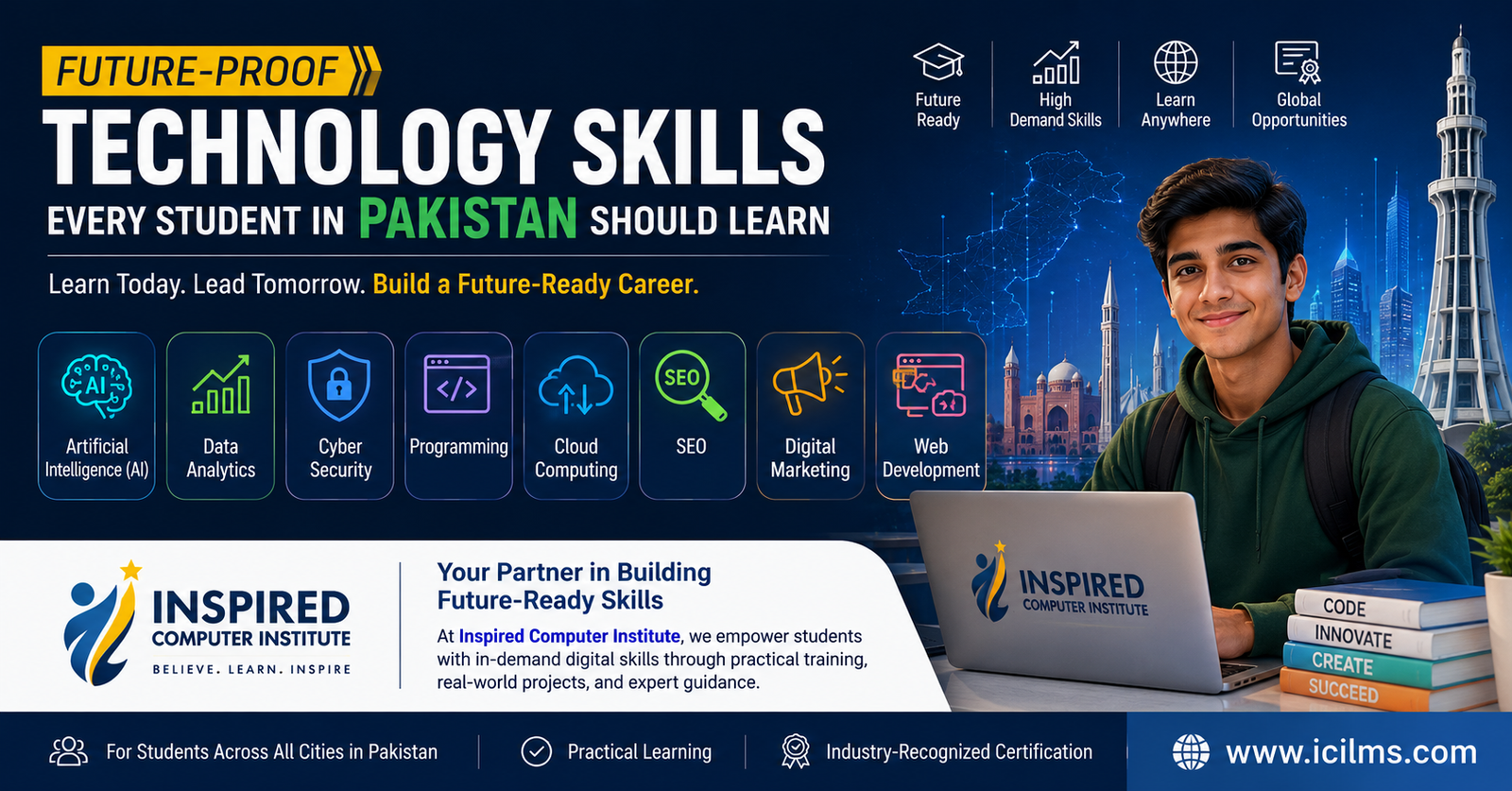
Future-Proof Technology Skills Every Student in Pakistan Should Learn
Komal Shahzadi
- June 30, 2026
- Comment 0
Future-Proof Technology Skills Every Student in Pakistan Should Learn
Why Future-Ready Technology Skills Matter More Than Ever
Technology is transforming industries at an unprecedented pace, and students across Pakistan have more opportunities than ever before to build successful careers in the digital economy. Whether someone lives in Karachi, Lahore, Islamabad, Rawalpindi, Faisalabad, Multan, Peshawar, Quetta, Hyderabad, Sialkot, Gujranwala, Bahawalpur, Sukkur, Abbottabad, or any other city, the demand for technology professionals continues to rise. Companies are actively searching for individuals who can solve problems using digital tools, analyze data, secure networks, develop software, and market businesses online.
Pakistan’s technology sector has experienced significant growth over the past decade. Freelancing, software exports, e-commerce, fintech, and digital startups continue to expand, creating thousands of opportunities for skilled professionals. According to reports from the Pakistan Software Export Board (PSEB), the country’s IT exports have steadily increased, reflecting the growing importance of technical talent. International companies are also hiring remote professionals, allowing Pakistani students to compete in the global marketplace without leaving their hometowns.
Future-proof skills are valuable because they remain relevant even as technology evolves. Instead of preparing students for only one job, these skills provide flexibility across multiple industries. A student who learns programming today may become a software engineer, AI developer, startup founder, data scientist, or cybersecurity expert tomorrow. This adaptability makes technology education one of the smartest long-term investments.
Industry experts consistently emphasize lifelong learning. As Microsoft CEO Satya Nadella has stated, “The learn-it-all will always do better than the know-it-all.” This mindset perfectly reflects today’s digital landscape, where continuous learning is essential for long-term success.
Artificial Intelligence (AI): The Skill Defining the Future
Artificial Intelligence has become one of the most influential technologies shaping healthcare, education, banking, manufacturing, transportation, agriculture, and entertainment. AI enables machines to recognize patterns, automate repetitive tasks, understand language, generate content, and assist people in making better decisions. Students who develop AI skills position themselves for careers that are expected to remain in high demand for years to come.
Learning AI involves understanding machine learning, deep learning, natural language processing, computer vision, and automation tools. Beginners can start with Python programming before progressing to libraries such as TensorFlow, PyTorch, and Scikit-learn. Fortunately, modern AI education has become more accessible, allowing students with little technical background to begin learning gradually.
Real-world applications of AI are everywhere. Banks use AI to detect fraud, hospitals analyze medical images using AI-powered systems, retailers personalize shopping experiences, and manufacturers improve production efficiency through predictive maintenance. Even educational platforms now use AI to personalize learning experiences based on student performance.
Career opportunities in AI continue to expand worldwide. Roles include AI Engineer, Machine Learning Engineer, Data Scientist, AI Researcher, Prompt Engineer, AI Consultant, and Automation Specialist. Global technology companies and startups alike seek professionals capable of developing intelligent solutions. As businesses increasingly integrate AI into their operations, students who build expertise in this field will enjoy strong career prospects both within Pakistan and internationally.
Data Analytics: Turning Information into Decisions
Every organization generates enormous amounts of data, but data only becomes valuable when it can be analyzed effectively. Data Analytics empowers businesses to understand customer behavior, improve operations, identify trends, and make informed strategic decisions. As digital transformation accelerates across Pakistan, demand for data-literate professionals continues to increase.
Students entering Data Analytics should become familiar with Microsoft Excel, SQL, Python, Power BI, Tableau, and statistical analysis. These tools enable analysts to clean data, visualize information, identify meaningful patterns, and present findings clearly to decision-makers.
Data Analytics supports nearly every industry. Healthcare organizations analyze patient outcomes, banks monitor financial transactions, retailers forecast inventory demand, marketing teams evaluate campaign performance, and logistics companies optimize delivery routes. Governments also use analytics for planning public services and infrastructure.
Common career options include Data Analyst, Business Intelligence Analyst, Data Visualization Specialist, Reporting Analyst, Operations Analyst, and Junior Data Scientist. Many organizations value analytical thinking even beyond traditional data roles, making these skills broadly applicable across different career paths.]
Cyber Security: Protecting the Digital World
As organizations become increasingly connected, cyber threats continue to evolve. Businesses, governments, schools, hospitals, and financial institutions all require robust cybersecurity measures to protect sensitive information. This growing need has created exceptional career opportunities for cybersecurity professionals.
Cyber Security focuses on preventing cyberattacks, identifying vulnerabilities, securing networks, protecting applications, and responding to security incidents. Students learn concepts such as ethical hacking, penetration testing, network security, digital forensics, encryption, risk management, and security monitoring.
Cybercrime costs organizations billions of dollars globally each year, making cybersecurity one of the fastest-growing technology fields. Companies actively seek professionals who understand both offensive and defensive security techniques. Certifications such as CompTIA Security+, CEH (Certified Ethical Hacker), and CISSP further strengthen career prospects.
Career opportunities include Cyber Security Analyst, Security Engineer, Ethical Hacker, SOC Analyst, Incident Response Specialist, Information Security Consultant, and Network Security Administrator. These roles often offer competitive salaries because organizations recognize the critical importance of protecting digital assets.
Programming: The Foundation of Modern Technology
Programming serves as the backbone of nearly every digital innovation. Mobile applications, websites, artificial intelligence systems, games, financial software, cloud platforms, and automation tools all rely on programming languages. Students who understand programming develop strong logical thinking and problem-solving skills that remain valuable throughout their careers.
Python has become one of the most popular beginner-friendly languages because of its readability and extensive applications in AI, automation, and data science. JavaScript powers modern websites and web applications, while Java remains widely used for enterprise software and Android development. C++, C#, and PHP also continue to play important roles in various industries.
Programming skills extend far beyond software development. Engineers automate repetitive tasks, researchers analyze scientific data, businesses create internal tools, and entrepreneurs build startups using programming knowledge. Learning to code encourages creativity by enabling students to transform ideas into real digital products.
Career opportunities include Software Developer, Full Stack Developer, Mobile App Developer, Backend Engineer, Frontend Developer, DevOps Engineer, Game Developer, and Software Tester. Even non-technical careers increasingly benefit from basic programming knowledge due to automation and digital transformation.
Cloud Computing: Powering Digital Innovation
Cloud Computing has fundamentally changed how organizations store data, develop software, and deliver online services. Rather than maintaining expensive physical infrastructure, businesses now rely on cloud platforms such as Amazon Web Services (AWS), Microsoft Azure, and Google Cloud Platform.
Students learning cloud technologies gain experience with virtual machines, cloud storage, networking, containers, serverless computing, cloud security, and infrastructure management. These skills are increasingly important as organizations migrate applications and services to cloud environments.
Cloud Computing offers numerous advantages, including scalability, flexibility, reliability, and cost efficiency. Startups can launch products quickly without purchasing expensive servers, while large enterprises benefit from improved disaster recovery and global accessibility. Knowledge of cloud technologies complements other disciplines such as AI, cybersecurity, software development, and data analytics, making cloud expertise highly valuable in today’s technology landscape.
SEO and Digital Marketing: Building Online Success
Every business wants visibility online, making Search Engine Optimization (SEO) and Digital Marketing essential skills for modern professionals. Whether promoting a local business in Pakistan or reaching international audiences, organizations depend on digital marketing strategies to attract customers and grow revenue.
SEO focuses on improving website visibility in search engines through keyword research, technical optimization, content creation, on-page SEO, and link building. Digital Marketing expands beyond SEO to include social media marketing, email marketing, paid advertising, content marketing, influencer marketing, analytics, and conversion optimization.
Businesses increasingly hire professionals who understand digital customer behavior. Small businesses, multinational corporations, educational institutions, healthcare providers, and e-commerce stores all benefit from effective digital marketing strategies.
Career opportunities include SEO Specialist, Digital Marketing Executive, Content Strategist, PPC Specialist, Social Media Manager, Marketing Analyst, and Growth Marketer. Freelancers also find substantial opportunities by offering digital marketing services to clients worldwide through online platforms.
Web Development: Creating the Internet of Tomorrow
Every organization needs a professional online presence, making Web Development one of the most practical technology skills students can learn. Web developers design, build, and maintain websites that are functional, secure, responsive, and user-friendly across all devices.
Front-end development focuses on creating the visual interface users interact with using technologies such as HTML, CSS, JavaScript, React, and Bootstrap. Back-end development manages databases, servers, APIs, and application logic using languages such as PHP, Python, Node.js, Java, or C#. Full Stack Developers combine expertise in both areas, making them highly versatile professionals.
Modern web development also emphasizes performance optimization, accessibility, responsive design, search engine optimization, and cybersecurity best practices. Businesses increasingly expect websites to load quickly, function smoothly on mobile devices, and provide exceptional user experiences.
Career options include Front-End Developer, Back-End Developer, Full Stack Developer, WordPress Developer, UI Developer, Web Application Developer, and Freelance Web Designer. Many students also launch their own businesses by creating websites for clients locally and internationally.
Where Students in Pakistan Can Learn These Future-Ready Skills
Choosing the right learning environment is just as important as selecting the right technology skill. Students benefit most from structured training, practical projects, experienced instructors, and hands-on practice that reflects real industry requirements. Quality education should focus not only on theoretical concepts but also on building portfolios and practical experience that employers value.
For students across Pakistan looking to build careers in technology, Inspired Computer Institute offers training in several future-ready disciplines, including Artificial Intelligence (AI), Data Analytics, Cyber Security, Programming, Cloud Computing, SEO, Digital Marketing, and Web Development. By combining classroom instruction with practical exercises and industry-focused learning, students can develop the technical competencies needed for today’s rapidly evolving job market.
When selecting any institute, students should evaluate factors such as curriculum quality, instructor experience, practical labs, career guidance, certification opportunities, and project-based learning. Consistent practice, curiosity, and continuous skill development remain essential regardless of where learning begins.
Conclusion
Technology continues to reshape every aspect of modern life, creating exciting opportunities for students willing to invest in future-ready skills. Artificial Intelligence, Data Analytics, Cyber Security, Programming, Cloud Computing, SEO, Digital Marketing, and Web Development represent some of the most valuable disciplines in today’s digital economy. These skills not only improve employability but also enable entrepreneurship, freelancing, remote work, and innovation across virtually every industry.
Students from every city in Pakistan can benefit from starting their technology journey today. With dedication, practical experience, and continuous learning, they can build rewarding careers that remain relevant in an ever-changing world. Institutions such as Inspired Computer Institute provide opportunities to learn these in-demand skills and prepare students for the challenges and opportunities of the future.
Frequently Asked Questions
1. Which technology skill is best for beginners in Pakistan?
Programming, Web Development, and Digital Marketing are excellent starting points because they provide a strong foundation and lead to multiple career opportunities.
2. Is Artificial Intelligence a good career choice?
Yes. AI is one of the fastest-growing fields globally, with increasing demand across healthcare, finance, manufacturing, education, and technology industries.
3. Can students learn these skills while studying?
Absolutely. Many students successfully learn programming, AI, digital marketing, and other technology skills alongside their academic studies through structured courses and consistent practice.
4. Why is Cyber Security becoming more important?
As businesses rely more on digital systems, protecting sensitive information from cyber threats has become essential, creating strong demand for cybersecurity professionals.
5. Where can students learn future-ready technology skills in Pakistan?
Students can enroll in reputable training institutes that offer practical, industry-focused education. Inspired Computer Institute is one option that provides training in AI, Data Analytics, Cyber Security, Programming, Cloud Computing, SEO, Digital Marketing, and Web Development.