Blog Post

Complete Guide to IT Courses at ICI LMS – Skills Employers Want in 2026

Complete Guide to IT Courses at ICI LMS – Skills Employers Want in 2026

Complete Guide to IT Courses at ICI LMS – Skills Employers Want in 2026

Introduction to Inspired Computer Institute (ICI LMS)

Technology continues to reshape every industry, from healthcare and finance to retail and manufacturing. As businesses accelerate their digital transformation efforts, the demand for professionals with practical and job-ready IT skills has reached unprecedented levels. Inspired Computer Institute (ICI LMS) aims to bridge the gap between academic learning and industry requirements by offering a wide range of information technology courses designed for learners at different skill levels. Whether someone is taking their first steps into computing or looking to upgrade existing technical expertise, ICI LMS provides structured learning pathways that align with current market demands.

The institute focuses on delivering practical knowledge that students can immediately apply in real-world scenarios. Rather than relying solely on theoretical instruction, many courses emphasize hands-on projects, assignments, and problem-solving exercises. This approach helps learners build confidence while developing technical competencies that employers actively seek. In today’s competitive job market, possessing relevant digital skills can significantly improve employment prospects, increase earning potential, and open doors to remote work opportunities.

Another major advantage of studying through a modern learning management system is flexibility. Learners can often access educational resources according to their schedules, making it easier for students, working professionals, and entrepreneurs to continue developing their expertise. As organizations increasingly prioritize digital literacy, cloud computing, cybersecurity awareness, data analysis, and software development skills, institutions such as ICI LMS play a critical role in preparing the workforce for future challenges. Understanding the available course options can help prospective students choose a learning path that matches both their interests and career aspirations.

Why IT Skills Matter More Than Ever in 2026

The technology landscape in 2026 is expected to be more dynamic than ever. Artificial intelligence, automation, cloud platforms, cybersecurity threats, and data-driven decision-making are influencing how companies operate across virtually every sector. Employers are searching for individuals who can adapt quickly to evolving technologies while contributing meaningful solutions to business challenges. This growing demand has transformed IT education from a specialized field into a valuable asset for nearly everyone.

Organizations now depend on digital systems for communication, customer engagement, operations management, and business analytics. As a result, even non-technical roles increasingly require a basic understanding of technology tools and digital workflows. Professionals with IT competencies often enjoy greater career mobility because their skills can be transferred across industries and geographical locations. Remote and hybrid work environments have further increased the need for employees who are comfortable using digital platforms and collaborating online.

Industry reports consistently indicate strong growth in areas such as cybersecurity, software development, cloud computing, and data analytics. Employers are not only looking for academic qualifications but also practical skills that can be demonstrated through projects and certifications. Learning through specialized IT courses enables students to build portfolios that showcase their abilities to recruiters and hiring managers. By investing in technology education today, learners position themselves for long-term career growth while remaining competitive in an increasingly digital economy.

Overview of IT Courses Offered by ICI LMS

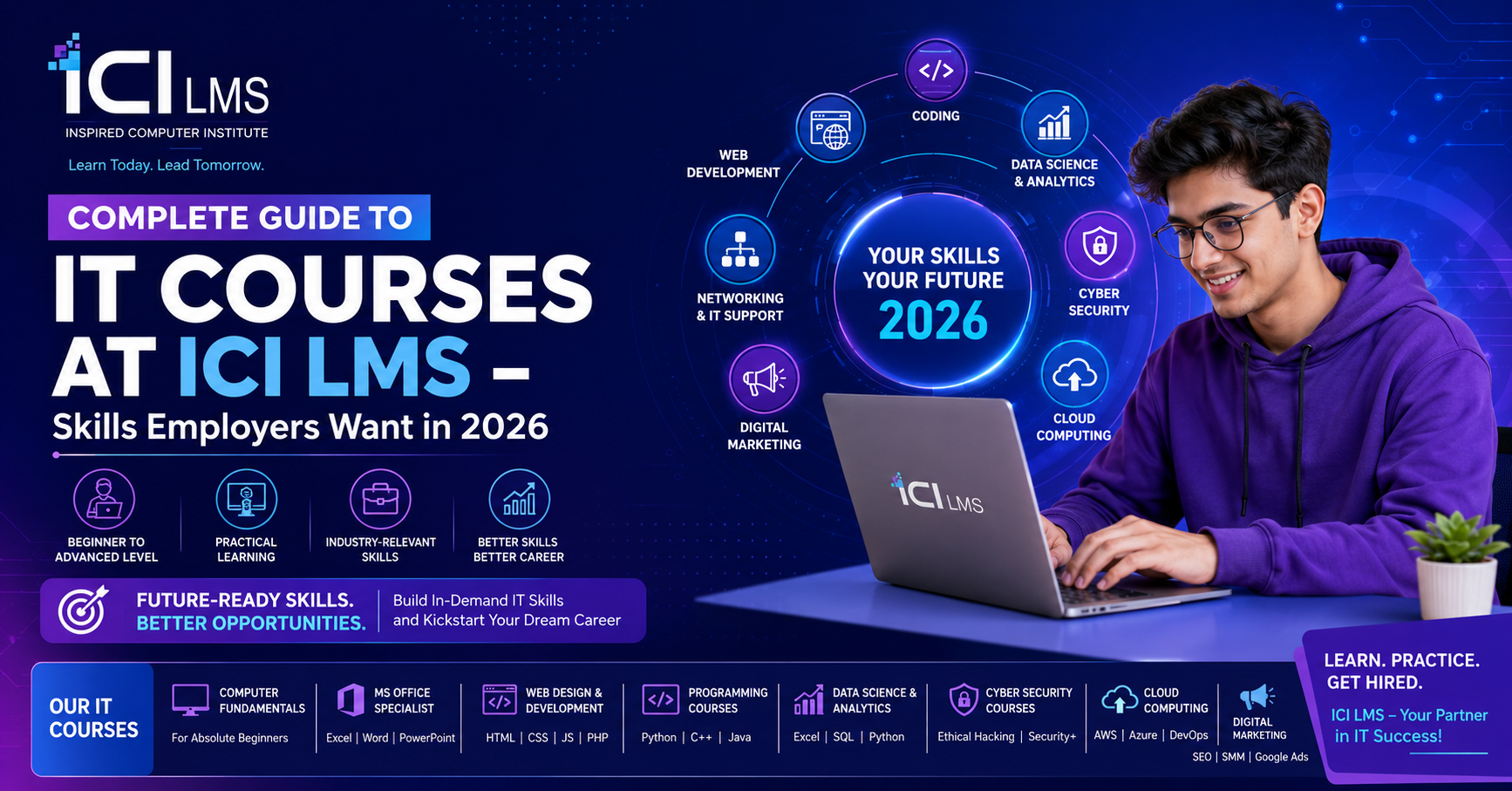
ICI LMS typically offers a diverse selection of technology-focused programs designed to meet the needs of students with varying levels of experience. The course catalog often spans foundational computer literacy programs, professional software training, web development, programming, networking, cybersecurity, digital marketing, and emerging technology disciplines. This comprehensive approach allows learners to build skills progressively while exploring different career paths within the technology sector.

One of the key strengths of a broad IT curriculum is that it accommodates multiple learning objectives. Some students may seek immediate employment after completing a short-term certification program, while others may pursue advanced technical skills to support long-term professional development. By providing structured training across multiple disciplines, ICI LMS enables learners to identify areas that align with their interests and strengths.

Modern employers often value candidates who possess a combination of technical expertise and practical problem-solving abilities. For this reason, effective IT education focuses not only on software and systems but also on critical thinking, project management, communication, and adaptability. Through a blend of theoretical knowledge and practical application, students gain exposure to real-world scenarios that prepare them for workplace challenges. Whether the goal is securing an entry-level position or transitioning into a specialized technology role, the variety of courses available through ICI LMS supports diverse career ambitions.

Learning Pathways for Beginners, Intermediate Learners, and Professionals

Not every student begins their learning journey with the same level of experience. Some may have never used advanced computer applications, while others already possess technical backgrounds and seek specialized certifications. Effective IT education recognizes these differences by providing tiered learning pathways that support gradual skill development.

Beginners typically start with foundational computer courses that introduce operating systems, internet usage, file management, typing skills, and productivity applications. These courses establish a strong digital foundation that serves as a stepping stone toward more advanced learning opportunities. Intermediate learners often progress into web development, programming, graphic design, digital marketing, or networking programs where they begin applying technical concepts to real projects.

Experienced professionals may pursue advanced topics such as cybersecurity, cloud computing, software engineering, database management, and data analytics. These specialized areas often require deeper technical knowledge and focus on industry-standard tools and methodologies. By following a structured learning pathway, students can avoid feeling overwhelmed while steadily expanding their expertise. This progressive approach ensures that learners develop confidence and competence at every stage of their educational journey.

Complete Guide to IT Courses at ICI LMS – Skills Employers Want in 2026

Basic Computer Skills Course

The Basic Computer Skills Course serves as the foundation for many other technology programs offered through ICI LMS. For individuals who are new to computers or returning to education after an extended period, this course provides essential knowledge needed to navigate today’s digital environment effectively. Mastering fundamental computer operations is often the first step toward broader technological literacy and future career development.

Students typically learn how computer systems function, how to manage files and folders, use operating systems efficiently, and perform everyday digital tasks. Practical exercises help learners become comfortable using keyboards, navigating software interfaces, accessing online resources, and communicating through digital platforms. These seemingly simple skills form the basis of productivity in virtually every modern workplace.

The importance of digital literacy cannot be overstated. Many employers expect candidates to possess at least basic computer competencies regardless of their specific job functions. Administrative assistants, customer service representatives, sales professionals, educators, and healthcare workers all rely on technology to complete daily responsibilities. By building confidence with computers, learners create a solid platform for pursuing more advanced technical training and career opportunities.

Core Topics Covered

The curriculum within a basic computer skills program generally includes a broad range of foundational topics. Students are introduced to computer hardware components, software applications, operating systems, internet navigation, email communication, and digital security practices. Understanding these concepts helps learners develop a practical understanding of technology and its role in everyday life.

Hands-on activities often play a significant role in reinforcing learning outcomes. Rather than memorizing theoretical concepts, students actively practice tasks such as creating documents, organizing files, browsing the internet safely, and using communication tools. This experiential approach encourages confidence and competence while reducing anxiety associated with unfamiliar technology.

Basic cybersecurity awareness is also becoming an increasingly important component of introductory computing education. Learners gain exposure to password management, phishing prevention, safe browsing practices, and data protection principles. These skills are valuable not only in professional environments but also in personal digital interactions. By mastering these core topics, students establish a strong foundation that supports future learning across multiple technology disciplines.

Career Opportunities After Learning Basic Computing

While basic computer skills alone may not qualify someone for highly specialized technical positions, they significantly enhance employability across numerous industries. Employers often consider digital literacy a minimum requirement for many administrative, operational, and customer-facing roles. Individuals who develop these competencies can pursue opportunities in office administration, retail operations, customer support, data entry, and clerical services.

Digital proficiency also increases workplace productivity and adaptability. Employees who can efficiently use software applications, communicate electronically, and manage information digitally contribute more effectively to organizational objectives. These capabilities often lead to greater career advancement opportunities over time.


For many learners, basic computing serves as a launching pad toward advanced training programs. Once foundational skills are established, students can confidently explore web development, programming, networking, graphic design, digital marketing, and cybersecurity courses. This progression expands career possibilities while enabling continuous professional growth in a technology-driven economy.


Microsoft Office and Productivity Skills Training

Modern workplaces depend heavily on productivity software, making Microsoft Office training one of the most valuable components of an IT education pathway. Employers across industries expect candidates to understand how to create professional documents, analyze data, prepare presentations, and manage communications efficiently. ICI LMS productivity-focused courses help students master the tools that organizations use daily to support operations and decision-making.

A strong understanding of office productivity software does much more than improve technical skills. It enables professionals to communicate more effectively, organize information systematically, and collaborate with colleagues across departments and locations. Whether someone works in finance, education, healthcare, human resources, logistics, or administration, proficiency in office applications often translates directly into increased workplace effectiveness.

The demand for these skills remains high because businesses continue to rely on digital documentation and data management systems. Employees who can create detailed reports, automate calculations, design impactful presentations, and manage records efficiently often stand out during recruitment processes. Learning productivity software is similar to learning the language of modern business. Once mastered, it becomes easier to participate in projects, support organizational goals, and contribute meaningful value to employers.

As organizations continue adopting hybrid and remote work models, productivity tools have become even more important. Employees are expected to collaborate digitally, share documents securely, and manage workflows online. Comprehensive Microsoft Office training helps learners adapt to these evolving workplace expectations while building practical skills that remain relevant across industries and career stages.

Essential Applications Included

Most Microsoft Office and productivity training programs cover several key applications that form the backbone of professional office environments. Microsoft Word teaches document creation, formatting, templates, reports, letters, and professional communication standards. Students learn how to produce polished documents suitable for business and academic settings.

Microsoft Excel is often one of the most sought-after skills among employers. Learners explore spreadsheets, formulas, functions, charts, pivot tables, and data analysis techniques. Excel skills are valuable in accounting, finance, inventory management, project planning, sales tracking, and business reporting. Many organizations specifically prioritize candidates who demonstrate advanced spreadsheet proficiency.

Microsoft PowerPoint helps students develop presentation design skills. Effective presentations are essential for meetings, training sessions, sales pitches, and executive reporting. Learners discover how to structure information visually while engaging audiences through professional slide design.

Additional modules may include Microsoft Outlook for email and calendar management, Microsoft Access for database applications, and cloud collaboration tools such as Microsoft Teams and OneDrive. Together, these applications provide a comprehensive toolkit that supports workplace productivity and digital collaboration. Mastering them enhances employability while preparing students to operate efficiently in technology-driven business environments.

Industries That Value Office Productivity Skills

Office productivity skills are among the most universally applicable competencies in today’s workforce. Nearly every industry relies on documentation, communication, reporting, and data management. As a result, professionals with strong Microsoft Office capabilities enjoy broad employment opportunities.

The healthcare sector uses productivity software for scheduling, reporting, patient record management, and administrative coordination. Educational institutions depend on these tools for lesson planning, student record maintenance, and institutional communication. Financial organizations utilize Excel extensively for budgeting, forecasting, financial modeling, and performance analysis.

Government agencies, legal firms, manufacturing companies, retail businesses, and nonprofit organizations also require employees capable of managing information efficiently. Administrative assistants, office managers, customer service representatives, HR specialists, accountants, and project coordinators all benefit from productivity software expertise.

The versatility of these skills means learners are not limited to a single career path. Instead, they gain capabilities that transfer across multiple industries and professional roles. This flexibility makes productivity training one of the most practical investments for individuals seeking career growth and long-term employability.

Complete Guide to IT Courses at ICI LMS – Skills Employers Want in 2026

Graphic Design and Creative Technology Courses

The digital economy has created enormous demand for visually compelling content. Businesses compete for attention across websites, social media platforms, advertisements, mobile applications, and digital publications. As a result, graphic design courses have become increasingly popular among students interested in combining creativity with technology.

Graphic design is much more than creating attractive visuals. It involves strategic communication through images, typography, color theory, and layout design. Effective designers understand how visual elements influence audience perception and engagement. Through structured training, students learn how to transform ideas into professional designs that support branding, marketing, and communication objectives.

Creative technology careers continue expanding as organizations invest heavily in digital marketing and online customer experiences. Companies need logos, promotional materials, social media graphics, website visuals, product packaging, and multimedia content. Skilled designers help businesses communicate effectively while building strong brand identities.

Graphic design training also offers opportunities for entrepreneurship and freelancing. Many designers work independently, serving clients globally through online marketplaces and remote collaboration platforms. This flexibility appeals to individuals seeking creative careers with location-independent earning potential. By developing both artistic and technical abilities, learners position themselves for success in a rapidly growing digital marketplace.

Software and Design Principles Taught

Graphic design programs typically introduce students to industry-standard software applications used by creative professionals worldwide. Popular tools often include Adobe Photoshop, Adobe Illustrator, Adobe InDesign, Canva, and other digital design platforms. Students learn how to create, edit, and optimize visual content for both print and digital media.

Beyond software proficiency, successful designers must understand core design principles. Topics such as color psychology, typography, visual hierarchy, balance, contrast, composition, and branding play a critical role in creating effective designs. These concepts help students make informed creative decisions rather than relying solely on artistic intuition.

Project-based learning is particularly valuable in graphic design education. Students frequently create logos, posters, brochures, advertisements, social media campaigns, and branding materials. These projects help build portfolios that demonstrate practical skills to potential employers and clients.

The combination of technical software expertise and strong design fundamentals enables graduates to work in advertising agencies, marketing departments, publishing companies, media organizations, and freelance businesses. As visual communication continues to dominate digital channels, demand for skilled graphic designers remains strong across numerous industries.

Web Development Courses

The internet serves as the foundation of modern business, communication, and commerce. Every organization, from small startups to multinational corporations, relies on websites and web applications to engage customers and deliver services. Consequently, web development remains one of the most in-demand IT skills in 2026.

Web development combines creativity, problem-solving, and technical expertise. Developers build the websites and online platforms that people use every day to shop, learn, communicate, and conduct business. The field offers diverse career paths ranging from front-end development and user experience design to back-end programming and full-stack engineering.

One of the major advantages of web development is accessibility. Many successful developers begin with no prior technical background and gradually build expertise through structured learning and practical projects. Modern educational programs focus on hands-on development experiences that mirror real-world industry requirements.

Organizations increasingly seek professionals who can create responsive, secure, and user-friendly digital experiences. Whether working for a technology company, marketing agency, educational institution, or e-commerce business, web developers play a crucial role in driving digital innovation and organizational growth.

Front-End Development Skills

Front-end development focuses on the parts of websites that users see and interact with directly. Students typically learn HTML, CSS, and JavaScript, the foundational technologies that power modern web experiences. These languages enable developers to structure content, design layouts, and create interactive functionality.

Responsive design is a critical component of front-end development. Websites must function effectively across desktops, tablets, and smartphones. Learners explore techniques for creating adaptable interfaces that provide consistent user experiences regardless of device type.

Modern front-end development often includes frameworks and libraries such as React, Vue, or Angular. These technologies help developers build sophisticated web applications more efficiently while meeting industry standards. Students also gain exposure to user experience principles that improve website usability and accessibility.

Employers highly value front-end developers because customer engagement increasingly occurs through digital platforms. Businesses recognize that well-designed websites improve conversion rates, customer satisfaction, and brand perception. As online competition intensifies, organizations continue investing heavily in front-end development talent.

Back-End Development Skills

While front-end developers focus on user interfaces, back-end developers build the systems that power website functionality behind the scenes. Back-end development involves databases, servers, application logic, security mechanisms, and system integrations that enable websites to operate effectively.

Students often learn programming languages such as PHP, Python, Java, Node.js, or similar technologies. These tools allow developers to create dynamic applications capable of processing user requests, managing data, and supporting business operations.

Database management is another essential skill. Learners explore technologies such as MySQL, PostgreSQL, and MongoDB while developing an understanding of data storage, retrieval, and optimization techniques. Strong database skills are fundamental for building scalable applications capable of supporting large user bases.

Security considerations are also emphasized within back-end training. Developers must understand authentication, authorization, encryption, and secure coding practices to protect sensitive information. Organizations increasingly prioritize cybersecurity, making secure development skills particularly valuable in today’s technology landscape.

Back-end developers are highly sought after because they enable businesses to deliver reliable digital services. Their work supports e-commerce platforms, content management systems, online learning environments, financial applications, and countless other technology solutions.

Programming and Software Development Training

Software powers nearly every aspect of modern life. From mobile applications and enterprise systems to artificial intelligence tools and cloud platforms, software development has become one of the most influential and rewarding career fields in the global economy. ICI LMS programming and software development courses are designed to equip learners with the skills necessary to build, maintain, and improve digital solutions that businesses and consumers rely on daily.

Learning programming is often compared to learning a new language. At first, the syntax and logic may seem unfamiliar, but with consistent practice, students begin to understand how software communicates with computers and solves complex problems. Programming education develops more than technical skills; it strengthens critical thinking, analytical reasoning, and structured problem-solving abilities that are valuable across countless professions.

One of the biggest advantages of software development careers is versatility. Developers can work in industries such as healthcare, finance, education, e-commerce, telecommunications, gaming, logistics, and government services. The ability to create software solutions opens opportunities for full-time employment, consulting, freelancing, entrepreneurship, and remote work.

The software industry continues expanding due to increasing digital transformation initiatives worldwide. Businesses are constantly seeking developers capable of building innovative applications, automating processes, improving customer experiences, and integrating emerging technologies. By mastering programming fundamentals and practical development techniques, learners position themselves for long-term success in one of the fastest-growing sectors of the economy.

Popular Programming Languages and Frameworks

Programming courses at ICI LMS often introduce students to languages that are widely used in professional software development environments. Each language serves specific purposes and provides unique advantages depending on project requirements and career goals.

The following table highlights some commonly taught programming technologies and their primary applications:

Technology Common Uses Career Opportunities
Python Automation, AI, Data Science, Web Development Python Developer, Data Analyst, AI Engineer
Java Enterprise Applications, Android Development Software Engineer, Backend Developer
JavaScript Interactive Websites, Web Applications Front-End Developer, Full-Stack Developer
PHP Dynamic Websites, CMS Development Web Developer
C# Desktop Applications, Gaming, Enterprise Systems Software Developer, Game Developer
SQL Database Management and Analysis Database Administrator, Data Analyst

Students also learn modern frameworks that increase development efficiency and align with current industry standards. Examples include React for front-end development, Laravel for PHP applications, Django for Python projects, and Spring Boot for Java-based systems.

Practical projects play a central role in software development education. Learners build applications, debug code, collaborate on projects, and solve real-world challenges. These experiences help create professional portfolios that demonstrate technical abilities to employers. As organizations continue investing in software-driven innovation, skilled developers remain among the most sought-after professionals in the global job market.

Digital Marketing and SEO Courses

Technology is not limited to software and infrastructure. Businesses also depend heavily on digital channels to reach customers, build brands, and generate revenue. As consumer behavior increasingly shifts online, digital marketing has become an essential discipline that combines creativity, analytics, strategy, and technology.

ICI LMS digital marketing courses help students understand how businesses attract, engage, and convert audiences through online platforms. Rather than relying solely on traditional advertising methods, organizations now use search engines, social media, email campaigns, content marketing, and paid advertising to connect with potential customers. This transformation has created substantial demand for professionals who understand digital marketing principles and tools.

One of the most valuable aspects of digital marketing education is its practical nature. Students learn how marketing campaigns operate in real business environments, how to measure performance using analytics, and how to optimize strategies for better results. These skills are highly transferable across industries because nearly every organization requires online visibility.

Digital marketing also provides exceptional entrepreneurial opportunities. Small business owners, freelancers, consultants, and startup founders can apply marketing skills directly to grow their ventures. By understanding audience behavior, content strategy, and search engine optimization, professionals can increase online reach while supporting organizational growth objectives.

Career Growth in Digital Marketing

Digital marketing encompasses multiple specialized disciplines, allowing professionals to choose career paths that align with their strengths and interests. Some individuals focus on Search Engine Optimization (SEO), helping websites improve visibility in search engine results. Others specialize in social media marketing, paid advertising, content creation, email marketing, or marketing analytics.

Students often learn key areas such as:

  • Search Engine Optimization (SEO)
  • Search Engine Marketing (SEM)
  • Social Media Marketing (SMM)
  • Content Marketing
  • Email Marketing
  • Google Analytics
  • Google Ads
  • Facebook and Instagram Advertising
  • Marketing Automation

The growing importance of online customer acquisition has increased employer demand for digital marketing specialists. Companies actively seek professionals capable of generating traffic, improving conversion rates, increasing brand awareness, and maximizing marketing return on investment.

Career opportunities include Digital Marketing Specialist, SEO Expert, Social Media Manager, Content Strategist, PPC Specialist, Marketing Analyst, and E-commerce Marketing Manager. Because digital marketing results can be measured and optimized using data, organizations continue investing heavily in professionals who possess these capabilities. This makes digital marketing one of the most accessible and rapidly growing career fields in the technology sector.

Networking and Cybersecurity Training

As businesses become more connected through digital technologies, maintaining reliable and secure networks has become a critical priority. Networking and cybersecurity professionals ensure that organizations can communicate effectively, protect sensitive information, and defend against increasingly sophisticated cyber threats.

ICI LMS networking and cybersecurity programs focus on the infrastructure and security systems that support modern digital operations. Students learn how computer networks function, how devices communicate, and how organizations protect data from unauthorized access. These skills are particularly valuable because cybersecurity concerns continue escalating across every industry.

Cybercrime has evolved into a global challenge affecting governments, corporations, healthcare providers, educational institutions, and individuals. Organizations face threats such as ransomware attacks, phishing campaigns, data breaches, and insider risks. As a result, cybersecurity expertise is no longer optional—it has become a strategic necessity.

Networking knowledge forms the foundation of many IT careers. Understanding how systems connect and exchange information enables professionals to troubleshoot issues, optimize performance, and implement secure architectures. Combined with cybersecurity training, networking education provides learners with highly marketable skills that remain in strong demand worldwide.

Complete Guide to IT Courses at ICI LMS – Skills Employers Want in 2026

Security Skills Employers Demand

Employers increasingly seek candidates with practical cybersecurity competencies that can help reduce organizational risk. Modern cybersecurity training often covers a broad range of topics designed to address evolving threat landscapes.

Common cybersecurity areas include:

Cybersecurity Skill Importance
Network Security Protects organizational networks from attacks
Ethical Hacking Identifies vulnerabilities before attackers do
Incident Response Handles security breaches effectively
Security Monitoring Detects suspicious activities
Risk Assessment Evaluates organizational security posture
Access Control Manages user permissions securely
Data Protection Safeguards sensitive information

Students frequently gain hands-on experience using security tools, monitoring systems, and simulated attack environments. This practical exposure helps learners understand both offensive and defensive security strategies.

Career opportunities in this field include Network Administrator, Cybersecurity Analyst, Security Engineer, Ethical Hacker, Information Security Specialist, and Security Operations Center (SOC) Analyst. Due to the ongoing shortage of cybersecurity professionals globally, qualified candidates often enjoy strong employment prospects and competitive salaries.

Data Analytics and Emerging Technology Skills

Data has become one of the most valuable resources in the modern economy. Organizations collect enormous amounts of information from customers, operations, marketing activities, financial transactions, and digital platforms. Transforming this information into actionable insights requires specialized analytical skills, making data analytics one of the fastest-growing fields in technology.

ICI LMS data analytics programs help students understand how to collect, organize, analyze, and interpret data to support business decisions. Rather than relying solely on intuition, modern organizations increasingly use evidence-based strategies driven by analytics. This shift has created significant demand for professionals who can uncover patterns, identify opportunities, and communicate findings effectively.

Data analytics intersects with numerous emerging technologies, including artificial intelligence, machine learning, automation, and business intelligence platforms. Professionals who understand these technologies are positioned to contribute to innovation initiatives that shape the future of business and society.

Learning analytics also develops valuable problem-solving skills. Students learn how to ask meaningful questions, evaluate information critically, and generate insights that support organizational objectives. These abilities remain relevant across industries and contribute to long-term career adaptability.

Future-Proof Careers in Technology

The technology sector continues evolving rapidly, but certain skills consistently remain valuable because they help organizations make informed decisions and innovate effectively. Data analytics is one such area that supports a wide range of business functions.

Students may learn tools such as:

  • Microsoft Excel Advanced Analytics
  • Power BI
  • Tableau
  • SQL
  • Python for Data Analysis
  • Data Visualization Techniques
  • Business Intelligence Reporting

These skills support careers including Data Analyst, Business Intelligence Analyst, Reporting Specialist, Operations Analyst, and Data Consultant. Professionals who combine analytics expertise with business knowledge often become highly influential contributors within organizations.

Emerging technologies such as artificial intelligence, machine learning, cloud computing, and automation are also creating new career opportunities. Companies seek individuals capable of understanding technological trends while applying them strategically to solve business challenges. Developing expertise in analytics and emerging technologies helps learners future-proof their careers in an increasingly data-driven world.

Choosing the Right ICI LMS Course for Your Career Goals

Selecting the right IT course depends on personal interests, current skill levels, and long-term career objectives. Individuals who are new to technology may benefit from starting with basic computer skills and productivity training before progressing to more specialized disciplines. Building a strong foundation often makes advanced learning more manageable and effective.

Students interested in creativity and visual communication may find graphic design programs particularly rewarding. Those who enjoy problem-solving and building digital products often gravitate toward web development and software programming. Individuals interested in protecting systems and investigating threats may find cybersecurity careers highly engaging.

Digital marketing offers excellent opportunities for those who enjoy strategy, communication, and business growth, while data analytics appeals to learners who enjoy working with numbers, patterns, and decision-making processes. Networking provides a strong technical foundation for infrastructure-related careers and often serves as a pathway into cybersecurity and cloud computing roles.

Before selecting a course, learners should evaluate industry demand, career aspirations, preferred working styles, and opportunities for continued growth. Choosing a learning path aligned with both personal interests and market needs increases motivation, improves learning outcomes, and enhances long-term career satisfaction.

Complete Guide to IT Courses at ICI LMS – Skills Employers Want in 2026

Conclusion

Inspired Computer Institute (ICI LMS) offers a comprehensive range of IT courses designed to prepare learners for the rapidly evolving technology landscape of 2026 and beyond. From foundational computer literacy and Microsoft Office training to advanced web development, programming, cybersecurity, digital marketing, graphic design, networking, and data analytics programs, students can access learning pathways that match their current abilities and future ambitions.

The modern workforce increasingly values practical digital skills, adaptability, and continuous learning. Organizations across industries seek professionals capable of leveraging technology to improve productivity, solve problems, protect information, and drive innovation. By investing in relevant IT education, learners position themselves for rewarding careers in fields that continue to experience strong demand and growth.

Whether the goal is securing an entry-level position, transitioning into a technology-focused role, launching a freelance career, or pursuing specialized technical expertise, ICI LMS provides opportunities to build valuable skills that align with employer expectations. As technology continues shaping the future of work, acquiring these competencies remains one of the most effective ways to enhance career prospects and professional success.

Frequently Asked Questions (FAQs)

1. What is ICI LMS?

ICI LMS (Inspired Computer Institute Learning Management System) is an online learning platform that provides IT and professional skills training. It offers courses ranging from basic computer literacy to advanced technology subjects such as web development, programming, cybersecurity, digital marketing, and data analytics.

2. Who can enroll in ICI LMS courses?

Anyone interested in developing IT skills can enroll. Courses are designed for students, job seekers, working professionals, entrepreneurs, and individuals looking to switch careers into the technology sector.

3. Do I need prior computer knowledge to start learning at ICI LMS?

No. Beginners can start with foundational courses such as Basic Computer Skills and Microsoft Office training before progressing to more advanced programs like programming, networking, or cybersecurity.

4. Which course is best for getting a job quickly?

Courses such as Microsoft Office, Digital Marketing, Graphic Design, Web Development, and Basic Computer Skills often help learners qualify for entry-level positions more quickly because these skills are widely used across industries.

5. What programming languages can I learn through ICI LMS?

Depending on the available curriculum, students may learn popular programming languages such as Python, Java, JavaScript, PHP, C#, and SQL, along with modern frameworks used in professional software development.

6. Is web development a good career choice in 2026?

Yes. Web development remains one of the most in-demand technology careers. Businesses of all sizes require websites, web applications, and online platforms, creating strong demand for skilled front-end, back-end, and full-stack developers.

7. What career opportunities are available after completing cybersecurity training?

Cybersecurity learners can pursue roles such as Cybersecurity Analyst, Security Engineer, Ethical Hacker, SOC Analyst, Information Security Specialist, and Network Security Administrator. Demand for cybersecurity professionals continues to grow worldwide.

8. Can ICI LMS courses help me start freelancing?

Yes. Skills such as graphic design, web development, programming, SEO, digital marketing, content creation, and data analysis are highly suitable for freelancing. Many professionals use these skills to work with clients locally and internationally.

9. Which IT skills are most in demand by employers in 2026?

Some of the most sought-after skills include:

  • Cybersecurity
  • Artificial Intelligence and Machine Learning
  • Data Analytics
  • Cloud Computing
  • Software Development
  • Web Development
  • Digital Marketing
  • Networking
  • Database Management
  • UI/UX Design

These skills align with ongoing digital transformation initiatives across industries.

10. How do I choose the right course at ICI LMS?

Choose a course based on your career goals, interests, and current skill level. Beginners should start with foundational computer courses, while those interested in creative work may prefer Graphic Design. Individuals interested in coding can choose Programming or Web Development, while learners focused on security and infrastructure may benefit from Networking and Cybersecurity programs. Selecting a course that matches both your interests and market demand can maximize career growth opportunities.

Leave a Reply

Your email address will not be published. Required fields are marked *