Currently Empty: ₨ 0
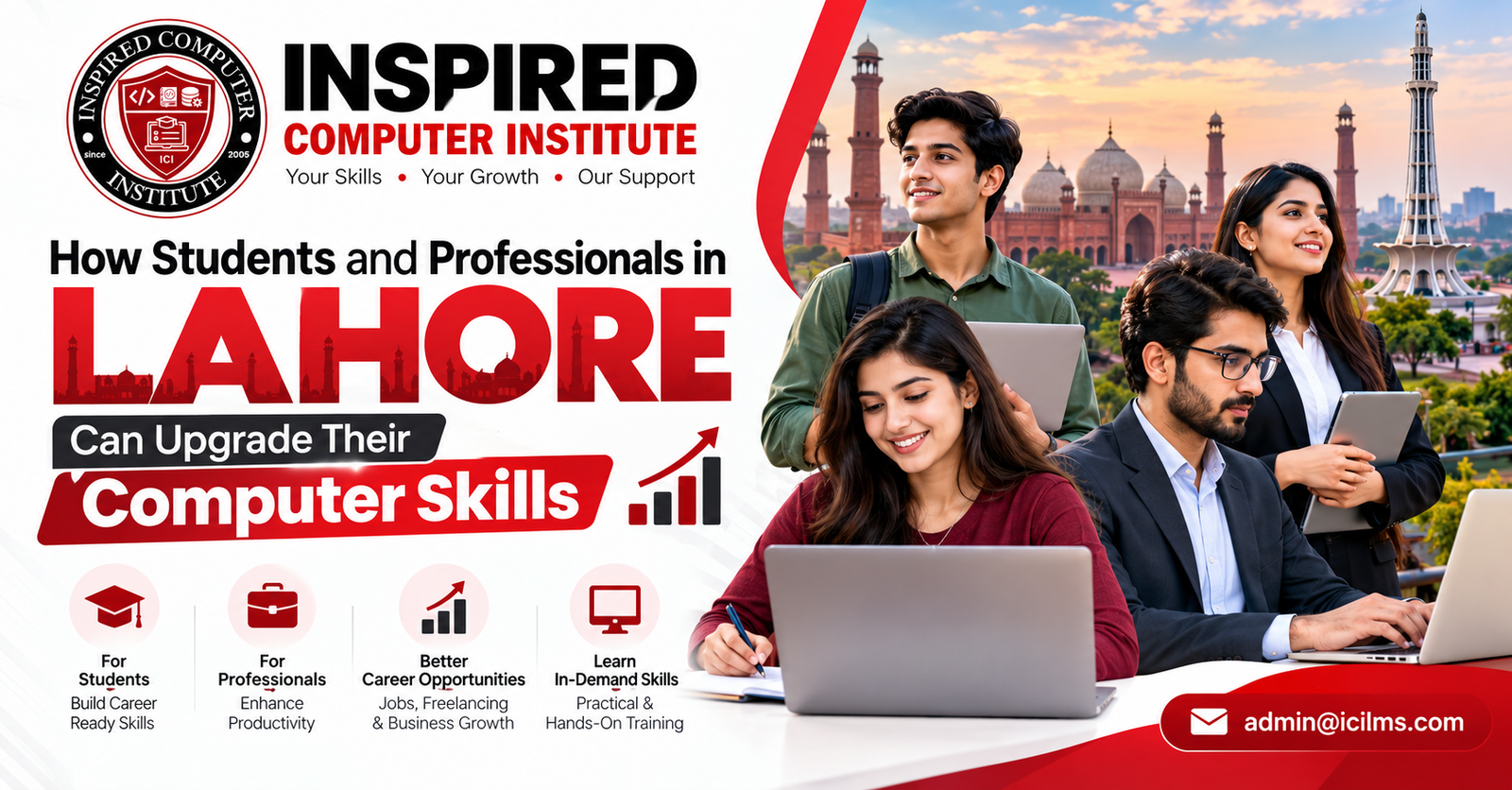
How Students and Professionals in Lahore Can Upgrade Their Computer Skills
Komal Shahzadi
- October 7, 2026
- Comment 0
How Students and Professionals in Lahore Can Upgrade Their Computer Skills
Lahore has always been known for education, commerce, culture, and ambition, but the city’s modern job market increasingly runs on something less visible: digital capability. Whether you are a university student preparing for your first internship, a fresh graduate looking for employment, an office worker hoping for a promotion, a business owner trying to become more productive, or a freelancer searching for international clients, stronger computer skills can dramatically expand what you are able to do. Knowing how to turn on a laptop, browse websites, or type a document is no longer enough. Employers and clients increasingly value people who can work efficiently with spreadsheets, presentations, cloud platforms, artificial intelligence tools, digital marketing systems, design software, programming environments, and online collaboration tools.
The encouraging part is that you do not need to become a computer scientist to benefit. Computer skills exist on a spectrum, and the right skills depend on where you want to go. An accounting student might gain far more immediate value from advanced Excel than from learning JavaScript. A marketing professional may benefit from SEO, analytics, Canva, AI tools, and advertising platforms. Someone hoping to become a software developer needs an entirely different learning path involving programming, databases, Git, APIs, and real projects. Think of digital skills as tools in a toolbox: carrying every tool ever invented makes little sense, but carrying the right ones can make you extraordinarily effective.
For students and professionals searching for computer courses in Lahore, therefore, the biggest challenge isn’t simply finding a course. There are countless tutorials, institutes, YouTube channels, online platforms, and short certifications available. The harder question is deciding what to learn, how deeply to learn it, and how to turn that knowledge into measurable career value. This guide walks through that process from the fundamentals to advanced career skills, with a strong emphasis on practical learning rather than collecting certificates that eventually disappear into a drawer.
Why Computer Skills Matter More Than Ever in Lahore
Walk into almost any modern workplace and computers sit somewhere at the center of its operations. Banks manage digital records and financial systems. Universities use learning platforms, spreadsheets, presentations, research databases, and online collaboration tools. Retail businesses track inventory and customers digitally. Marketing agencies depend on analytics, content management systems, advertising dashboards, and creative software. Software companies obviously require deeper technical expertise, while even traditional businesses increasingly communicate with customers through websites, social media, WhatsApp, email, and digital payment systems. This means computer skills in Lahore are no longer relevant only to IT professionals.
For students, digital competence can improve academic performance before it ever produces a salary. Imagine two students preparing the same university project. One manually gathers information, struggles with formatting, and creates an ordinary presentation. The other knows efficient online research techniques, organizes references properly, analyzes information in Excel, uses AI responsibly for brainstorming and revision, and builds a polished presentation. Both students may understand the subject equally well, yet one can communicate that knowledge far more effectively. Digital proficiency acts like a multiplier: it can make existing knowledge more useful.
Professionals experience the same effect. An employee who needs three hours to organize a report manually may watch an Excel-savvy colleague complete a similar task in thirty minutes using formulas, filters, PivotTables, templates, or automation. Productivity differences like these become difficult for employers to ignore. Someone who can solve routine digital problems independently also requires less supervision and can gradually take responsibility for more complex work.
The rise of remote work and freelancing makes these abilities even more valuable. A professional living in Lahore is no longer restricted to opportunities within commuting distance. Digital skills can create access to clients, employers, teams, and projects elsewhere in Pakistan or internationally. That doesn’t mean every learner will immediately land a remote job after completing a course. It means that strong practical computer skills remove geographical barriers that previously limited many career paths. Your laptop can become a classroom, office, portfolio, communication hub, and eventually an income-producing workstation.
Assess Your Current Computer Skills Before Choosing a Course
One common mistake is enrolling in whatever computer course happens to be popular. Someone hears that web development is profitable and immediately joins a programming class. Another person sees social media posts about data science and signs up without understanding basic Excel. Someone else completes course after course because certificates feel like progress. This approach resembles boarding a bus simply because plenty of people are already sitting inside—you might travel a long distance without getting any closer to your destination.
Start instead with a simple computer skills assessment. Ask yourself what you can genuinely accomplish without following a tutorial every few minutes. Can you organize files into sensible folders, compress and extract files, install trusted software, manage browser downloads, create professional emails, use cloud storage, and troubleshoot straightforward problems? Can you format a Word document properly? Can you build Excel formulas rather than using Excel merely as a digital notebook? Can you create a professional presentation from scratch? The answers reveal whether your foundation needs work.
Next, examine the requirements of the jobs or opportunities you want. Search relevant job descriptions and note recurring technical requirements. A finance-related role might repeatedly mention Excel, reporting, ERP systems, dashboards, or Power BI. Digital marketing vacancies may request SEO, Google Analytics, social media advertising, content management, or design capabilities. Development roles could require HTML, CSS, JavaScript, React, Python, SQL, Git, or another technical stack. The recurring requirements provide a much better curriculum than random social-media trends.
Create three categories: skills you already possess, skills you partially understand, and skills you need to learn. Be strict with yourself. Watching ten Photoshop tutorials doesn’t automatically make graphic design one of your professional skills. You should be able to complete a realistic task independently before describing yourself as competent.
This assessment prevents wasted time and money. More importantly, it creates a baseline. Repeat the exercise after three or six months and you can see whether you are actually progressing rather than merely consuming educational content.
Identify Skill Gaps Based on Your Education or Career Goals
Once you know your starting point, connect every skill you intend to learn with an outcome. This small change can completely transform the way you study. Instead of saying, “I want to learn computers,” a BBA student might decide, “I want to become proficient in Excel, PowerPoint, business reporting, and Power BI so I can compete for analyst internships.” A computer science student might aim to build three deployable web applications before graduation. A working accountant could focus on advanced spreadsheets, data visualization, accounting software, and AI-assisted productivity.
Students should look at both their degree requirements and the world outside their university. Academic curricula provide important theoretical foundations, but employers frequently expect practical software skills alongside those foundations. An engineering student, for example, might require technical software specific to the discipline while still benefiting enormously from spreadsheets, documentation, presentations, programming, and data analysis. A humanities student could combine research and communication abilities with SEO, content management, digital marketing, or data visualization.
Working professionals should perform a slightly different analysis. Look at the person one or two levels above your current role. What does that person know that you don’t? Perhaps your manager creates dashboards while you only enter data. Maybe senior marketers understand analytics while you mainly publish content. Perhaps experienced developers can use Git confidently, review code, work with databases, and deploy applications while you remain comfortable only with basic programming exercises. Those differences indicate where your next learning investment belongs.
You can also examine freelance marketplaces and remote job advertisements, even if freelancing isn’t your immediate goal. They provide useful clues about commercially valuable skills. Don’t chase every fashionable keyword you encounter, though. Markets move quickly, and shallow knowledge of ten technologies is often less useful than genuine proficiency in two or three complementary ones.
A strong learning strategy therefore combines career relevance, personal interest, and practical demand. Where those three overlap, you have found a promising skill to develop. That focus makes it easier to resist distractions whenever another “must-learn” technology appears on your social feed.
Build Strong Basic Computer and Digital Literacy Skills
Advanced skills look exciting, but weak foundations eventually create problems. Someone can learn a sophisticated application while still wasting enormous amounts of time because they cannot manage files efficiently, troubleshoot common errors, distinguish trustworthy downloads from suspicious ones, or understand basic cybersecurity. If your foundation is shaky, begin there without embarrassment. Every skyscraper depends on concrete that nobody notices once the building is finished.
Basic computer literacy should include comfortable use of an operating system, applications, browsers, files, folders, external storage, cloud storage, printers, PDFs, screenshots, keyboard shortcuts, and basic settings. You should understand common file formats and know why a PDF behaves differently from a Word document or why an XLSX file needs spreadsheet software. These concepts sound simple until someone urgently sends you a ZIP archive, asks for a PDF conversion, or expects several documents to be organized and shared within minutes.
Digital security belongs in the same foundation. Learn how to create strong unique passwords, recognize phishing attempts, use multi-factor authentication, update software, protect important files, and maintain backups. Students and freelancers often keep years of work on a single laptop without a dependable backup. One damaged drive or stolen device can erase projects, assignments, client files, and portfolios in an afternoon.
Typing speed and keyboard shortcuts also deserve attention. Saving three seconds doesn’t sound impressive, but repeating that saving hundreds of times each working day adds up. Learn shortcuts for copying, pasting, undoing, switching windows, searching documents, selecting content, taking screenshots, and managing browser tabs. Efficiency is partly about eliminating tiny pieces of friction.
Most importantly, learn to solve small computer problems independently. Search the exact error message, read documentation, compare credible solutions, and test changes carefully. Troubleshooting is itself a computer skill. Software will change throughout your career, but the ability to investigate unfamiliar problems will remain valuable long after today’s applications have been replaced.
Master Windows, File Management, Email, and Internet Research
Four everyday abilities deserve particular attention because they quietly affect almost everything else you do: operating-system navigation, file management, professional email, and online research. You don’t need to know every Windows setting, but you should be comfortable navigating applications, managing storage, adjusting basic settings, using Task Manager when appropriate, connecting devices, installing and removing legitimate applications, and understanding where downloaded files actually go.
File management sounds boring until poor organization costs you twenty minutes before an important meeting. Adopt a predictable naming system. Instead of storing five files called “final.docx,” “final2.docx,” and “final-real.docx,” include useful information such as project, document type, date, or version. Organize folders around projects or responsibilities and keep critical files synchronized with an appropriate backup or cloud service. Professional organization is often invisible, but its absence becomes painfully visible.
Email requires similar discipline. A professional message needs a meaningful subject, concise explanation, clear request, appropriate attachment, and sensible tone. Learn the difference between reply and reply-all, understand CC and BCC, and check attachments before clicking Send. Students entering internships sometimes underestimate email because casual messaging dominates their personal communication. Workplaces still rely heavily on structured written communication, and sloppy messages can create an unexpectedly poor impression.
Finally, strengthen your research habits. Search engines are enormously powerful when you know how to frame queries, compare sources, narrow results, and verify claims. Learn to distinguish primary sources, official documentation, established publications, forums, marketing pages, and anonymous content. Generative AI makes verification even more important because fluent language can create an illusion of certainty.
Treat the internet as a gigantic library in which some books were written by experts and others by strangers with megaphones. Digital literacy means knowing the difference. That skill helps with university assignments, workplace decisions, programming problems, market research, and almost every advanced computer skill you might pursue later.
Learn Microsoft Office for Academic and Professional Success
Microsoft Office remains one of the most practical skill sets for students and professionals because documents, spreadsheets, and presentations appear across an enormous range of occupations. Yet there is a substantial difference between having used Word, Excel, and PowerPoint and being genuinely productive with them. Many people list Microsoft Office skills on their CV after typing assignments in Word and entering numbers into Excel. Employers often expect considerably more.
In Microsoft Word, move beyond typing and changing font sizes. Learn styles, headings, page breaks, section breaks, headers and footers, tables, automatic tables of contents, comments, Track Changes, citations, page numbering, and consistent document formatting. If you regularly produce reports, proposals, research papers, or official documentation, these features can save hours while making your work look far more professional.
PowerPoint deserves equal attention. Good presentations are not documents stretched across slides. They communicate one idea at a time using hierarchy, concise text, useful visuals, readable charts, and consistent design. Students can practice by redesigning an old university presentation. Professionals can rebuild a routine workplace report into a clear executive presentation. The goal is communication, not decorative animation.
Then comes Excel, arguably one of the highest-value general business tools you can learn. Even people outside finance use spreadsheets for budgets, inventory, schedules, customer records, reporting, analysis, operations, and planning. Understanding formulas, logical functions, lookups, PivotTables, charts, filtering, sorting, conditional formatting, data cleaning, and structured tables can substantially increase productivity.
The best way to learn Office is through realistic projects. Build a formatted research report in Word, an expense tracker and analysis dashboard in Excel, and a presentation explaining the results. Software proficiency grows through doing, not through memorizing menu locations. When you can receive a messy business problem and independently turn it into a clean document, useful spreadsheet, or persuasive presentation, you have developed a skill employers can actually use.
Develop Practical Skills in Word, Excel, and PowerPoint
Tutorials are useful, but tutorials alone create an illusion of competence. You watch an instructor build a PivotTable and everything feels obvious. Two days later, you open a blank spreadsheet and suddenly cannot remember where to begin. This happens because recognition and independent performance are different cognitive tasks. The cure is straightforward: every learning session should produce something.
Suppose you are learning Word. Create a five-page business report with a cover page, heading hierarchy, table, images, page numbers, references, and automatic table of contents. Turn on Track Changes and practice editing it as though a colleague had requested revisions. Export the finished report as a PDF and check whether the formatting survives. That one project forces multiple features to work together.
For Excel, create a fictional sales dataset containing products, dates, regions, salespeople, quantities, prices, and costs. Use formulas to calculate revenue and profit, clean inconsistent entries, summarize results with PivotTables, and create charts that answer specific questions. Which product generates the highest profit? Which month performs best? Which salesperson has the strongest average order value? Suddenly Excel becomes a decision-making tool rather than a collection of formulas.
PowerPoint can build on the same project. Take the insights from your spreadsheet and explain them in eight to ten slides. Create a title, executive summary, charts, key observations, recommendations, and final action slide. Keep formatting consistent and remove anything that doesn’t support your message.
Now you have something more valuable than three completion certificates: evidence of practical ability. Save polished versions in a portfolio folder. If appropriate, remove sensitive or proprietary information and show selected work during interviews or freelance discussions. The central principle applies far beyond Microsoft Office: don’t simply learn software features individually. Combine them to solve realistic problems. That’s where knowledge begins turning into employable competence.
Upgrade Your Excel and Data Analysis Skills
If you already understand everyday computer use, advanced Excel and data analysis can be one of the most practical upgrades available. Businesses generate data constantly: sales figures, expenses, inventory, attendance, customer activity, marketing performance, operational metrics, survey results, and financial records. Raw numbers have limited value until someone can organize them, identify patterns, and communicate what they mean.
Begin by becoming comfortable with formulas and references. Understand relative and absolute references, logical functions such as IF, aggregation functions such as SUMIFS and COUNTIFS, text manipulation, date functions, error handling, and modern lookup techniques available in your version of Excel. Learn how Excel tables work because structured data makes analysis easier and more reliable. Data validation and conditional formatting can help prevent or highlight problems before they spread through a workbook.
Next, develop data-cleaning habits. Real-world datasets are rarely as tidy as classroom examples. Names may be misspelled, dates inconsistent, cells blank, numbers stored as text, and categories duplicated under slightly different labels. Learning to diagnose and clean these problems is often more commercially useful than creating complicated formulas. From there, PivotTables and PivotCharts allow you to summarize large datasets quickly and explore questions without rebuilding calculations repeatedly.
Professionals interested in analytics can eventually expand into Power Query, Power BI, SQL, and Python, depending on their goals. You don’t need to learn everything simultaneously. Excel can provide an excellent bridge between basic office productivity and serious data analysis because its visual interface makes concepts such as tables, filters, aggregation, and calculated fields easier to grasp.
Use projects connected to Lahore’s real business environment. Analyze hypothetical retail sales, restaurant orders, student enrollment, property listings, logistics records, or marketing leads. Ask business questions before touching the software. Which category is growing? Where are costs increasing? What does customer behavior suggest? Data analysis is not about making colorful dashboards. It is about turning messy information into useful decisions, and that is precisely why the skill travels so well across industries.
Learn Graphic Design and Creative Digital Skills
Not everyone upgrading their computer skills needs to become a programmer or analyst. Graphic design and digital content creation can be highly useful for students, marketers, entrepreneurs, social media professionals, freelancers, and small-business owners. Lahore’s active retail, food, fashion, education, e-commerce, events, and service sectors all create demand for digital communication. A business may need social posts today, a menu tomorrow, product images next week, and promotional material before its next campaign.
Beginners can start with accessible design platforms before moving into professional tools. The important thing is not which application you open first; it is whether you understand basic design principles. Learn visual hierarchy, alignment, spacing, typography, contrast, color relationships, consistency, and composition. A beginner often tries to improve a design by adding more. Experienced designers frequently improve it by removing distractions.
If graphic design becomes a serious career direction, deepen your knowledge of raster and vector workflows, image editing, illustration, branding, print requirements, export formats, and eventually interface design if that interests you. Learn why a logo should work at different sizes, why resolution matters, how RGB differs from CMYK in relevant workflows, and why copying attractive designs from Pinterest doesn’t create a coherent brand system.
Students can build experience by creating posters for societies, presentations, event graphics, portfolio pieces, or fictional brand campaigns. Professionals can redesign their own LinkedIn graphics, reports, proposals, or business marketing materials. Freelancers should create portfolio projects that resemble the services they hope to sell.
AI image and design tools have changed creative workflows, but they haven’t eliminated the need for judgment. Someone still needs to choose what looks appropriate, fix inconsistencies, respect intellectual-property considerations, and align creative work with a client’s objective. Tools can generate options; taste and communication determine which option works. Combine design fundamentals with modern software and AI-assisted workflows, and creative computer skills can become useful across far more roles than traditional graphic-design jobs alone.
Develop Web Development and Programming Skills
Programming offers a deeper technical path for students and professionals who enjoy problem-solving, systems, and building things. It can lead toward web development, software engineering, automation, data analysis, mobile development, artificial intelligence, testing, cybersecurity, and numerous related specialties. But programming is also where many learners become trapped in endless tutorials. They keep starting new courses because watching someone else code feels safer than confronting an empty editor.
For web development, a sensible foundation is HTML, CSS, and JavaScript. HTML gives pages structure, CSS controls presentation, and JavaScript introduces behavior and programming logic in the browser. Once you can build responsive pages confidently, you can explore frameworks and backend technologies according to your goals. Don’t rush into a fashionable framework before understanding the language and concepts underneath it. Frameworks change; fundamentals travel with you.
Programming learners should become comfortable with variables, data types, conditions, loops, functions, data structures, debugging, and breaking larger problems into smaller pieces. Learn Git and basic version control earlier than many beginners do. Git isn’t merely a tool for senior developers; it gives learners a safer way to experiment, track changes, and eventually collaborate with others.
Then build. Create a portfolio website, task manager, expense tracker, small inventory system, student-management application, booking interface, or another project you can explain confidently. Your early applications will be imperfect. That’s exactly the point. Bugs force you to read documentation, inspect error messages, search intelligently, test assumptions, and understand why code behaves differently from what you expected.
AI coding assistants can accelerate this process, but don’t let them replace understanding. If generated code breaks and you cannot explain what it does, you don’t truly control your project. Treat AI like a fast pair programmer rather than an autopilot system. The person who can understand, evaluate, debug, and improve code will remain far more capable than someone who can only prompt software into generating it.
Choose the Right Programming Language for Your Goals
Beginners often ask which programming language is “best,” but that question resembles asking which vehicle is best without saying whether you need to cross a city, deliver furniture, or race on a track. The right language depends on what you intend to build. Rather than comparing languages endlessly, connect your choice to a concrete career direction and start creating projects.
If you are interested in front-end web development, JavaScript is central because it runs directly in browsers and forms the foundation of the modern interactive web. Developers can also use JavaScript or TypeScript in backend and full-stack environments. If data analysis, automation, machine learning, or general beginner-friendly programming interests you, Python is a strong option because of its readable syntax and broad ecosystem. For enterprise development, mobile development, systems programming, or specialized software roles, other languages may be more appropriate.
Whatever you choose, stay with it long enough to understand programming rather than repeatedly restarting at beginner level. Learn syntax, but spend more energy on concepts. A loop is a programming idea, not merely a Python feature. Functions, objects, algorithms, data structures, APIs, databases, testing, and debugging transfer across languages even when the syntax changes.
Look at actual job advertisements in Lahore and remote roles that interest you. Record which languages and technologies appear repeatedly. This grounds your learning in market reality without turning you into a trend chaser. If a particular technology appears consistently across roles you genuinely want, it deserves investigation.
Then create a progression of increasingly difficult projects. Start with tiny command-line programs or simple webpages, advance to applications that store data, and eventually build something involving authentication, APIs, databases, deployment, or collaboration. Document your decisions and publish suitable code to GitHub.
Your first programming language is not a marriage contract. You can learn another later. The goal is to reach the point where learning the second language is easier because you already understand programming itself. Depth first makes breadth far easier.
Build Digital Marketing and SEO Skills
Digital marketing is another attractive route because it combines technology, communication, psychology, data, and commercial thinking. Businesses don’t simply need websites and social accounts; they need those channels to attract attention, generate leads, create sales, and retain customers. Someone who understands how digital channels contribute to those goals can become valuable without being a traditional programmer.
Start with the customer journey. Who is the audience? What problem are they trying to solve? Where do they search for information? What makes them trust a brand? Which action should they take next? Once you understand these questions, tools such as SEO, content marketing, social media, email marketing, paid advertising, and analytics become parts of a larger system rather than isolated tricks.
SEO is particularly useful for learners who enjoy research and content. Study search intent, keyword research, site structure, on-page optimization, internal linking, technical fundamentals, content quality, and measurement. Avoid treating SEO as stuffing a target phrase into every paragraph. Modern search optimization is fundamentally about making useful content discoverable, understandable, trustworthy, and satisfying for the people searching for it.
Analytics should accompany marketing skills from the beginning. If you run a campaign, you need to know what success means. Traffic alone may not matter if nobody contacts the business or purchases anything. Learn concepts such as impressions, clicks, click-through rates, conversions, acquisition costs, engagement, attribution limitations, and return on investment. The precise metrics depend on the campaign.
Students can practice using personal projects rather than waiting for employment. Build a niche website, publish useful articles, optimize pages, experiment with social content, and document what happens. Professionals can volunteer for controlled internal projects or help a small business with clearly defined objectives.
A marketer who combines creativity with analytical ability has an advantage. Good digital marketing is not simply posting content; it is running measurable experiments around human behavior. That mindset turns a collection of platforms into a professional skill set.
Explore Artificial Intelligence and Modern Productivity Tools
Artificial intelligence has rapidly become part of everyday digital work, which makes AI literacy useful across many professions. Students can use AI for brainstorming, explaining difficult concepts, creating practice questions, improving drafts, exploring coding problems, or structuring study plans. Professionals can use it to summarize information, draft routine communications, analyze text, brainstorm strategies, generate formulas, assist with code, and accelerate repetitive tasks. The value, however, depends heavily on how intelligently the tool is used.
Learn to give AI sufficient context. A vague prompt usually produces a generic response. Explain the objective, audience, constraints, available information, desired format, and examples when appropriate. Then evaluate the result rather than accepting it automatically. Generative systems can produce incorrect claims, fabricated references, insecure code, awkward writing, or misleading interpretations while sounding perfectly confident.
Students need to be particularly careful about academic integrity. University policies vary, and submitting AI-generated work as your own may violate course requirements. Use these tools as tutors and assistants where permitted rather than as invisible substitutes for learning. If AI solves every difficult problem before you struggle with it, you may finish assignments faster while quietly weakening the very skills the assignment was intended to develop.
Professionals should also think about confidentiality. Avoid placing sensitive customer information, proprietary business data, credentials, or confidential documents into tools unless your organization’s policies and approved systems explicitly permit it. Productivity isn’t worth creating a security problem.
The strongest approach is to combine AI with genuine domain expertise. An accountant who understands accounting can evaluate an AI-generated financial explanation. A developer can review generated code. A marketer can recognize weak positioning. A researcher can verify questionable sources. AI amplifies judgment, but it does not magically create judgment.
Instead of asking whether AI will replace a particular career, ask a more useful question: how can someone in that career use modern tools responsibly to perform higher-quality work faster? That question leads directly toward practical skills.
Learn Freelancing Skills to Earn Online From Lahore
Freelancing attracts many learners because it offers the possibility of working with clients beyond Lahore and even beyond Pakistan. Yet completing a technical course and becoming a successful freelancer are two different achievements. Freelancing combines a marketable service with communication, positioning, pricing, sales, project management, reliability, and reputation. Ignoring the second half is one reason technically capable beginners sometimes struggle to win work.
First, define a service instead of advertising yourself as someone who “knows computers.” Clients buy outcomes. “I create responsive WordPress websites for small businesses” is clearer than “I know web development.” “I clean Excel data and build business dashboards” describes a problem you can solve. The same principle applies to graphic design, SEO, content, automation, video editing, programming, virtual assistance, and other digital services.
Then create evidence. If nobody has hired you yet, build realistic sample projects. A web developer can create demo websites. A designer can develop fictional brand identities. An Excel specialist can build dashboards using public or synthetic data. An SEO learner can audit a website and document recommendations. A portfolio reduces the amount of trust a stranger must give you.
Communication matters enormously. Read client requirements carefully, ask relevant questions, clarify deliverables, confirm deadlines, and avoid promising skills you don’t possess. A freelancer who communicates reliably can outperform a more technically advanced competitor who disappears for three days and returns with the wrong deliverable.
Also learn basic financial discipline. Track project income and expenses, understand platform fees where applicable, maintain records, and investigate current Pakistani banking, tax, payment, and foreign-remittance requirements through official sources when they apply to you. Those rules can change, so don’t rely on an old tutorial.
Finally, don’t expect instant results. Your first proposals may receive no response. Your first portfolio may need improvement. Treat early freelancing as a business-development process rather than a lottery ticket. Build skill, proof, communication ability, and professional reliability together, and online earning becomes a much more realistic objective.
Choose Between Online and Physical Computer Courses in Lahore
Students searching for the best computer courses in Lahore often wonder whether classroom training is better than online learning. Neither format automatically wins. The better choice depends on your learning habits, budget, schedule, access to equipment, need for feedback, and the quality of the specific instructor or institution.
Physical classes provide structure. You have a timetable, instructor, classmates, and a defined environment dedicated to learning. That can be particularly helpful if you repeatedly buy online courses but never finish them. Face-to-face instruction also makes immediate questions and guided practical work easier in some settings. The disadvantages can include commuting time, fixed schedules, variable instructor quality, and potentially higher costs.
Online courses offer flexibility and enormous variety. A student in Lahore can study programming, Excel, design, cloud computing, marketing, or AI from instructors anywhere in the world. Recorded lessons allow you to pause, repeat, and learn around university or work. Free resources can also make learning surprisingly affordable. Yet flexibility has a hidden price: nobody forces you to open the lesson tomorrow.
Before paying for either format, examine the curriculum closely. Ask whether students complete projects, receive feedback, practice independently, and finish with abilities that map to real job requirements. Investigate instructor experience and recent student work where verifiable examples are available. Be cautious of guaranteed-income promises or courses marketed primarily through dramatic salary claims.
A hybrid approach often works beautifully. Attend structured training for difficult fundamentals while using documentation, online tutorials, practice platforms, and communities to expand your knowledge. The internet can fill gaps your classroom leaves behind, while a classroom can provide accountability the internet cannot.
Remember that a course is an environment for learning, not a transfer of competence. Paying the fee doesn’t install the skill into your brain. Whatever format you choose, independent practice determines how much of the investment survives after the final class.
Build a Portfolio Instead of Collecting Certificates
Certificates can be useful. They show that you completed structured learning and, depending on the credential, may demonstrate knowledge that employers recognize. The problem begins when certificates become the objective rather than evidence along the way. Ten course-completion PDFs cannot compensate for being unable to perform a practical task during an interview.
Build a digital skills portfolio alongside your education. The format should match your field. Developers can maintain GitHub repositories and deployed applications. Designers can present selected visual projects with explanations. Data analysts can show dashboards and case studies. Digital marketers can document campaigns, audits, content strategies, or measurable experiments. Office professionals can create sanitized examples of dashboards, reports, presentations, templates, and process improvements.
Quality beats quantity. Three polished projects that demonstrate different abilities are usually more persuasive than twenty unfinished exercises copied from tutorials. For each project, explain the problem, your approach, tools used, major decisions, challenges, and outcome. This reveals how you think rather than simply showing the final screenshot.
Students can create projects without waiting for clients. Analyze a public dataset. Build a fictional e-commerce dashboard. Redesign a hypothetical restaurant’s visual identity. Create a website for an imaginary service business. Develop an application solving a student problem. Conduct an SEO audit of a publicly accessible website without claiming an affiliation. The project can be fictional while the skill demonstration remains genuine.
Professionals have an additional option: document workplace achievements where confidentiality permits. Perhaps you automated a repetitive spreadsheet process, redesigned a reporting template, created a dashboard, or improved a digital workflow. Describe the outcome without revealing private information.
A strong portfolio changes the interview conversation from “I completed a course” to “Here is what I can do.” That distinction matters. Employers and clients ultimately need results, and projects provide tangible evidence that your computer skills exist outside a certificate.
Create a Practical Computer-Skills Learning Plan
Learning becomes much easier when it has a schedule. Instead of promising yourself that you will “learn Excel someday,” create a twelve-week plan with specific weekly outcomes. Keep it realistic. A university student handling exams and assignments should not design a study schedule that requires four uninterrupted hours every evening. Consistency usually beats heroic bursts followed by exhaustion.
Choose one primary skill and, if necessary, one supporting skill. Suppose your target is data analysis. Your primary path could progress through Excel fundamentals, formulas, data cleaning, PivotTables, visualization, and dashboards. A supporting skill might be basic Power BI. If your goal is front-end development, focus on HTML, CSS, JavaScript, Git, and increasingly complex projects rather than simultaneously studying Python, Java, cybersecurity, cloud computing, and graphic design.
Divide each week among learning, practice, and production. Tutorials introduce concepts. Exercises reinforce them. Projects integrate them. A useful rule is to spend progressively more time creating things as your foundation grows. By the final weeks, your project should consume more time than your course videos.
Track outputs rather than hours alone. “Studied for ten hours” tells you very little. “Built an Excel dashboard with PivotTables and lookup formulas” demonstrates progress. Keep a simple learning log recording what you studied, what you built, where you struggled, and what needs revision.
Add periodic review because skills decay when unused. Rebuild an old exercise without instructions. Explain a concept aloud as though teaching another student. Attempt a project from a blank file. These tests reveal whether knowledge has moved from recognition to recall.
Finally, protect your attention. You don’t need five simultaneous courses. Finish, practice, build, then expand. A focused learner spending an hour a day for months can travel surprisingly far because competence compounds. Each new skill makes the next related skill easier, and eventually what once felt technical becomes ordinary.
Turn Your New Computer Skills Into Career Opportunities
The final step is translating ability into opportunity. Don’t wait until you feel like an expert; expertise is a moving target. Once you can complete realistic tasks independently, begin presenting those abilities professionally. Update your CV so that your skills section contains specific technologies rather than vague phrases such as “computer expert.” More importantly, connect skills to accomplishments wherever possible.
Instead of writing “Microsoft Excel,” describe what you have actually done with it: built reporting dashboards, cleaned datasets, created PivotTables, automated calculations, or analyzed sales data. Developers should mention applications and technologies they used. Marketers should describe campaigns, audits, analytics, or content projects. Designers should link to relevant portfolios. Evidence makes claims believable.
Optimize your LinkedIn profile and other professional profiles you genuinely use. Connect with classmates, alumni, colleagues, recruiters, industry communities, and professionals working in roles you want to understand. Networking doesn’t mean sending strangers a message asking them for a job. It means participating professionally, learning how an industry works, sharing useful projects, and gradually becoming visible to people in that field.
Internships and entry-level projects can bridge the gap between training and employment. A student who has completed several projects may be ready to apply even without years of experience. Professionals can look for opportunities inside their existing organizations: volunteer to improve a report, assist with analytics, automate a repetitive task, or contribute to a digital initiative. Small successes create credibility.
Keep learning after you find work. Software changes, AI tools evolve, platforms disappear, and new workflows emerge. The most durable skill isn’t mastery of one particular application. It is the ability to learn unfamiliar technology, apply it to a real problem, and keep adapting.
For students and professionals in Lahore, that mindset is particularly powerful. Your location may shape the opportunities immediately around you, but strong digital competence can broaden your professional reach dramatically. Learn deliberately, create evidence, communicate your value, and treat computer skills as an evolving career asset rather than a course you complete once.
Conclusion
Upgrading your computer skills does not require learning everything technology has to offer. It requires choosing the skills that align with your goals and becoming genuinely competent at using them. A student may begin with digital literacy, Microsoft Office, Excel, and presentation skills before moving toward analytics, marketing, programming, or design. A working professional may discover that mastering spreadsheets, AI tools, data visualization, or automation produces a much faster career return than starting an unrelated technical field from zero.
The key is practical learning. Don’t confuse watching with doing, certificates with competence, or familiarity with mastery. Build documents, dashboards, websites, designs, campaigns, applications, and other projects. Make mistakes. Debug them. Ask better questions. Rebuild your work without following tutorials. Every completed project strengthens both your skill and your confidence.
Lahore offers students and professionals the advantages of a large educational and commercial environment, while online learning opens access to knowledge far beyond the city. You can combine classroom instruction with online courses, official documentation, communities, AI-assisted learning, and personal projects. What matters isn’t where the lesson comes from but what you can independently accomplish afterward.
Start with one goal. Assess your current level, select the most relevant skill, create a manageable learning schedule, and produce something tangible every week. After a few months, compare your portfolio with where you started. That visible evidence of progress is far more meaningful than simply saying you have been “learning computers.”
Your computer can be entertainment, or it can become a career-building tool, creative studio, classroom, analytical workstation, and gateway to global opportunities. The difference lies in the skills you develop and what you decide to build with them.
Frequently Asked Questions
1. What are the best computer skills for students in Lahore?
Microsoft Office, Excel, online research, professional communication, AI literacy, presentation skills, and basic cybersecurity provide a strong foundation. Students can then specialize in programming, data analysis, graphic design, digital marketing, or another field aligned with their degree and career plans.
2. Which computer skill is best for getting a job?
There is no single best skill for every job. Excel and Office skills have broad applicability, while programming, data analytics, digital marketing, design, and specialized business software can be valuable for particular careers. Study job advertisements in your target field and identify recurring requirements.
3. Is learning Microsoft Excel useful for students?
Yes. Excel is useful for calculations, budgeting, research data, reporting, charts, business analysis, and many administrative tasks. Learning formulas, PivotTables, data cleaning, and visualization can be particularly valuable.
4. Can I learn computer skills at home?
Absolutely. Online courses, official documentation, tutorials, practice platforms, and personal projects make home learning practical. The biggest requirement is consistency and sufficient hands-on practice rather than simply watching videos.
5. Are physical computer courses in Lahore better than online courses?
Not automatically. Physical courses can provide structure, accountability, and direct instructor interaction, while online courses offer flexibility and greater choice. Evaluate the instructor, curriculum, practical projects, feedback, cost, and your learning habits.
6. How long does it take to learn basic computer skills?
A motivated beginner can become significantly more comfortable with everyday computer tasks within weeks, but proficiency develops through continued use. The timeline varies according to your starting level, practice frequency, and the skills you include.
7. Which programming language should a beginner learn?
Choose according to your objective. Python is popular for automation, data work, and general programming, while JavaScript is fundamental for interactive web development. Career requirements should guide the choice more than online popularity contests.
8. Is graphic design a good computer skill to learn?
It can be, particularly for people interested in marketing, branding, social media, freelancing, or creative careers. Learn design fundamentals alongside software rather than concentrating exclusively on tool commands.
9. Can computer skills help me earn through freelancing?
Yes, but technical knowledge alone doesn’t guarantee freelance income. You also need a clear service, portfolio, communication ability, professional reliability, client acquisition skills, and realistic expectations.
10. Which computer skills are useful for office jobs?
Word, Excel, PowerPoint, email, cloud collaboration, file management, online research, PDF handling, cybersecurity awareness, and increasingly AI-assisted productivity are useful across many office environments.
11. Should I learn Power BI after Excel?
It can be a logical progression if your career involves reporting, business intelligence, or data analysis. Strong spreadsheet and data fundamentals make it easier to understand data modeling and visualization tools.
12. How can university students practice computer skills without a job?
Create personal and fictional projects. Build dashboards, websites, applications, presentations, marketing campaigns, research reports, or designs. Student societies and university projects can also provide practical experience.
13. Do employers care about computer-course certificates?
Certificates can strengthen a profile, particularly when they come from recognized programs, but employers also care about practical performance. Projects, portfolios, assessments, internships, and demonstrable achievements can provide stronger evidence of ability.
14. Is digital marketing worth learning in Lahore?
It can be valuable for marketing careers, businesses, agencies, e-commerce projects, and freelancing. Focus on fundamentals such as customer behavior, SEO, content, advertising concepts, analytics, and conversion rather than learning only how to operate individual platforms.
15. How can professionals improve their computer skills while working full-time?
Use a realistic weekly schedule and focus on one skill connected to your existing work. Even consistent short practice sessions can produce progress when paired with practical projects and immediate workplace application.
16. Should students learn AI tools?
Yes, AI literacy is increasingly useful, but students should learn responsible use, fact-checking, privacy awareness, and their institution’s academic-integrity rules. AI should strengthen learning rather than replace it.
17. How do I know whether I have actually mastered a computer skill?
Try completing a realistic project from a blank file without step-by-step instructions. If you can solve problems, troubleshoot errors, explain your decisions, and produce a professional result independently, you have stronger evidence of competence.
18. What is the best way to build a computer-skills portfolio?
Choose three to five polished projects closely related to the work you want. Explain the problem, tools, process, challenges, and outcome, and publish them through an appropriate portfolio platform while protecting confidential information.
19. Can someone without a computer science degree learn technical skills?
Yes. Many practical digital skills can be learned through structured courses, self-study, projects, and practice. Some specialized careers or employers may require formal qualifications, so check the requirements of your target roles.
20. What should I learn first if I have very limited computer knowledge?
Begin with operating-system navigation, typing, file management, internet research, email, cybersecurity basics, Word, Excel, and PowerPoint. Once that foundation becomes comfortable, choose a specialization based on your career goals